
Brown China-mark moth
Elophila nymphaeata
Description
How to identify
The Brown China-mark moth (Elophila nymphaeata) is a fascinating species of moth in the family Crambidae, known for its unique semi-aquatic lifestyle. It is one of the few Lepidoptera species whose larvae are truly adapted to underwater life.
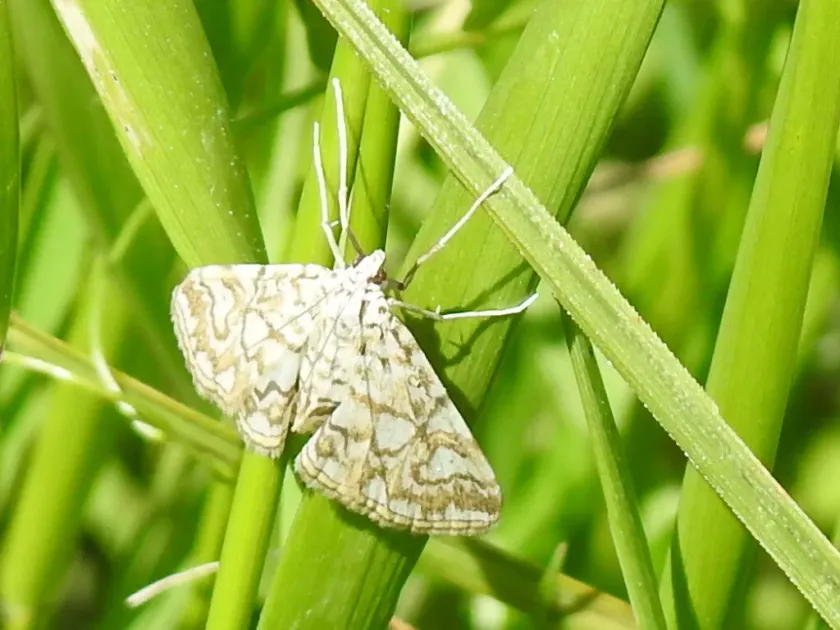
Adult moths have a wingspan of approximately 25–30 mm. Their wings feature a delicate, reticulated pattern of brown and white markings, providing excellent camouflage against floating leaves and pond debris.
The larvae are distinctive because they possess tracheal gills, which allow them to extract oxygen from the water. Their bodies are generally yellowish or greenish, helping them blend in with their food sources.
Pupation occurs within a tough, silk-lined case constructed by the larva. This protective enclosure is crafted from leaf fragments and is typically attached to the underside of a leaf or submerged stem.
The life cycle is temperature-dependent, typically involving one or two generations per year. The insect overwinters as a larva in a protected cocoon among aquatic vegetation or detritus.
What it damages
The primary hosts for this moth include a variety of aquatic plants, most notably water lilies (Nymphaea), pondweed (Potamogeton), and yellow water-lilies. These plants provide both food and building materials for the larvae.
Larvae feed on the leaf tissue, often creating distinctive holes or scalloped edges. In heavy infestations, the larvae can consume large sections of the leaf, severely hindering the plant's ability to photosynthesize.
Beyond direct consumption, the larvae cause damage by cutting pieces of leaves to build their protective cases. This mechanical damage weakens the structural integrity of the leaves, leading to premature decay.
Affected plants often show stunted growth, reduced flowering, and a decline in overall health. Open wounds on the foliage can also serve as entry points for pathogens and fungal infections.
In ornamental ponds, the presence of the Brown China-mark moth can be detrimental to the aesthetic value of the garden, as the damaged, ragged foliage ruins the appearance of water feature plantings.
When it appears
Adult moths are generally active from June through August. They are nocturnal and are often found resting near the edges of ponds during the day, making them somewhat difficult to spot.
After mating, females lay eggs on the undersides of leaves. The larvae hatch and quickly begin feeding, constructing their signature cases as they grow through several instar stages.
The peak of damage usually occurs in mid-to-late summer, when the water temperature is optimal for the rapid growth and development of the larvae.
As autumn approaches, the larvae slow their feeding activity. Younger larvae seek out protected spots in the pond substrate or decaying vegetation to enter diapause and survive the winter.
Monitoring for signs of the pest should be consistent during the warm months, especially during July and August when the population density is at its highest.
Signs of infestation
The most recognizable sign is the presence of neatly cut leaf fragments, often referred to as "patches," on the surface of floating leaves. These are the building blocks of the larval cases.
Empty or occupied cases floating near the plant surface are clear evidence of the insect's presence. Larvae use these portable shelters to hide from predators while feeding.
Small, initial feeding scars that progress into larger, jagged holes are typical of early-stage larval activity. Observing these patterns on the leaves is a strong indicator of an infestation.
Small dark granular droppings (frass) found on the surface of the leaves are a definitive sign of active larval feeding. This residue can often be found near the leaf edge or the larval case.
A general decline in the health of the water lily patch, characterized by yellowing and rotting leaves, suggests that a significant population of larvae may be present underneath.
Control measures
Physical removal is the most effective and eco-friendly control method for small ornamental ponds. Regularly inspect the leaves and remove any larvae or their cases by hand.
Autumn pond maintenance, specifically the removal of dead plant material and debris, significantly reduces the number of overwintering larvae, thereby preventing population explosions the following year.
- Introduce natural predators such as fish (e.g., goldfish or koi), which will actively feed on the larvae.
- Use biological control agents like Bacillus thuringiensis (Bt) if approved for your local water safety regulations.
- Promote habitat for aquatic insects and amphibians that may naturally predate upon the moths and larvae.
Avoid the use of broad-spectrum chemical insecticides. These substances are highly toxic to the aquatic environment, potentially killing fish, beneficial insects, and other pond life.
Maintaining a balanced ecosystem is the best long-term strategy. A healthy pond with high biodiversity will naturally regulate pest populations, keeping them below the threshold of economic damage.
Taxonomy
- Latin name
- Elophila nymphaeata
- Order
- Lepidoptera (butterflies)
- Family
- Crambidae
- EPPO code
- NYMHNY
Discussion
No discussions yet — be the first.