
Common Footman
Eilema lurideola
Description
How to identify
The Common Footman (Eilema lurideola) is a moth belonging to the family Erebidae. It is widely recognized by its distinctive and slender appearance when resting.
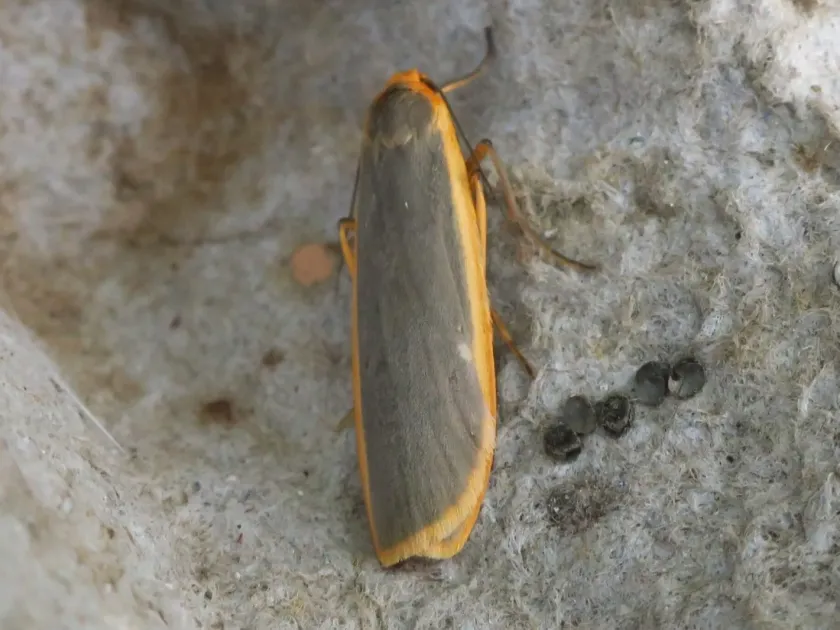
The adult moth has lead-grey forewings with a conspicuous yellow costa (the leading edge), which distinguishes it from other similar species in the Eilema genus.
The larvae are covered with long, dense hairs arranged in tufts. Their body colour is generally dark, featuring two rows of bright yellow or orange spots along the dorsal side.
The pupae are enclosed in loosely spun grey cocoons, often found hidden within tree bark crevices or among plant debris during the mid-summer period.
The species undergoes a complete metamorphosis, including egg, larval, pupal, and adult stages, with larvae being the primary stage responsible for feeding.
What it damages
The primary food source for Common Footman larvae consists of various lichens and algae that grow on the bark of deciduous and coniferous trees.
While primarily lichen-feeders, under high population density or lack of preferred food, caterpillars may occasionally consume buds or young leaves of fruit trees.
This feeding behavior can cause minor damage to the aesthetic quality of ornamental plants and may lead to stress in already weakened nursery seedlings.
In most forestry and orchard settings, they are considered secondary pests, but their presence is a reliable indicator of high lichen cover on the trunks.
Extensive stripping of lichens from tree bark can also lead to the exposure of the bark surface, making it more susceptible to environmental stress.
When it appears
The flight period for adult Common Footman moths typically occurs from June through August, during which they are active during the night hours.
Females lay their eggs in small clusters directly onto the lichen-covered surfaces, ensuring the larvae have immediate access to food upon hatching.
The larval stage is most active during the spring and early summer months when environmental temperatures are optimal for their growth and development.
Pupation usually takes place in late summer, and the subsequent generation of adults emerges shortly after to complete the annual lifecycle.
In cooler northern climates, the species generally produces one generation per year, whereas warmer southern regions may support a partial or full second brood.
Signs of infestation
The most common sign of an infestation is the appearance of 'bald' or bare patches on the trunks of trees where the lichen cover has been grazed away.
During the spring, small groups of hairy caterpillars can be spotted moving slowly across the bark, systematically clearing the surface of lichens.
The presence of grey, silken cocoons nestled within the rough fissures of the tree bark is a clear indicator that the larvae have reached the pupal stage.
Occasional bite marks on fresh buds or leaf margins near the stem indicate that the larvae have transitioned to feeding on the tree's soft vegetative tissue.
Monitoring adult numbers can be effectively done using light traps, as these moths are strongly attracted to artificial light sources during the night.
Control measures
Effective management begins with maintaining healthy tree vigor through proper pruning to improve air circulation and reduce excessive moisture.
- Manual removal of excessive lichen or cleaning the bark surface can significantly reduce the available food source for the larvae.
- Applying a whitewash (lime-based mixture) to the tree trunks in early spring can discourage lichen growth and deter egg-laying.
- Encouraging natural predators such as insectivorous birds in the orchard helps to keep the population of hairy caterpillars in check.
- In nursery environments, biological control methods using specialized microbial insecticides may be used if the larval population causes significant damage.
Always prioritize integrated pest management (IPM) practices, ensuring that interventions are targeted and minimize impact on beneficial garden insects.
Taxonomy
- Latin name
- Eilema lurideola
- Order
- Lepidoptera (butterflies)
- Family
- Erebidae
- EPPO code
- EILELU
Discussion
No discussions yet — be the first.