
Dotted Footman
Eilema caniola
Description
How to identify
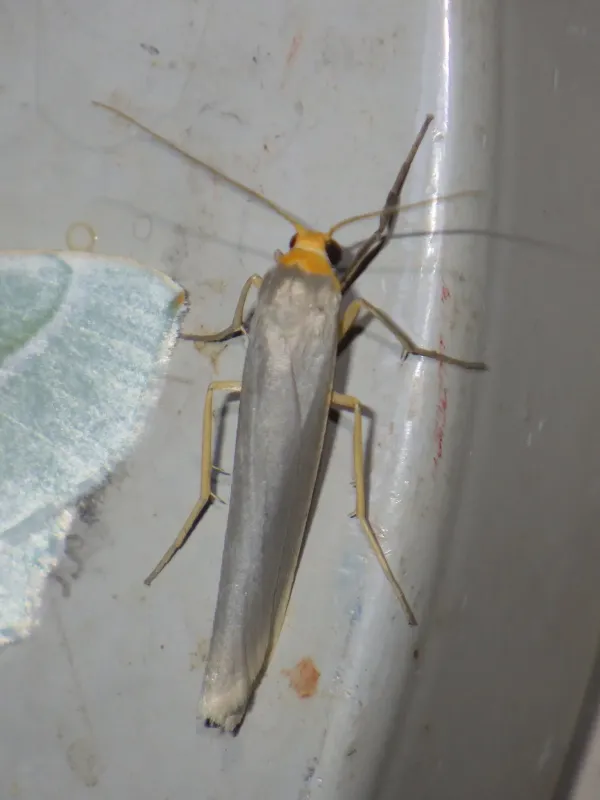
The Dotted Footman (Eilema caniola) is a moth belonging to the Erebidae family, subfamily Arctiinae. The adult moth has a wingspan of 28 to 35 mm, with wings typically colored in ash-grey or silvery-grey, distinguished by a subtle yellowish costa.
The larvae are approximately 25 mm long. They exhibit a dark coloration with longitudinal yellow or orange stripes and are densely covered with hair tufts, which is a classic feature of this species. This appearance makes them relatively easy to identify in the field.
The pupa is dark brown or black and is usually enclosed in a delicate cocoon made of silk mixed with the larvae's own shed hairs. This cocoon serves as protection during the developmental stage.
The life cycle can consist of one or two generations per year, depending on the climatic conditions. In warmer southern regions, the development is more rapid, which can lead to higher population densities.
These moths are primarily nocturnal. During the day, they remain stationary, often resting on tree trunks or stones, using their cryptic coloration to blend into the environment and avoid detection.
What it damages
The primary food source for Dotted Footman larvae is lichens, which grow on the bark of fruit and ornamental trees. Under normal conditions, they are considered lichen-feeders and do not directly harm plant tissues.
However, when population densities are high, the larvae may feed on young leaves, buds, and succulent shoots. This is particularly problematic for saplings in nurseries, where foliage loss leads to stunted growth.
Host plants commonly affected include apple, pear, cherry, and various deciduous shrubs. In cases where lichen availability is limited, the larvae may shift their diet, potentially damaging the fruit itself, which lowers commercial value.
The economic impact of this pest is most significant in unmanaged or neglected orchards where trees are heavily covered with epiphytic lichens, providing an ideal habitat for the moth to lay eggs.
Larval feeding on foliage reduces the plant's photosynthetic capacity, causing stress that negatively impacts tree vitality, yield, and overall cold hardiness throughout the winter months.
When it appears
The adult flight period typically occurs from June through late August. Females lay their eggs in small clusters, primarily on bark surfaces covered with lichens or on the undersides of leaves.
The species overwinters as young larvae. They seek refuge in bark crevices, beneath fallen leaves, or in other protected spots where they can survive the cold season before resuming activity in the spring.
Spring activity begins when temperatures become consistently warm, signaling the larvae to feed again before they proceed to pupation. If a second generation occurs, it usually reaches its peak in July and August.
Monitoring the moth population is best achieved using light traps in the evening, which helps agriculturalists determine if intervention is necessary based on the number of captured adults.
Early spring inspections of orchard trunks allow for the detection of overwintering larvae, facilitating the implementation of control measures before the blooming phase begins.
Control measures
The primary control measure involves mechanical cleaning of tree trunks and main branches to remove lichen growth. Removing this food source makes the trees unattractive for egg-laying and larval survival.
Biological insecticides based on Bacillus thuringiensis are highly effective and environmentally safe for controlling larvae in the early stages, ensuring minimal impact on non-target species.
In commercial settings with severe infestations, contact-acting insecticides may be utilized during the peak hatching periods, provided they are authorized for use in the specific crop.
Good horticultural practices, such as proper pruning and canopy thinning, improve airflow and light penetration, which inhibits the growth of lichens and creates an unfavorable environment for the Dotted Footman.
Recommended management strategies include:
- Mechanical scraping of bark to remove moss and lichen buildup.
- Applying whitewash or lime-based treatments to tree trunks in the autumn.
- Collecting and disposing of fallen leaf litter where larvae might congregate.
- Using pheromone or light traps to manage adult population numbers.
- Targeted spraying with bio-insecticides during the active growing season.
Taxonomy
- Latin name
- Eilema caniola
- Order
- Lepidoptera (butterflies)
- Family
- Erebidae
- EPPO code
- LITSCA
Discussion
No discussions yet — be the first.