
Duponchelia fovealis
Duponchelia fovealis
Description
How to identify
Duponchelia fovealis is a small moth belonging to the family Crambidae, which has become a significant pest in greenhouse horticulture.
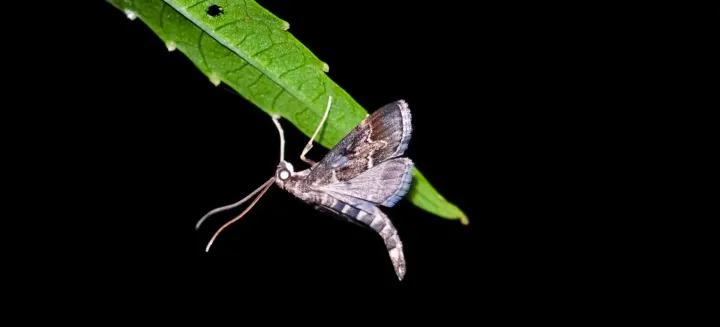
Adult moths have a wingspan of approximately 20 mm. Their wings are brown with distinct light, wavy transverse bands, creating a recognizable zig-zag pattern.
A key behavioral trait of the adult is that it often holds its abdomen curled upwards while at rest on leaves or other surfaces.
The larvae, or caterpillars, reach a length of 20-25 mm and are cream-colored with dark, sclerotized spots on each body segment.
Their head capsule is dark brown or black, serving as a reliable feature for distinguishing this species from other similar greenhouse moth larvae.
What it damages
Duponchelia fovealis is a polyphagous pest capable of causing extensive damage to a wide range of ornamental and vegetable crops.
Common host plants include roses, begonias, kalanchoes, and cyclamens, as well as peppers, cucumbers, and strawberries grown under glass.
The larvae feed on various parts of the plant, including leaves, flowers, and buds, often creating webbed galleries while they feed.
They are particularly destructive because they burrow into the base of the stems, causing the plant to wilt and collapse rapidly.
Feeding damage to fruit, such as peppers, can lead to secondary fungal infections and total loss of the marketable product.
When it appears
In greenhouse environments, Duponchelia fovealis can complete its lifecycle year-round, as artificial heating maintains favorable conditions.
Development from egg to adult usually takes about 3 to 5 weeks, depending on the temperature, allowing for multiple overlapping generations.
Females lay their eggs in clusters, typically on the undersides of leaves, stems, or within the moist substrate near the plant base.
The pest thrives in humid environments, which are characteristic of many modern greenhouse production systems.
While population growth may slow in colder months without heating, the pest remains active as long as the greenhouse temperature is above threshold levels.
Signs of infestation
The presence of fine webbing on leaves or around the base of stems is often the first visual indicator of a Duponchelia infestation.
Small, dark, granular frass (excrement) pellets found on leaves or on the soil surface are common signs of larval feeding activity.
Wilting plants that do not respond to irrigation are a major red flag, often indicating larvae have bored into the crown or stem.
Damaged flower buds and distorted foliage are frequently observed as the larvae preferentially feed on young, succulent plant tissues.
In severe cases, the entire plant base may be eaten away, causing the plant to fall over and die within a short period.
Control measures
Effective management begins with monitoring adult populations using sticky traps (yellow or blue) to detect early arrivals.
Cultural practices are paramount, including strict sanitation, the removal of infested plant debris, and the elimination of weeds that may host the pest.
Biological control agents, such as predatory mites, nematodes, or Bacillus thuringiensis sprays, have shown good efficacy in greenhouse settings.
If chemical intervention is necessary, choose insecticides registered for lepidopteran pests, ensuring careful rotation to prevent resistance buildup.
- Regular inspection of the basal stem area.
- Sanitization of benches and tools to prevent spread.
- Optimal humidity control to reduce breeding efficiency.
Taxonomy
- Latin name
- Duponchelia fovealis
- Order
- Lepidoptera (butterflies)
- Family
- Crambidae
- EPPO code
- DUPOFO
Discussion
No discussions yet — be the first.