
Stem and bulb nematode
Ditylenchus dipsaci
Description
How to identify
The Stem and Bulb Nematode Ditylenchus dipsaci is a microscopic worm belonging to the order Tylenchida and the family Anguinidae. It is typically 1 to 1.8 mm in length and features a slender, eel-like body.
These nematodes possess a specialized feeding apparatus called a stylet, which is used to penetrate plant tissues and extract cellular contents. They live endoparasitically, residing within the plant structure for most of their lifecycle.
A key biological feature of this pest is its ability to enter anhydrobiosis, a dormant state where it can survive for several years in dry plant debris, soil, or even within seeds.
The life cycle involves egg, larval, and adult stages. Under favorable conditions, such as temperatures between 15°C and 20°C and high moisture, a full generation cycle can be completed in about three weeks.
Dissemination usually occurs through the movement of infested propagation materials, such as bulbs, garlic cloves, seeds, or via contaminated agricultural tools and irrigation water.
What it damages
Ditylenchus dipsaci is a notorious polyphagous pest that attacks over 450 species of plants. It causes significant economic damage, particularly to Allium species like onions and garlic, as well as tulips and narcissi.
Leguminous crops such as beans, peas, and clover are also highly susceptible to infestation. The nematode disrupts normal growth by feeding on parenchyma cells, causing internal decay.
Infestation typically starts at the base of the plant, where nematodes enter through the root plate or young leaf tissues. Once inside, they reproduce rapidly, leading to tissue structural failure.
The damage often facilitates secondary infections by bacteria and fungi, which accelerate the rotting process, especially during storage of bulbs and tubers.
The pest's ability to live saprophytically on fungal mycelium in the soil allows it to persist even when its preferred host crops are not present in the field.
Signs of infestation
Visual symptoms often include stunted plant growth, swelling, and twisting of stems and leaves. In onions, the leaves become thickened, brittle, and chlorotic.
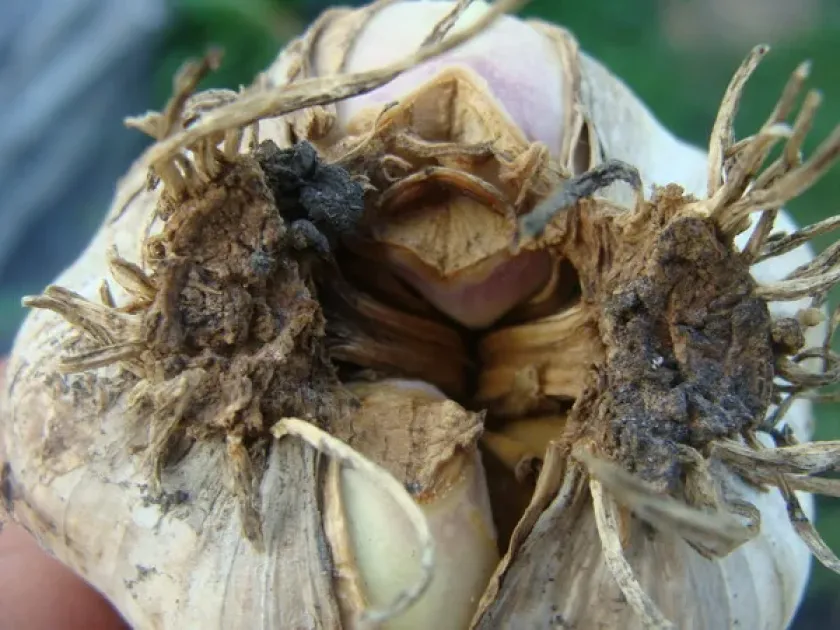
A cross-section of an infested bulb reveals distinct brown or grey rings of necrotic tissue. The internal consistency of the bulb becomes spongy and loose, often leading to total collapse.
Seedlings may exhibit severe distortion, a symptom sometimes called 'bloat' or 'sickle leaf', where the plantlets are deformed and exhibit irregular growth patterns.
In strawberry plants, damage manifests as short, stunted petioles, crinkled leaves, and reddish or necrotic lesions on the crown and stems.
- Yellowing and wilting of the foliage.
- Cracking of the bulb base or root zone.
- Unpleasant putrid smell emanating from rotten bulb tissues.
Control measures
Implementing a strict crop rotation program is the primary defense strategy. Avoiding susceptible hosts for at least 3 to 4 years helps reduce the nematode population in the soil.
Quality control of propagation material is paramount. Using certified nematode-free sets and bulbs prevents the introduction of the pest into clean fields.
Heat treatment is an effective measure for curing infested bulbs; dipping them in water at 45°C for one to two hours can significantly reduce nematode activity without harming the plant.
Good soil management, including the removal of crop residues and weeds, prevents the buildup of the nematode population between seasons.
Application of nematicides may be necessary in extreme cases, though their effectiveness is often limited by the soil environment and the pest's ability to penetrate deep within plant tissues.
Taxonomy
- Latin name
- Ditylenchus dipsaci
- Order
- Nematodes
- Family
- Anguinidae
- EPPO code
- DITYDI
Discussion
No discussions yet — be the first.