
Potato tuber nematode
Ditylenchus destructor
Description
How to identify
The potato tuber nematode Ditylenchus destructor is a plant-parasitic nematode belonging to the order Tylenchida and the family Anguinidae. These microscopic worms are vermiform, typically reaching lengths of 1.0 to 1.5 mm, making them invisible to the naked eye.
These pests function as endoparasites, entering plant tissues through lenticels or wounds. They secrete enzymes that facilitate the breakdown of pectin in cell walls, allowing them to move and feed throughout the plant tissue efficiently.
The life cycle of the nematode depends heavily on environmental conditions, typically spanning between 20 and 45 days. They thrive in moderate temperatures and high soil moisture, conditions often found during the growing season of tuber crops.
Ditylenchus destructor is remarkably resilient, capable of surviving in the soil without a host for extended periods by entering a state of cryptobiosis. This trait makes it a highly persistent and dangerous quarantine pest in international trade.
Females lay eggs inside the plant tissues where they feed. Once a generation completes its development, the population quickly spreads through the host tissue, leading to significant colonization and internal structural collapse.
What it damages
While potatoes are the primary host, the nematode has a wide range of secondary hosts. This includes various bulbs, vegetables such as carrots, onions, and garlic, as well as several common weeds, complicating management efforts.
Damage occurs in both the field and storage facilities. In storage, the nematode spreads through contact, moving from infected tubers to healthy ones, which can cause total loss of stored batches if left unmanaged.
Field symptoms include stunted plant growth, chlorosis, and premature senescence of the foliage. Infested plants have reduced vigor, resulting in smaller and fewer tubers compared to healthy plants.
The economic impact is profound due to both yield reduction and the high rejection rate of marketable produce. Potatoes with even minor symptoms of nematode damage are typically discarded during the sorting and packing process.
Secondary pathogens such as fungi and bacteria often exploit the damaged tissues. These opportunists accelerate decay, causing the tubers to become soft, mushy, and foul-smelling, often masking the primary cause of the damage.
Signs of infestation
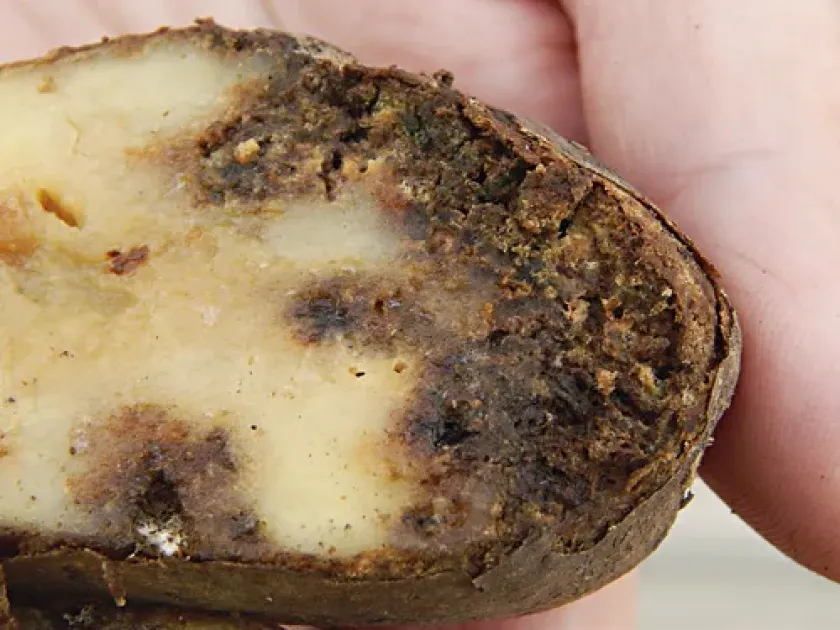
Initial signs on the surface of tubers appear as small, pale, discolored spots. Over time, these spots sink and darken, often taking on a brownish or greyish hue as the epidermis becomes brittle.
When an infested potato is cut open, there is a distinct layer of soft, dark, and mealy tissue directly beneath the skin. This diseased area is frequently separated from healthy white flesh by a well-defined border.
As the infestation progresses, the skin of the tuber may crack, forming visible fissures or ulcers. These cracks serve as entry points for secondary infections that eventually turn the entire tuber into a mass of decay.
In advanced stages of storage infestation, the entire internal structure of the tuber may be destroyed. The tuber becomes spongy and shriveled, eventually turning into a dry, hollowed-out husk filled with nematodes.
Although the foliage might appear mostly normal in mild infections, a careful inspection of the stolons often reveals swelling, thickening, and necrosis, which are early indications of the presence of the parasite.
Control measures
Prevention through quarantine measures is the most effective management strategy. Farmers should only use certified, nematode-free seed tubers and avoid planting in fields with a known history of infestation.
Crop rotation is essential for reducing soil populations. Avoiding susceptible hosts for a minimum of 4 to 5 years helps starve the nematode population, although it does not guarantee complete eradication due to their survival mechanisms.
- Rigorous cleaning and disinfection of storage facilities and equipment.
- Effective weed control to eliminate alternative hosts throughout the field.
- Deep plowing to incorporate organic matter and disrupt the soil environment.
- Regular soil sampling and testing to monitor population densities.
Chemical control via nematicides is available but often restricted due to environmental concerns and application challenges. Treatments are usually applied at planting, but they rarely provide 100% control.
Biological alternatives, such as using specific fungi (e.g., Purpureocillium lilacinum) or chitinolytic agents, are being researched and implemented in some regions as part of an Integrated Pest Management (IPM) approach to minimize chemical reliance.
Taxonomy
- Latin name
- Ditylenchus destructor
- Order
- Nematodes
- Family
- Anguinidae
- EPPO code
- DITYDE
Discussion
No discussions yet — be the first.