
Dipsosphecia mellinipennis
Dipsosphecia mellinipennis
Description
How to identify
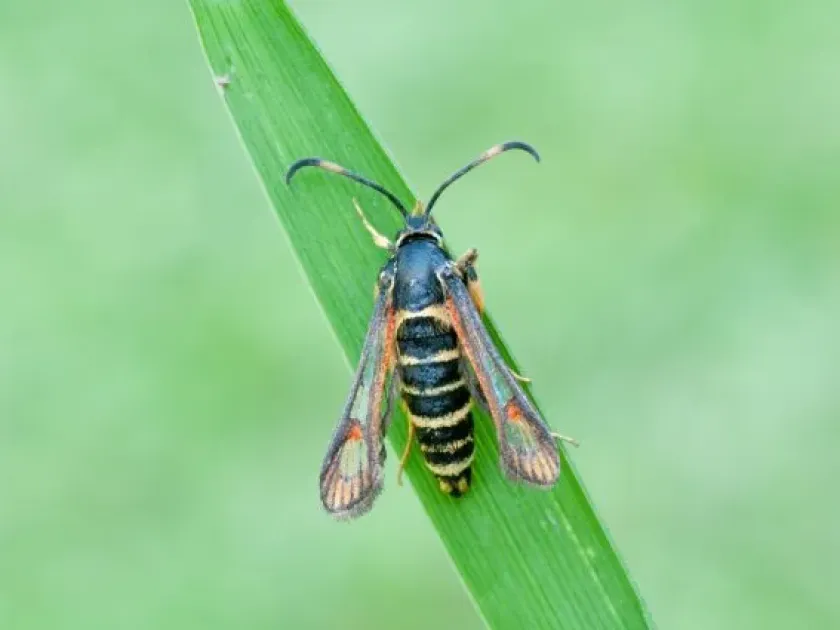
Dipsosphecia mellinipennis is a species of clearwing moth belonging to the Sesiidae family. Adults are well-known for their Batesian mimicry, closely resembling wasps in appearance, which serves as a deterrent to potential predators.
The wings of the moth are largely transparent, with scaled margins and distinct veins. The body is slender and typically adorned with bright yellow or orange bands, further enhancing the wasp-like appearance of the insect.
The larvae are whitish to yellowish with a dark, sclerotized head capsule. They are specialized borers, spending their entire developmental period hidden inside the stems, branches, or root collars of host plants.
The life cycle of this species is complex and often spans one to two years. Development is heavily influenced by the host plant's vigor and the local climatic conditions in the environment where the moth resides.
Expert identification of this specific species often requires examination of genitalia or host association, as many clearwing moths share a similar physical appearance in the field.
What it damages
The primary damage is caused by the larvae, which bore into the wood and inner bark. This activity disrupts the transport of water and nutrients, severely weakening the structural integrity of the plant.
Dipsosphecia mellinipennis targets various woody shrubs and trees. The resulting wounds in the bark act as entry points for secondary pathogens, such as fungi and bacteria, which can accelerate the decline of the host.
Signs of infestation include localized necrosis, gummosis (oozing of sap), and bark deformations. Infected plants frequently exhibit stunted growth, premature leaf yellowing, and dieback of individual branches.
Because the larvae are hidden deep within the tissue, early detection is difficult. By the time visual symptoms become prominent, the structural damage to the wood is often already significant.
In severe cases, or if the infestation occurs near the root crown, the disruption of the vascular system can be fatal to the plant, especially in young or stressed specimens.
When it appears
Adult flight typically occurs during the warmer months, starting in early summer. The moths are most active during bright, sunny, and calm days when they search for mates and suitable oviposition sites.
Females lay eggs on the bark of host plants, usually near buds or in existing cracks. Once the eggs hatch, the small larvae immediately burrow beneath the bark to begin their feeding cycle.
The larvae overwinter inside the wood or roots, remaining dormant until temperatures rise in the spring. This internal location provides them with protection from harsh winter weather and many external predators.
Pupation takes place within the larval galleries. Before the adult moth emerges, the pupa partially pushes itself out of the exit hole, leaving the empty pupal casing protruding from the surface of the bark.
The number of generations per year can vary based on regional latitude. Warmer climates may allow for a shorter, more rapid developmental cycle compared to cooler northern regions.
Signs of infestation
The most reliable sign of an infestation is the presence of frass (larval excrement) appearing as a sawdust-like material around small holes in the bark, indicating active feeding inside.
Wilting of foliage or individual branches in mid-summer, while the rest of the plant appears healthy, is a common symptom suggesting that the vascular system is being compromised by boring larvae.
Bark swelling or the formation of galls near the base of the tree or branch junctions can also indicate a long-term presence of the pest, as the plant attempts to grow over the larval tunnels.
Careful inspection of the trunk may reveal circular exit holes, which are the points where the adult moths emerged. These holes are characteristic signs that a generation of the pest has completed its cycle.
General loss of vigor, thin foliage, and a lack of new growth are systemic indicators of a heavy infestation that has likely been present for at least one or two full seasons.
Control measures
Cultural management is essential, focusing on the pruning and destruction of infested branches to remove larvae before they can emerge as adults and reproduce.
Pheromone traps are highly effective for monitoring adult activity. Tracking the flight periods allows for the precise timing of insecticide applications to target newly hatched larvae.
Chemical control should be applied during the period of egg-laying or early larval emergence. Contact insecticides applied to the bark can kill young larvae before they succeed in penetrating the wood.
Biological control agents, such as entomopathogenic nematodes, can be used as a targeted treatment by applying them to the bark or into galleries, offering a safer alternative to conventional chemical sprays.
Maintaining plant health through adequate irrigation, proper fertilization, and avoiding physical damage to the trunk helps trees maintain their natural defenses against wood-boring pests.
Taxonomy
- Latin name
- Dipsosphecia mellinipennis
- Order
- Lepidoptera (butterflies)
- Family
- Sesiidae
- EPPO code
- DIPSME
Discussion
No discussions yet — be the first.