
Dipsosphecia clearwing moth
Dipsosphecia
Description
How to identify
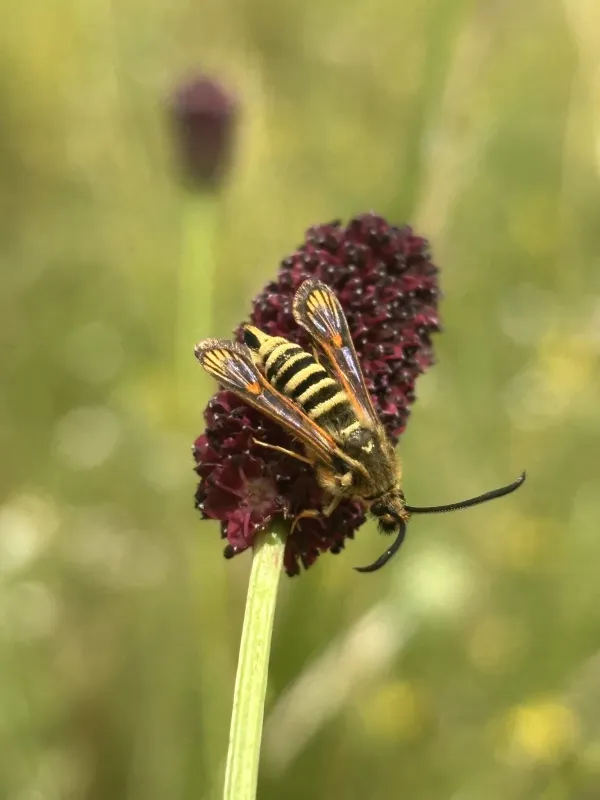
Clearwing moths of the genus Dipsosphecia belong to the family Sesiidae (clearwing moths) of the order Lepidoptera. Visually, adult specimens resemble wasps or hornets, which is a form of protective mimicry.
The body of the imago is slender, with mostly transparent wings characterized by scale patterns along the edges and on the cross-veins. The wingspan is usually small, and the coloration often includes bright yellow or orange rings on the abdomen.
The larvae of the clearwing moth have a whitish or yellowish body with a brown head. They lead a concealed lifestyle, developing inside plant tissues, which makes them difficult to detect during initial inspections.
The life cycle of this pest spans one or two years depending on the climatic conditions of the region. Pupation occurs inside the galleries that the larva bores into the stems or roots of the host plant.
Identification is complicated by the fact that the moths are active mainly during the day, yet their flight is rapid and erratic, making them difficult to spot with the naked eye.
What it damages
The pest primarily attacks members of the legume family (Fabaceae), in particular various species of sainfoin, as well as some species of composite plants.
The main damage is caused by the larvae, which penetrate the root neck or stems of the plants. By feeding on tissues, they disrupt sap flow and weaken the overall vigor of the crop.
In areas where larvae have entered, growth retardation, deformation, and gradual wilting of the shoots can be observed. If the infestation is severe, plants often die due to the destruction of the root system.
The damaged areas become open pathways for the entry of fungal and bacterial infections, which further degrades the health of the affected plantings.
Significant economic harm is noted during mass reproduction, when up to 30–50% of crops are affected, leading to a direct decrease in seed yield or biomass.
When it appears
Adult flight is usually observed in the summer period, most often in June and July, when stable, warm weather necessary for mating and egg-laying is established.
Females lay eggs primarily on the basal part of the stem or on the soil surface near the host plant. The hatched larvae immediately begin searching for entry points to bore inside.
The larvae spend the majority of their lives inside the plant, feeding on tissues throughout the summer and autumn months. Overwintering occurs in the larval stage within the constructed galleries.
In spring, as soil and air temperatures rise, the larvae resume feeding, preparing for the pupation stage. The entire development cycle is strictly tied to the vegetation period of the host plant.
It is crucial for agronomists to monitor crop health during the onset of the forage crop flowering period, as this is when pest activity reaches its peak.
Signs of infestation
One of the early signs of infestation is the presence of characteristic entrance holes in the lower part of the stem, near the surface of the soil.
The presence of larval excrement in the form of fine brown frass around the base of the stem indicates an active feeding process occurring inside the tissue.
- Premature yellowing and wilting of individual shoots or the entire bush.
- Growth delays compared to neighboring healthy specimens.
- Increased brittleness of stems at the base under mechanical stress.
When cutting open the stem, one can discover characteristic longitudinal galleries filled with excrement and the larva itself, which occupies space within the damaged area.
In late summer or autumn, secondary necrosis may develop on affected plants, caused by the rotting of tissues damaged by the larvae.
Control measures
Agrotechnical methods are the foundation of control: following crop rotation and maintaining spatial isolation of crops from old, overgrown areas containing wild legumes.
Deep autumn plowing helps destroy a portion of the overwintering larvae by disrupting their refuges in the soil and the roots remaining after harvest.
The use of biological agents, such as preparations based on entomopathogenic nematodes or bacteria, allows for the reduction of the population without environmental harm.
Chemical insecticides are effective only during the moth flight period, before the larvae have managed to bore into the stems. Systemic treatments are feasible only in the early stages of vegetation.
It is important to remove and destroy heavily infested plants in a timely manner to prevent the spread of the pest to adjacent fields and to reduce the overall infection reservoir.
Taxonomy
- Latin name
- Dipsosphecia
- Order
- Lepidoptera (butterflies)
- Family
- Sesiidae
- EPPO code
- DIPSSP
Discussion
No discussions yet — be the first.