
Didesmococcus scale
Didesmococcus
Description
How to identify
The Didesmococcus scale is a member of the Coccidae family, commonly known as soft scales. Unlike armored scales, these insects do not produce a separate shell but instead use their own thickened, sclerotized skin as a protective covering.
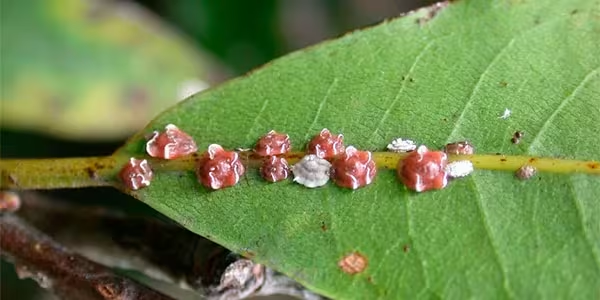
Adult females are sessile, meaning they remain fixed in one location once they settle on a branch. They exhibit a distinct convex, hemispherical shape and vary in color from light brown to deep chestnut, providing camouflage against the tree bark.
Adult males are rarely seen as they are small, winged, and short-lived. Their primary function is to locate and fertilize the sedentary females, after which they die without feeding.
The life cycle involves incomplete metamorphosis. The most mobile stage is the first-instar nymph, often referred to as a "crawler," which is the only phase capable of active dispersal to other parts of the host plant.
Identification is usually confirmed by examining the morphological features of the adult female under a microscope, focusing on the anal cleft and body plate characteristics.
What it damages
Didesmococcus species primarily target stone fruit trees, including apricot, peach, plum, and cherry. Heavy infestations can also impact other woody plant species in warmer climate regions.
The insects damage the tree by inserting their mouthparts into the plant tissue and sucking phloem sap. This feeding process causes a significant drain on the tree's nutrient reserves and water balance.
As a result, heavily infested trees show reduced vigor, stunted shoot growth, and chlorotic leaves that drop prematurely. This weakening effect significantly reduces the plant's ability to survive harsh winter conditions.
The direct impact on yield is substantial, as fruits on infested branches may be smaller, lower in sugar content, and prone to pre-harvest drop, leading to significant economic loss.
Additionally, the honeydew secreted by the scales promotes the growth of sooty mold, which blocks sunlight from reaching the leaves, thereby inhibiting photosynthesis.
When it appears
The pest typically overwinters as second-instar nymphs, tucked into the crevices of tree bark where they are protected from winter cold and drying winds.
Feeding resumes in the spring as temperatures rise, allowing the nymphs to complete their development into adult females just before or during the flowering phase of the host trees.
Crawler emergence generally occurs in early to mid-summer. This period is the most critical time for monitoring and applying management tactics, as nymphs are most vulnerable.
There is usually one generation per year, though warmer climates may allow for partial second generations if environmental conditions remain favorable for an extended period.
In autumn, the life cycle concludes with the migration of young nymphs to suitable overwintering sites on the woody parts of the tree.
Signs of infestation
The most prominent sign of an infestation is the presence of small, bump-like structures on the bark that look like unusual buds or growths, often grouped in clusters.
Sticky honeydew on the leaves and branches is a key indicator of active scale feeding, frequently attracting ants that provide protection for the scale colonies.
The appearance of black sooty mold on the foliage is a secondary sign, indicating that the scale population has been feeding long enough to support fungal growth.
Generalized tree decline, including yellowing leaves, sparse canopy density, and twig dieback, serves as a late-stage warning of significant infestation levels.
Physical evidence, such as cracked bark or visible liquid droplets on the surface, is common during the active feeding stages of the female scales.
Control measures
Sanitation is a vital first step, involving the removal and destruction of heavily infested branches to reduce the source of the infestation.
Chemical control should be timed to coincide with the crawler stage, as the protective scale covering is not yet fully developed, making the insects susceptible to contact insecticides.
Dormant oil applications during the early spring, before bud break, are highly effective as they smother the overwintering nymphs.
- Systemic insecticide applications during the growing season.
- Encouraging natural predators such as ladybirds and parasitic wasps.
- Scrubbing bark to remove overwintering sites before spring growth begins.
Always verify the chemical compatibility with the specific stone fruit stage to prevent phytotoxicity and ensure adherence to harvest interval regulations.
Taxonomy
- Latin name
- Didesmococcus
- Order
- Hemiptera (bugs, aphids, leafhoppers)
- Family
- Coccidae
- EPPO code
- DDSMSP
Discussion
No discussions yet — be the first.