
Dichomeris ustalella
Dichomeris ustalella
Description
How to identify
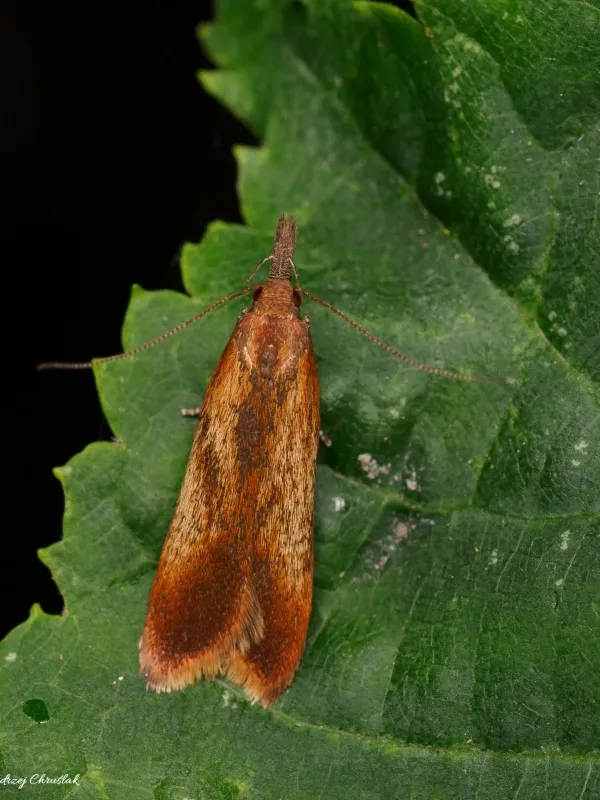
Dichomeris ustalella is a species of moth belonging to the family Gelechiidae (twirler moths). These small insects are part of the order Lepidoptera and possess a distinct morphology.
The adult moth has a wingspan of approximately 14–18 mm. Its forewings are characterized by a dark brown or blackish basal area, contrasting with an ochreous-brown distal section, which aids in identification.
The larvae are typically slender with a cylindrical body, often pale green or yellowish. They are known for their leaf-tying behavior, using silk to construct protective retreats.
The lifecycle follows a complete metamorphosis: egg, larva (caterpillar), pupa, and adult. They are generally nocturnal, making direct observation of adults difficult without light traps.
Taxonomically, the species is grouped within the subfamily Dichomeridinae, with characteristics typical of the Gelechiidae family, including long, upcurved labial palpi.
What it damages
This moth primarily affects deciduous trees, with a preference for hosts like oak (Quercus), beech (Fagus), and hornbeam (Carpinus) in European forests and gardens.
The larvae feed on the foliage, initially skeletonizing the leaves and eventually consuming entire leaf tissues, leaving only the primary veins behind.
By spinning leaves together with silk, the caterpillars create shelters that protect them from predators and environmental stressors, while also providing a constant food source.
Heavy infestations can lead to significant defoliation, which stresses the tree, reduces its photosynthetic capacity, and slows down annual growth rates, especially in young saplings.
Secondary damage occurs when weakened trees become susceptible to fungal pathogens or secondary wood-boring insects due to the physiological stress caused by foliage loss.
When it appears
Adult moths are typically active during late spring, generally emerging from late April through June, which coincides with the appearance of tender young leaves.
Larval development takes place during the spring and early summer months (May and June), which is the most active feeding period for this pest.
Pupation usually occurs in mid-summer. The pupae are often found within folded leaves or tucked into bark crevices, depending on the specific environmental conditions.
The species overwinters as either a pupa or an adult, seeking shelter in protected areas such as leaf litter, bark fissures, or soil crevices near the host tree.
Phenology is highly dependent on spring temperatures, meaning that warmer seasons lead to an earlier emergence of the moths and subsequent larval activity.
Signs of infestation
The most visible sign of an infestation is the presence of tied or rolled leaves, which appear misshapen, brown, or withered compared to the surrounding healthy foliage.
Signs of feeding activity include small holes in the leaves or patches where the upper epidermis has been removed, creating a transparent or lattice-like appearance.
Accumulated frass (larval droppings) within the silk-tied leaf nests is a definitive indicator of an active caterpillar presence.
A thinning canopy on susceptible host trees during the late spring period often points to a high population density of Dichomeris ustalella or similar leaf-tying moths.
Adult moths can be detected at night using light traps, which effectively attract this species, allowing for accurate monitoring of their population numbers.
Control measures
Integrated Pest Management (IPM) for this species involves monitoring and cultural practices, such as removing heavily infested branches or clearing leaf litter to reduce wintering sites.
Biological control using Bacillus thuringiensis (Bt) is highly effective against the larval stage while posing minimal risk to beneficial insects, birds, and other wildlife.
In cases of severe outbreak in nurseries or decorative plantings, selective insecticides targeting Lepidoptera can be used, though timing must match the larval emergence.
Encouraging natural enemies, such as parasitic wasps and predatory beetles, is a sustainable way to maintain low pest populations in the long term.
- Monitor adult flight times using light traps.
- Prune and destroy severely infested leaf clusters.
- Apply biological insecticides during early larval instars.
- Preserve natural habitats for predator populations.
Taxonomy
- Latin name
- Dichomeris ustalella
- Order
- Lepidoptera (butterflies)
- Family
- Gelechiidae
- EPPO code
- DICMUS
Discussion
No discussions yet — be the first.