
Dichomeris ostracodes
Dichomeris ostracodes
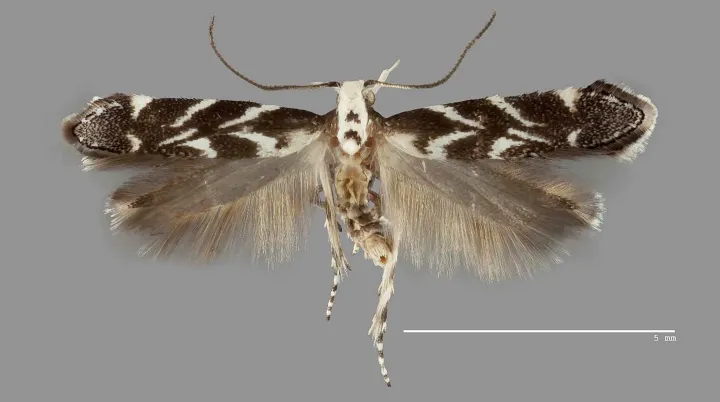
Description
How to identify
Dichomeris ostracodes is a species of moth belonging to the family Gelechiidae. As a micro-moth, it is often overlooked during field scouting due to its small size and effective camouflage in dense vegetation.
Adult moths are primarily nocturnal, showing flight activity during the night and dusk. This behavior makes it challenging for farmers to track population spikes using standard visual inspections during the day.
The biological cycle consists of eggs, larvae (caterpillars), pupae, and adults. Each stage is adapted to the specific conditions of forage legume fields, which provide both food and shelter.
The larvae are the primary damaging stage. They possess strong mandibles capable of processing fibrous legume tissue, and they often spin silk to anchor themselves or create protective leaf rolls.
Winter survival is achieved through diapause, with pupae or mature larvae remaining in the soil or protected leaf litter. This allows the population to persist and resume feeding immediately as temperatures rise.
What it damages
This pest primarily attacks perennial legumes, with alfalfa being the most significant crop at risk. The damage caused by caterpillars can lead to substantial reductions in green forage yield.
Clover crops and wild leguminous weeds also serve as hosts. These alternative hosts allow the pest to maintain its presence in the ecosystem even when the primary crop is harvested.
Initial damage usually involves young larvae skeletonizing the underside of leaves. As they grow, they move to the upper canopy, where they consume entire leaf blades, leaving only the primary veins.
In addition to foliage damage, the pest may attack the reproductive structures of the plants. This is particularly harmful for seed production fields, where bud and flower destruction directly impacts yield.
When infestation levels are high, the physiological health of the plant is compromised. The loss of leaf area reduces the plant's ability to store root reserves, weakening it for subsequent growth cycles.
When it appears
The first generation emerges in spring, coinciding with the rapid growth of alfalfa. Moths lay eggs on the leaves, starting the cycle of damage that progresses through the season.
Multiple generations occur throughout the summer, depending on regional climatic factors. Warm, stable weather significantly accelerates the development of the larvae, leading to more frequent damage.
The peak feeding period for larvae often aligns with the main harvest cycles. Infestations are most noticeable before the first or second cut, as the caterpillars consume the most forage at this time.
In hot, dry summer months, larvae may migrate deeper into the canopy to seek shade and humidity, making them harder to control with contact insecticides.
As the season draws to a close, the final generation prepares for overwintering. These larvae stop feeding and seek safe havens in the debris at the base of the plants.
Signs of infestation
Key symptoms include the presence of rolled or folded leaves, often bound together by fine silk threads. These nests serve as protection for the developing larvae.
Visual signs of skeletonized leaves are common. The leaves appear thinned, with the tissue between the veins removed, leaving a translucent or lace-like appearance.
Droppings (frass) may be visible in the leaf axils or on the leaf surfaces, indicating the presence and intensity of larval feeding activity.
Stunted plant growth is a common secondary symptom. Infected patches may look yellowish or lack the vigor of adjacent, uninfested parts of the field.
- Silk webbing on the top of the canopy.
- Leaf rolling and twisting.
- Skeletonized leaf patches.
- Visible caterpillars dropping to the ground when disturbed.
Control measures
Early harvest (mowing) is the most effective cultural control measure. Harvesting removes the foliage where larvae are feeding and disrupts their life cycle by destroying their food source.
Sanitation practices, such as removing weeds around the field edges that belong to the legume family, can reduce the reservoir of moths between seasons.
Chemical control should be implemented based on economic thresholds. Applying insecticides during the early larval stage is more effective than targeting mature caterpillars, which are more resilient.
Integrated Pest Management (IPM) strategies emphasize the use of beneficial insects, such as parasitoid wasps, which can naturally regulate the population of the moth.
Monitoring using pheromone traps can help track moth emergence and timing, allowing for more precise applications of control measures only when necessary.
Taxonomy
- Latin name
- Dichomeris ostracodes
- Order
- Lepidoptera (butterflies)
- Family
- Gelechiidae
- EPPO code
- DICMOS
Discussion
No discussions yet — be the first.