
Dark Tussock
Dicallomera fascelina
Description
How to identify
The Dark Tussock (Dicallomera fascelina) is a moth of the Erebidae family, subfamily Lymantriinae. The adult moths have a wingspan ranging from 35 to 50 mm, with forewings featuring a greyish-brown pattern marked by distinct dark transverse bands.
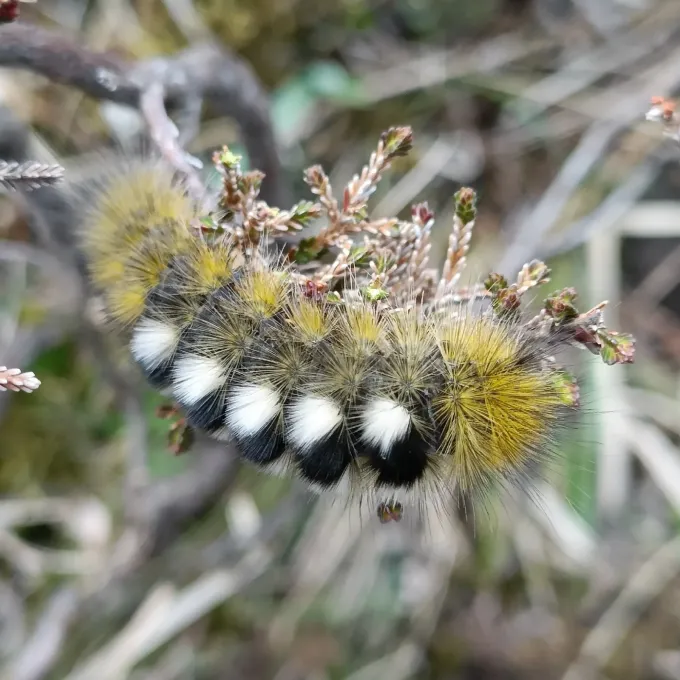
The larvae, or caterpillars, are notable for their dense tufts of hair, which often serve as a warning mechanism against predators. These hairs can sometimes cause skin irritation in humans upon contact.
The pupae are dark brown and are housed within a tough cocoon, composed of silk mixed with the shed hairs from the caterpillar, providing excellent protection against environmental elements.
This species is widely distributed across the Palearctic region, commonly found in temperate forest zones, scrublands, and heathlands throughout Europe and parts of Asia.
Females are typically less flight-capable than males, which often influences their egg-laying behavior, concentrating populations on specific host plants.
What it damages
The larvae are polyphagous, meaning they feed on a wide variety of plant species. While they prefer deciduous trees, they are known to attack various ornamental and fruit-bearing plants.
Common host plants include species like birch (Betula), oak (Quercus), willow (Salix), and alder (Alnus), as well as various berry bushes in managed gardens.
Damage typically begins in early spring, as larvae feed on developing buds and young foliage, which can cause significant growth reduction in young or weakened trees.
Heavy infestations can lead to partial or total defoliation, stripping branches of leaves and severely stressing the host plant's metabolic capacity.
Chronic feeding weakens the tree's defense mechanisms, making it more susceptible to secondary wood-boring insects and pathogenic fungal infections.
When it appears
The Dark Tussock typically follows a univoltine life cycle, meaning one generation per year. Larvae overwinter in the second or third instar, usually hiding within leaf litter or deep bark crevices.
In spring, as temperatures rise, the caterpillars emerge from hibernation to feed on the burgeoning buds. This feeding period continues until mid-summer.
Pupation occurs in July or August, where the larvae construct cocoons on twigs or tree trunks. The transition into the pupal stage is a critical period for population dynamics.
Adult moths emerge in late summer, usually between July and August, for mating and egg deposition on the host plants' bark or leaf surfaces.
The eggs hatch shortly after, and the young larvae feed for a short duration before entering the overwintering state once autumn temperatures drop.
Signs of infestation
The most visible sign of an infestation is the presence of eaten leaves, often exhibiting a skeletonized appearance where only the veins remain intact.
Small amounts of silk webbing among leaves or branches are often associated with the larvae's movement and feeding sites, providing shelter during the day.
The accumulation of frass (larval droppings) beneath infested trees is a clear indicator that a colony is actively feeding in the canopy above.
Co-occurring signs include the presence of shed larval skins or discarded cocoons attached to the bark, which remain visible even after the moth has emerged.
Individual caterpillars are easily spotted due to their distinctive, colorful tufts of hair, which stand out against the green foliage of the host plant.
Control measures
Mechanical control includes the removal and destruction of egg clusters during winter, which significantly lowers the population density for the following spring.
Biological control using Bacillus thuringiensis (Bt) sprays has proven highly effective against young larvae while remaining environmentally friendly and safe for beneficial insects.
Chemical intervention with pyrethroids or organophosphates should be reserved for severe outbreaks where economic damage to the plant stock is imminent.
- Promoting a healthy environment for birds and predatory insects.
- Regular monitoring of host plants for early detection of larval stages.
- Using pheromone-based monitoring tools if high-density outbreaks are recurring.
Maintaining high horticultural standards and removing deadwood or excessive leaf litter can reduce the available overwintering sites, limiting the pest's potential growth.
Taxonomy
- Latin name
- Dicallomera fascelina
- Order
- Lepidoptera (butterflies)
- Family
- Erebidae
- EPPO code
- DASCFA
Discussion
No discussions yet — be the first.