
Neotropical corn stalk borer
Diatraea lineolata
Description
How to identify
Diatraea lineolata is a moth species belonging to the order Lepidoptera and the family Crambidae. It is a significant agricultural pest primarily found in the Neotropical regions of the Americas.
Adult moths typically have a wingspan of 20 to 30 mm. The forewings are yellowish-brown, marked with distinct dark longitudinal lines that run parallel to the wing veins.
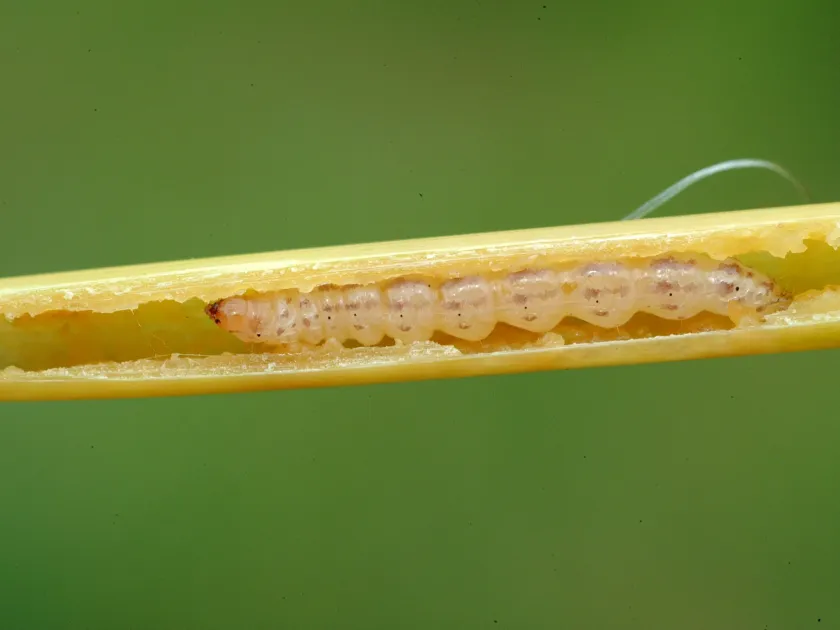
The larvae are cream-colored with brown spots on each body segment, which distinguishes them from related species found in the same geographical areas.
Pupae are found within the tunnels created inside the host plant's stalk. They are elongated and brown, designed to withstand the environment until the adult moth emerges.
These moths are nocturnal, actively flying at night to seek host plants for oviposition, displaying significant dispersal capabilities across agricultural landscapes.
What it damages
The primary host for Diatraea lineolata is maize (Zea mays), where the pest causes extensive damage to both subsistence and commercial crops.
In addition to corn, the larvae can infest sugarcane, sorghum, and several wild grasses, which often serve as alternative hosts between corn growing seasons.
Damage begins shortly after egg hatch, as young larvae feed on the leaf tissues, creating rows of holes that appear as the leaves unfurl.
As the larvae grow, they bore into the stalks, creating long tunnels. This internal feeding disrupts the plant's vascular system, hindering the transport of water and nutrients.
The structural damage to the stalks often leads to lodging, stunted growth, and a reduction in both the size and quality of the corn ears produced by the plant.
When it appears
The development cycle of Diatraea lineolata is heavily influenced by regional climate conditions, allowing for multiple generations per growing season.
Females lay eggs in clusters on the underside of leaves, covering them with a secretion that hardens to protect the developing embryos from predators and environmental stress.
Larval development typically spans three to four weeks, depending on ambient temperature and the availability of high-quality nutritional sources within the plant.
Peak infestation levels usually occur during the vegetative growth stages of corn, which is the period when the plant is most vulnerable to internal boring damage.
During the off-season, the insect survives primarily as diapausing larvae within the remnants of host plants, including crop stubble left in the field after harvest.
Signs of infestation
Early warning signs include the presence of transparent patches and perforations on the foliage, commonly referred to as "windowpane" damage.
The presence of frass (larval excrement) near the entry points on the stalk is a clear indicator that a larva has successfully bored into the plant tissue.
A severe symptom known as "dead heart" occurs when the central leaves of the plant wither and die due to the larva destroying the apical meristem.
Lodging or stems breaking at the lower nodes, particularly during windy conditions, is a late-stage symptom of internal structural damage caused by tunnel boring.
- Leaf perforation patterns.
- Accumulation of frass at leaf axils.
- Wilting of the central leaf whorl.
- Premature plant death.
Control measures
Effective management requires an integrated approach that targets multiple life stages of the pest to minimize field population density.
Cultural practices, such as deep plowing and the destruction of crop residues immediately after harvest, are essential to eliminate overwintering sites for the larvae.
The selection of corn hybrids with inherent resistance or transgenic traits (e.g., Bt corn) provides the most effective protection against stalk-boring damage.
Biological control methods, including the release of parasitoid wasps or the use of entomopathogenic fungi, can help suppress populations in sustainable farming systems.
Chemical control should be limited to instances where monitoring data indicates that the population exceeds the economic injury level, focusing on the timing of larval hatch.
Taxonomy
- Latin name
- Diatraea lineolata
- Order
- Lepidoptera (butterflies)
- Family
- Crambidae
- EPPO code
- DIATLI
Discussion
No discussions yet — be the first.