
Southwestern corn borer
Diatraea grandiosella
Description
How to identify
The Southwestern corn borer (Diatraea grandiosella) is a member of the Crambidae family. Adult moths have a wing span of 25–35 mm and are characterized by a pale yellow to straw-white coloration.
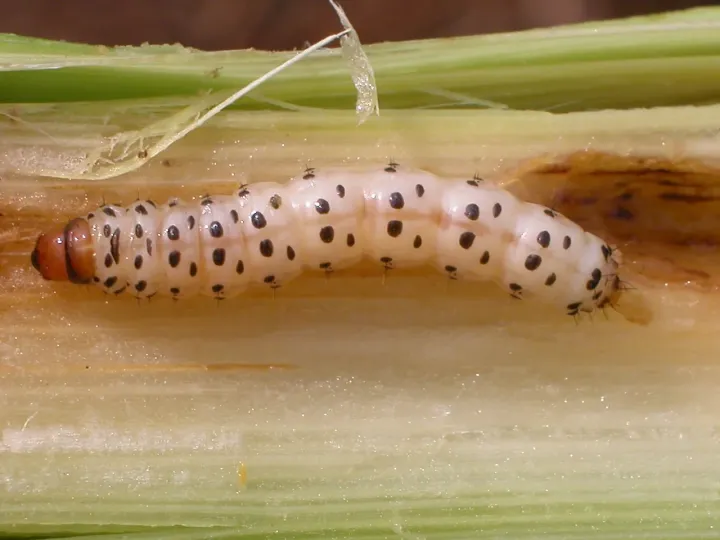
Larvae pass through several stages. Summer-generation larvae are white with distinct black spots on each body segment, making them easily identifiable in the field during the growing season.
Overwintering larvae differ significantly as they are completely white and lack the dark pigmentation found in summer generations. These larvae prepare a specific overwintering chamber in the corn stalk.
Pupae are brown and develop inside the corn stalk, protected from external environmental factors. The pupal stage duration is highly dependent on ambient temperatures.
As a highly specialized pest, it is predominantly found in the warmer regions of North America, where its population can thrive due to favorable environmental conditions and abundant host plants.
What it damages
The primary host plant for this species is corn (maize). While it can sporadically infest other grasses like sorghum, its economic impact is most severe in commercial corn production.
Young larvae feed on leaf surfaces, creating small feeding windows. As they grow, they bore into the stalk, causing significant physical damage to the plant's internal structure.
When larvae tunnel into the growing point or the "whorl" of the plant, it leads to a condition known as "dead heart," which stunts plant growth and significantly reduces yield potential.
The most severe damage occurs at the end of the season when larvae tunnel toward the base of the stalk. They construct a girdle, causing the stalk to weaken and lodge, leading to harvest losses.
Severe infestations can result in yield losses ranging from 20% to 50% due to grain weight reduction and the difficulty of mechanically harvesting lodged plants.
When it appears
The life cycle typically consists of two to three generations per year. The first-generation adults emerge in late spring to begin laying eggs on corn foliage.
Second and third generations develop mid-to-late season. This is when the pest is most damaging, as larvae infest the ear zone and lower stalk parts during critical development stages.
Overwintering occurs as full-grown larvae within the stalk base. They remain in diapause through the winter months and pupate in the following spring as temperatures rise.
Monitoring for adult flight via pheromone traps is essential for timing interventions. Predicting emergence based on degree-day models allows for precise application of control measures.
Temperature fluctuations significantly dictate the seasonal timing. Warmer summers promote higher reproductive rates, often leading to more intense infestations in subsequent years.
Signs of infestation
Early-season signs include "window-paning" on the leaves, where larvae consume the leaf tissue while leaving the thin upper epidermis intact, creating a translucent appearance.
A "dead heart" condition, where the central leaf of the whorl wilts and dies, indicates that larvae have bored into the growing point of the plant.
Presence of frass (larval waste) accumulating in leaf axils or near the base of the plant is a strong indicator of active tunneling within the stalk.
Lodging of the stalks at the end of the season, often occurring without significant storm activity, is a classic sign of internal girdling by overwintering larvae.
Splitting the stalks reveals distinct vertical tunnels. These tunnels, along with the presence of white or spotted larvae, confirm the diagnosis of a Southwestern corn borer infestation.
Control measures
Cultural practices include early planting to ensure plants pass the most vulnerable growth stages before high populations of moths emerge. Tillage helps destroy overwintering larvae.
Chemical control using insecticides is effective only during the short window before larvae penetrate the stalk. Once inside the tissue, they are protected from most surface-applied chemicals.
Biological control, such as releasing Trichogramma wasps, can significantly reduce the viability of egg masses, serving as an important part of an integrated pest management program.
The use of Bt-transgenic corn is the most effective management strategy. The toxin expressed by these hybrids kills larvae upon ingestion, providing season-long control.
Crop rotation is fundamental to breaking the pest cycle. By removing the corn host for a season, the local population of the borer is drastically reduced, mitigating risks for future crops.
Taxonomy
- Latin name
- Diatraea grandiosella
- Order
- Lepidoptera (butterflies)
- Family
- Crambidae
- EPPO code
- DIATGR
Discussion
No discussions yet — be the first.