
Busck's sugarcane borer
Diatraea busckella
Description
How to identify
Busck's sugarcane borer (Diatraea busckella) is a moth species belonging to the family Crambidae. It is recognized as a significant agricultural pest, specifically known for attacking graminaceous crops within its native range in the Neotropics.
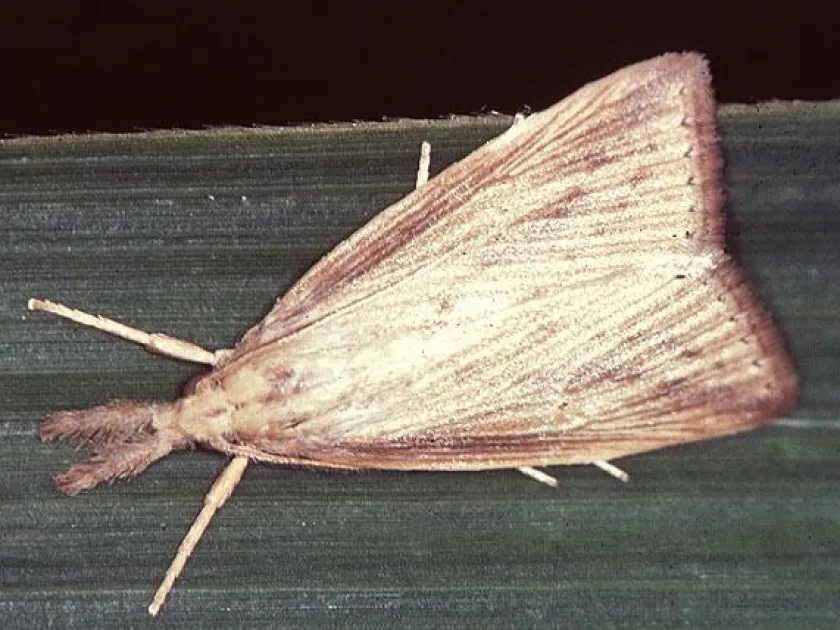
The adult moth is typical of the genus Diatraea, featuring wingspans usually ranging between 20 and 30 millimeters. Its forewings are characterized by pale, straw-colored to light brown markings, which act as effective camouflage against the dry foliage of host plants.
The larval stage is the most destructive phase of this insect's life cycle. The caterpillars are generally creamy-white with a series of distinct dark spots on their segments, which help distinguish them during field scouting.
The biological cycle of Diatraea busckella is highly dependent on ambient temperature and humidity. In favorable tropical climates, multiple generations can emerge per year, leading to overlapping life stages that complicate traditional pest management.
Understanding the specific environmental requirements of this species is essential for agronomists, as its population dynamics are closely linked to the seasonal phenology of the target crops, such as sugarcane and maize.
What it damages
Diatraea busckella primarily affects the stalks of cereal crops. Larvae burrow into the stems upon hatching, consuming the internal pith, which contains the essential vascular tissues responsible for nutrient and water transport.
Direct damage results in stunted growth and significantly reduced yields. In maize, the destruction of the apical meristem or internal stem tissues often leads to a failure in ear development and grain filling.
A critical impact of the infestation is the loss of structural integrity of the plant stalk. Heavily tunneled stalks become prone to lodging, causing the plants to fall over, which makes mechanized harvesting extremely difficult and results in high field losses.
The tunnels created by the larvae serve as entry points for various pathogens, including fungi that cause stalk and ear rots. These secondary infections often cause more severe grain quality degradation than the initial larval damage.
During periods of severe infestation, entire sections of a crop can be destroyed, leading to significant economic losses for farmers, particularly when the pest pressure is left unmonitored during the critical vegetative growth stages.
Signs of infestation
The presence of Diatraea busckella is often detected by small, circular exit or entrance holes on the outer surface of the stalk. These are frequently accompanied by frass (larval excrement) resembling sawdust.
One of the classic indicators of infestation is "dead heart," where the central leaf whorl of the plant withers and dies. This occurs when the larvae bore into the growing point of the plant, cutting off its vital development.
Field inspectors can identify the pest by splitting suspect stalks vertically. This reveals distinct longitudinal tunnels filled with larval frass, and often, the presence of the larvae or pupae within these hidden chambers.
Plants affected by the borer often exhibit visible developmental delays compared to healthy plants. They are typically shorter, have thinner stems, and display irregular leaf patterns or premature yellowing due to nutrient transport interruption.
Late-stage symptoms include the bending or snapping of stalks, especially during windstorms or as the weight of the developing ears increases, as the internal damage makes the plant unable to support its own biomass.
Control measures
Management of the Busck's sugarcane borer requires an Integrated Pest Management (IPM) approach. Cultural practices, such as the thorough destruction of crop residues immediately after harvest, are vital to eliminate overwintering sites for the larvae.
Crop rotation is an effective strategy to break the life cycle of the pest, preventing it from establishing a persistent population in fields that are planted with susceptible cereal crops year after year.
Biological control plays a significant role in managing this species. The introduction of egg parasitoids, such as Trichogramma wasps, has proven effective in suppressing populations by targeting the moth's egg clusters before they hatch.
Chemical control should be applied based on economic threshold levels rather than fixed schedules. Systemic insecticides are preferred to reach the larvae once they have moved into the stems, with applications timed to coincide with the most vulnerable stages of larval development.
- Use pheromone traps to monitor adult flight activity and time insecticide applications.
- Remove and destroy volunteer maize or wild grasses that act as alternative hosts.
- Select resistant or transgenic crop varieties if available for the specific region.
Taxonomy
- Latin name
- Diatraea busckella
- Order
- Lepidoptera (butterflies)
- Family
- Crambidae
- EPPO code
- DIATBB
Discussion
No discussions yet — be the first.