
Diactor bilineatus
Diactor bilineatus
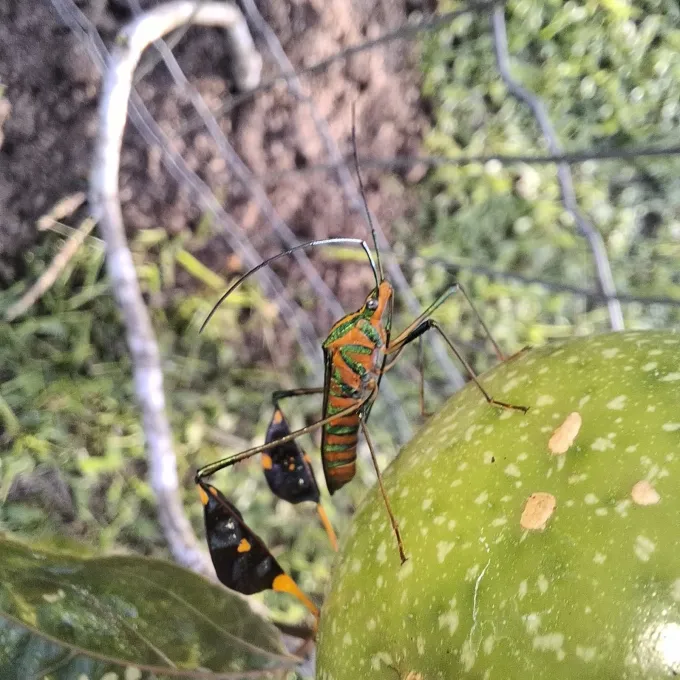
Description
How to identify
Diactor bilineatus, commonly known as the leaf-footed bug, belongs to the family Coreidae. It is a specialized pest of passion fruit plants (Passiflora species).
The adult insect is easily recognized by its elongated body, typically 20–25 mm in length, and the characteristic expansion of the hind tibiae, which resembles a leaf.
The body is brownish, featuring two prominent light-colored longitudinal stripes on the pronotum, which serves as a key diagnostic feature for species identification.
The insect undergoes incomplete metamorphosis: the nymph stages are wingless and smaller than adults but possess the same feeding apparatus, allowing them to cause damage early on.
Females lay eggs in clusters on the host plant, and the developmental speed is highly dependent on ambient tropical temperatures, leading to multiple generations per year.
What it damages
The primary host for Diactor bilineatus is the passion fruit (Passiflora edulis), where both adults and nymphs feed on the plant's sap.
The bugs prefer young, tender shoots, flower buds, and developing fruits, piercing the plant tissue with their specialized proboscis to suck out nutrients.
Damage to young fruit causes malformation, stunted growth, and premature fruit drop, which significantly reduces the harvest quality and quantity.
The piercing-sucking activity weakens the plant structure and provides an entry point for various secondary pathogens, such as fungi or bacteria.
Continuous feeding on vegetative parts can result in the necrosis of stems and leaves, ultimately affecting the overall vitality of the passion fruit plantation.
Signs of infestation
Early signs of infestation include the appearance of small dark lesions on young stems and leaf petioles where the bugs have fed.
The presence of nymph aggregations on the underside of leaves or on stems is a reliable indicator of active colonization within the plantation.
Observing misshapen or pitted fruit on the vine is a clear sign that Diactor bilineatus has reached a level of infestation requiring intervention.
Affected plants may exhibit wilting in the terminal shoots, often accompanied by chlorotic spots or tissue drying at the feeding sites.
Adult bugs are highly mobile; their sudden flight when approached is a common observation for growers walking through the vines.
Control measures
Effective management requires consistent monitoring of the plantation to identify the pest before it reaches critical population thresholds.
Manual removal of bugs during the early morning hours, when temperatures are lower and insects are less active, is a viable strategy for small-scale farms.
Biological control methods include the conservation of natural enemies, such as egg-parasitizing wasps that help naturally reduce the pest population.
When chemical control is necessary, selective insecticides should be applied to minimize the impact on essential pollinators like bees.
- Monitor fields regularly for egg clusters and nymphs.
- Remove wild Passiflora species near the plantation to eliminate reservoirs.
- Maintain plant health to improve tolerance against minor infestations.
- Apply targeted insecticides only when economic damage thresholds are exceeded.
Taxonomy
- Latin name
- Diactor bilineatus
- Order
- Hemiptera (bugs, aphids, leafhoppers)
- Family
- Coreidae
- EPPO code
- DACOBI
Discussion
No discussions yet — be the first.