
Clouded Buff
Diacrisia sannio
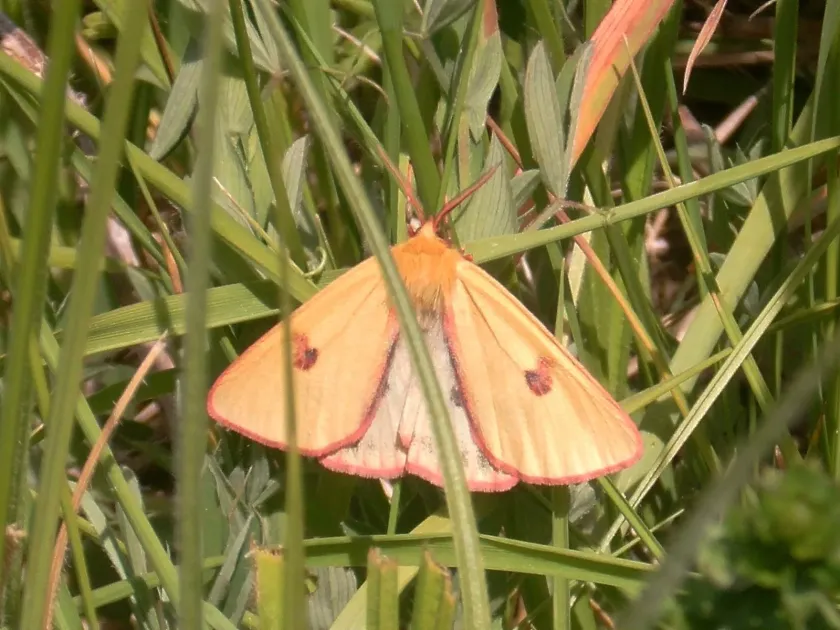
Description
How to identify
The Clouded Buff (Diacrisia sannio) is a moth species belonging to the Erebidae family and the Arctiinae subfamily, commonly known as tiger moths.
Adult moths are recognizable by their distinct coloration; males typically have yellowish forewings with a red border, while females are more orange-yellow with dark spots.
The wingspan of this species ranges from 40 to 50 mm, and their bodies are characterized by thick, hair-like scales, which is a hallmark of the Arctiinae subfamily.
Larvae (caterpillars) are covered in dense, long, and stiff hairs that form tufts, often brownish or greyish in appearance, which serve as a primary defense mechanism.
The pupal stage occurs inside a soft, silk-lined cocoon, which is constructed by the caterpillar using its own hair and fine silk strands for protection.
What it damages
This species is a generalist herbivore (polyphagous), capable of feeding on a wide variety of wild herbaceous plants and some agricultural crops.
Damage is primarily caused by caterpillars that graze on the leaf tissues, starting with small holes and progressing to total defoliation of the leaves.
Leguminous forage crops and various grassland plants are the most susceptible to infestation, particularly if they are adjacent to overgrown hedgerows or meadows.
High populations of caterpillars can significantly reduce the photosynthetic surface area, leading to stunted plant growth and decreased yield quality.
Economic damage occurs when caterpillars migrate in large numbers from natural habitats into cultivated fields, causing patchy destruction of crops.
When it appears
Adult Clouded Buff moths are nocturnal and are typically observed in flight from June through July, often being attracted to artificial light sources at night.
Female moths lay eggs in clusters on the undersides of leaves of host plants, ensuring that the emerging larvae have immediate access to food.
The larval stage develops during the summer months, feeding actively through late summer and early autumn before seeking a place to overwinter.
Diapause usually occurs during the larval stage, with the caterpillars hiding in the soil, leaf litter, or at the base of dense vegetation during the winter.
Pupation takes place in the spring of the following year, following the completion of the final larval instar, marking the beginning of a new generation.
Signs of infestation
Early signs of infestation include irregular holes in the leaf margins, which gradually expand into more substantial feeding damage across the plant.
The presence of hairy caterpillars, which curl into a tight ball when disturbed, is the most definitive indicator that the Clouded Buff is present.
Accumulations of frass (caterpillar excrement) on leaves or on the soil surface beneath the plants are common indicators of a thriving larval population.
Presence of fine webbing between stems or leaves, used for shelter or during the construction of the cocoon, points to the activity of this species.
Severe infestations are marked by a rapid decrease in the amount of healthy foliage, often accompanied by the visual presence of larvae feeding in the morning.
Control measures
Effective soil management, including late-season tilling and plowing, is the most successful method to disrupt the lifecycle of larvae overwintering in the soil.
Weed management around field margins is essential, as the moth often establishes its initial population on wild host plants before moving to cultivated crops.
Biological control agents, such as microbial insecticides based on Bacillus thuringiensis, are highly effective against younger larval stages while protecting pollinators.
Encouraging natural predators, including predatory wasps and insectivorous birds, plays a vital role in keeping the Clouded Buff population below economic thresholds.
Chemical intervention should be considered only as a last resort and must follow local regulations, targeting the areas of high infestation to minimize impact.
Taxonomy
- Latin name
- Diacrisia sannio
- Order
- Lepidoptera (butterflies)
- Family
- Erebidae
- EPPO code
- DIAISA
Discussion
No discussions yet — be the first.