
Clouded buff
Diacrisia
Description
How to identify
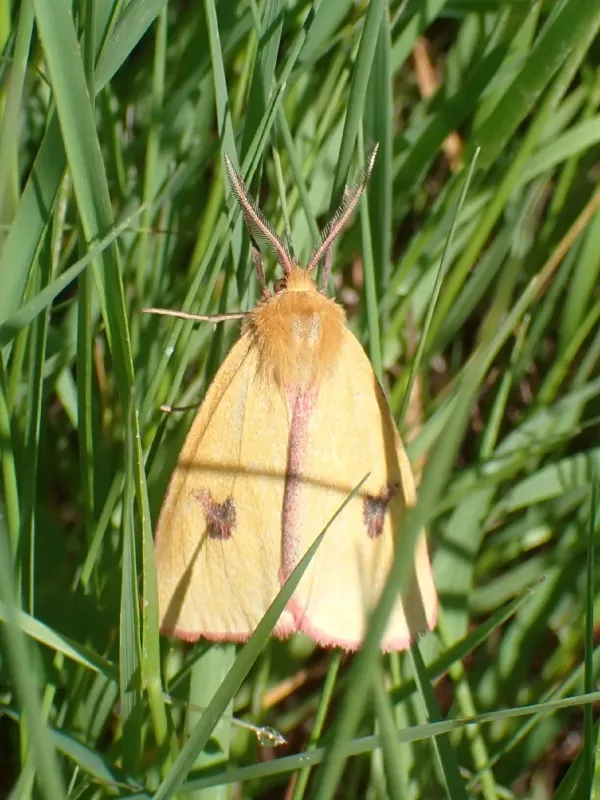
The Clouded buff (scientific name Diacrisia sannio) is a moth species belonging to the Erebidae family. It is known for its distinct visual appearance in the adult stage.
Male moths exhibit striking yellow wings with red or purple markings that form a cross-like shape. Females are generally more muted, often brown-yellow in color.
The larvae, or caterpillars, are covered in thick, dark hair. This dense hair helps protect them from predators and provides insulation during cooler periods.
Pupation occurs within a silken cocoon, which is reinforced with the caterpillar's own hairs for added protection against environmental factors.
The insect undergoes a complete metamorphosis, including egg, larval, pupal, and adult stages, with larvae being the primary stage responsible for plant damage.
What it damages
As a polyphagous insect, the Clouded buff larvae feed on a wide variety of plants. Their natural diet typically includes weeds such as plantain, dandelion, and sorrel.
In agricultural settings, these caterpillars may feed on young vegetables and leafy greens if these crops are planted in weed-infested areas.
The larvae consume leaves, which reduces the surface area available for photosynthesis, leading to weakened plant health and stunted growth.
Significant infestations can lead to complete defoliation, particularly in younger plants, which are less able to recover from leaf loss.
The damage is typically categorized as mechanical feeding, where the larvae bite holes or skeletalize the leaf tissue entirely.
When it appears
Adult moths are typically active during the late spring and early summer months, coinciding with the flowering of many host plants.
Larval development primarily takes place during the summer, where the caterpillars grow through several molts while feeding on available greenery.
The species overwinters in the larval stage, seeking refuge in leaf litter, debris, or the top layer of the soil during the winter months.
Activity resumes in early spring, as rising temperatures trigger the larvae to emerge and continue feeding until they are ready to pupate.
Typically, the Clouded buff has one generation per year, although environmental conditions can slightly influence the timing of their emergence.
Signs of infestation
The most evident sign of a Clouded buff infestation is the presence of irregular holes in the leaves of susceptible plants or surrounding weeds.
One can often spot the hairy, dark-colored caterpillars resting on stems or the undersides of leaves during the cooler parts of the day.
Frass (larval droppings) left on the leaf surfaces is a clear indication that caterpillars are feeding nearby and should be addressed.
Silken cocoons found near the base of plants or attached to foliage signify the transition to the pupal stage, indicating the end of the feeding cycle.
Visible damage to the plant's structure, including wilting or stunted growth caused by leaf depletion, is a common observation in severe cases.
Control measures
Effective weed management is the primary preventative measure, as keeping the area free of sorrel, plantain, and clover reduces the moth's breeding success.
Hand-picking caterpillars from garden plants is a simple and effective control method for small plots or hobby gardens.
Biological control agents, such as formulations containing Bacillus thuringiensis, can be used to specifically target larvae without harming non-target organisms.
Tilling the soil in late autumn helps disrupt overwintering sites, making it difficult for the larvae to survive the winter and reducing the population for the next spring.
Chemical control should be considered as a last resort, using products that are labeled for caterpillar management and are applied in accordance with local regulations.
Taxonomy
- Latin name
- Diacrisia
- Order
- Lepidoptera (butterflies)
- Family
- Erebidae
- EPPO code
- DIAISP
Discussion
No discussions yet — be the first.