
Dexia rustica
Dexia rustica
Description
How to identify
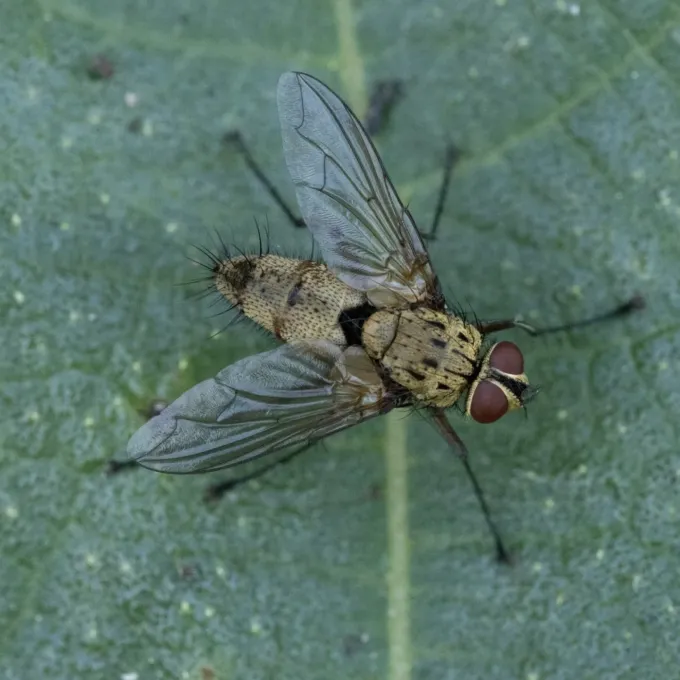
Dexia rustica is a species of parasitic fly belonging to the family Tachinidae, within the order Diptera. Adult flies are medium-sized and are characterized by a dense covering of hair on their bodies.
The morphology of these flies is typical for the Tachinidae family, including distinct bristles on the thorax and abdomen, which help in their classification among similar dipteran species.
Larvae of this species are legless, cylindrical, and white or cream-colored, perfectly adapted for their parasitic lifestyle inside the bodies of their hosts.
A key biological feature is their ovoviviparity, where eggs hatch inside the mother fly, allowing her to deposit live larvae directly near the target hosts in the soil.
Due to the cryptic nature of their larval stage, identification of Dexia rustica requires entomological expertise and examination of adult specimens.
What it damages
Dexia rustica is not a crop pest. It does not feed on plant tissues, roots, or fruits, and therefore causes no direct economic damage to agricultural production.
On the contrary, this species is highly beneficial to farmers as a natural parasitoid. Its larvae specialize in attacking the larvae of scarab beetles, commonly known as white grubs.
By preying on these soil-dwelling grubs, the fly plays a critical role in reducing the population of insects that feed on the root systems of grasses and vegetables.
The impact of this fly is strictly regulatory, helping maintain ecological balance in fields where scarab larvae might otherwise cause severe damage.
Farmers benefit from the presence of this fly as it provides a sustainable form of biological control, reducing the need for aggressive chemical soil treatments.
When it appears
Adult flies are typically observed during the warmer months, primarily in June and July, coinciding with the active period of their host larvae in the topsoil.
Females spend their time patrolling the soil surface or low vegetation, searching for chemical signals released by scarab larvae to locate their hosts.
The life cycle of the fly is closely synchronized with the phenology of scarab beetles, ensuring that larvae emerge when their hosts are most vulnerable.
Overwintering usually occurs in the larval stage, residing within the body of the host or within the soil, providing protection from harsh winter temperatures.
In temperate climates, the fly generally completes one generation per year, although minor variations may occur based on regional weather patterns.
Signs of infestation
There are no visible signs of plant damage caused by Dexia rustica. Instead, the presence of the fly is indicated by a reduction in soil pest populations.
During routine field inspections or soil sampling, one might encounter scarab grubs showing signs of parasitism, such as abnormal development or the presence of fly larvae inside them.
The activity of adult flies can be observed in gardens or fields where they feed on nectar from flowers, which provides the necessary energy for their search behavior.
A lack of sudden outbreaks of scarab beetles on a managed site often suggests that the population of natural enemies, such as Dexia rustica, is successfully keeping the pest numbers in check.
Detailed monitoring is usually restricted to research environments, using specialized traps to observe the adult flight activity during the peak summer season.
Control measures
Since Dexia rustica is a beneficial insect, no control or extermination measures are required; in fact, protection of this species is encouraged.
- Avoid excessive or unnecessary use of broad-spectrum insecticides that harm non-target beneficial insects.
- Maintain floral borders around crop fields to provide sugar sources for adult flies.
- Adopt sustainable soil management practices that minimize disturbance to the natural soil ecosystem.
- Use selective biological pesticides that do not interfere with the natural life cycle of parasitoid flies.
The best management strategy is to encourage a healthy biodiversity in the field, allowing natural enemies to fulfill their role in pest suppression.
Taxonomy
- Latin name
- Dexia rustica
- Order
- Diptera (flies)
- Family
- Tachinidae
- EPPO code
- DEXIRU
Discussion
No discussions yet — be the first.