
Pine tussock moth
Dasychira pinicola
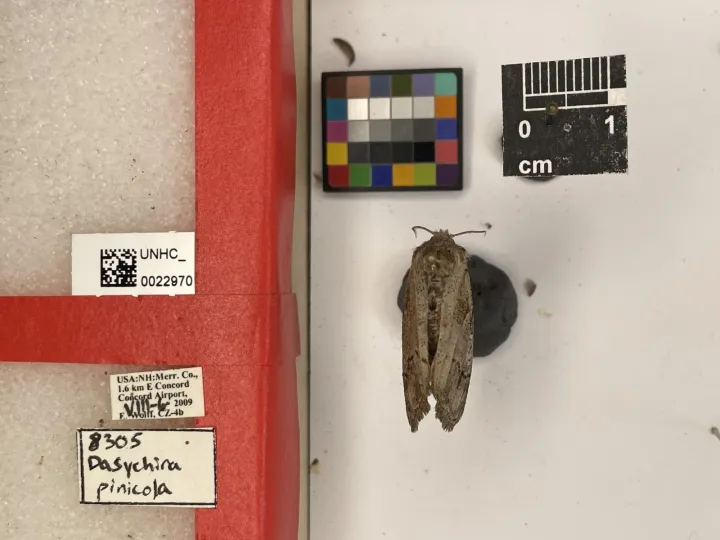
Description
How to identify
The pine tussock moth, known scientifically as Dasychira pinicola, is a member of the family Erebidae. Adult moths have a wingspan ranging from 45 to 60 mm, with wings typically displaying shades of grey and brown with zigzag markings.
The larvae, or caterpillars, are the most recognizable stage of this pest. They feature distinct tufts of hair along their backs, resembling brushes, which is a common characteristic of the Lymantriinae subfamily.
The life cycle of this species is univoltine, meaning there is one generation per year. During the winter, the moth survives as early-stage larvae, hiding within bark crevices or sheltered spots among pine needles to escape freezing temperatures.
In spring, as temperatures rise, the caterpillars emerge to begin their feeding cycle. They grow rapidly, passing through several larval stages before reaching the pupal stage during the summer months.
The adult moth life stage is relatively short, primarily dedicated to mating and egg-laying. Females lay their eggs in clusters, covering them with specialized abdominal scales for protection against predators and desiccation.
What it damages
This pest primarily infests pine species, though it can occasionally be found on spruce and other conifers. The damage is exclusively caused by the larvae, which are voracious eaters of needles.
During the early larval stages, the caterpillars cause minor damage by nibbling at the needle surfaces. However, as they mature, they consume whole needles, leading to severe defoliation of the canopy.
Widespread outbreaks of the pine tussock moth can result in the loss of nearly all foliage in a forest stand. This severe defoliation puts immense physiological stress on the host trees, weakening them significantly.
A weakened tree becomes an easy target for secondary pests, such as bark beetles and wood-boring insects, which can ultimately lead to the death of the tree.
Ecologically and economically, the damage leads to reduced timber growth, aesthetic degradation of forests, and increased susceptibility to wildfires due to the accumulation of dead, dry foliage and debris.
Signs of infestation
The most visible sign of infestation is the discoloration of the pine canopy, which turns a dull brown or reddish-orange color. This effect is often visible from a distance during heavy outbreaks.
Large amounts of larval droppings, appearing as small dark pellets, accumulate on the forest floor beneath infested trees. This is a reliable indicator of active larval feeding in the canopy above.
One can also observe remnants of needles that have been partially skeletonized, leaving only the tougher vascular tissues behind, which hang from the branches on silken threads.
During the pupal stage, silk cocoons can be found attached to the branches or hidden in the bark. These are typically camouflaged and require careful inspection to detect.
- Reddish-brown discoloration of the pine needles.
- Accumulation of larval frass (droppings) on the ground.
- Presence of silken threads and skeletonized foliage.
- Cocoons attached to branches or tree trunks.
Control measures
Biological control is the most recommended approach for managing large populations of the pine tussock moth. Applications of Bacillus thuringiensis (Bt) are highly effective and pose minimal risk to non-target organisms.
In cases where infestations threaten the survival of an entire stand, specific chemical insecticides may be used. These treatments must be applied during the early larval stage for maximum effectiveness.
Monitoring using pheromone traps is essential for early detection. By tracking the population density of adult moths, foresters can time their interventions to prevent major defoliation events.
Encouraging natural predators is a sustainable management strategy. Maintaining birdhouses for insectivorous birds and preserving habitats for predatory insects helps keep pest populations under natural regulation.
Good forest management practices, including thinning and the removal of severely weakened trees, help maintain stand vigor. A healthy forest is inherently more resilient to pests like the pine tussock moth.
Taxonomy
- Latin name
- Dasychira pinicola
- Order
- Lepidoptera (butterflies)
- Family
- Erebidae
- EPPO code
- DASCPI
Discussion
No discussions yet — be the first.