
Dasychira basiflava
Dasychira basiflava
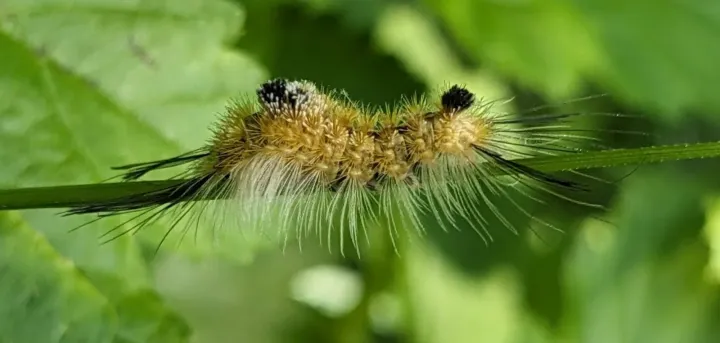
Description
How to identify
Dasychira basiflava is a member of the Erebidae family, specifically the Lymantriinae subfamily, commonly known as tussock moths. These insects are distinguished by the presence of dense tufts of hair on the bodies of their larvae.
The adult moth has a relatively cryptic appearance with mottled grey and yellowish-brown wings, allowing it to blend into the bark of host trees. Their wingspan is characteristic of medium-sized moths within the genus Dasychira.
The larvae are the most easily identifiable stage, featuring prominent tufts or "pencils" of hair, often accompanied by vibrant color patterns along the dorsal side. These hairs serve as a deterrent against predators and can cause skin irritation in humans.
Pupation occurs within silk cocoons, which the larvae construct in hidden areas, typically bark crevices or folded leaves. These cocoons are often reinforced with larval hairs, providing a sturdy protective casing for the developing pupa.
The sexual dimorphism in this species is marked by the difference in antennae structure: males possess feathery, bipectinate antennae used to detect female pheromones across long distances, while females have more filiform structures.
What it damages
The larvae of Dasychira basiflava are primary defoliators of broadleaf trees. Their preferred hosts include oak, birch, and other deciduous species that dominate temperate forests and landscape plantings.
Feeding damage begins as small holes in the leaf surface, which expand rapidly as the larvae grow. In high-density populations, the insects can consume entire leaf blades, leaving only the midribs and veins behind, causing severe defoliation.
This loss of foliage significantly reduces the tree's photosynthetic capacity. As a result, the tree experiences reduced annual growth, weakened vigor, and compromised ability to store energy reserves for the following season.
Prolonged or repeated outbreaks can lead to branch dieback or, in the case of young trees, total mortality. The stressed tree becomes a magnet for secondary infestation by wood-boring insects, further exacerbating the damage.
In nursery settings, damage to the canopy destroys the aesthetic and economic value of the stock. Early detection is vital to prevent the larvae from causing irreversible structural damage to the host plants.
When it appears
Adult moths are typically active during the summer months, with flight periods peaking in mid-summer. Monitoring for adults using light traps helps determine the timing of the next larval generation.
After mating, females lay eggs in clusters, usually on the bark of host trees. The timing of egg hatch depends heavily on the ambient temperature and the phenology of the host plant species.
Larvae develop throughout the summer and early autumn. In many regions, the species overwinter as partially grown larvae or pupae, hiding in protected niches until the return of warmer spring weather.
Weather conditions like late frosts or heavy rainfall can affect larval survival rates. Outbreaks often correlate with warm, dry summers that allow for accelerated life cycles and high survival rates of early-instar larvae.
Understanding the synchronization between the moth's life cycle and the host plant's growth stage is crucial for timing insecticide applications effectively, targeting the most vulnerable larval stages.
Signs of infestation
The most immediate sign of an infestation is the presence of frass (larval droppings) on the leaves and ground beneath the canopy. Even before seeing the caterpillars, the accumulation of frass indicates active feeding.
Visual identification of the larvae is common, as they often rest in exposed positions on branches or twigs. Their tufted hair makes them look like small, fuzzy brushes, which is a classic indicator of a tussock moth presence.
Skeletonized leaves are a secondary sign, occurring when larvae consume the interveinal tissue. If the canopy appears thinner or prematurely discolored in late summer, it is a strong indicator of heavy grazing.
The presence of silken cocoons in branch crotches or under bark flakes confirms that the population has completed a development cycle. These should be monitored to predict future generations in the same area.
Finally, adult moths fluttering around lights near infested areas in the evening provide evidence of a breeding population, suggesting the need for more intensive monitoring of the foliage in the surrounding trees.
Control measures
Biological control using Bacillus thuringiensis (Bt) is one of the most effective and environmentally friendly methods. These microbial insecticides are highly selective, targeting only Lepidopteran larvae while sparing beneficial predatory insects.
Chemical control involving contact-action insecticides may be necessary during severe outbreaks where defoliation threatens the survival of the trees. It is essential to apply these during the early larval stages for maximum efficacy.
- Mechanical removal of egg clusters and larvae;
- Installation of sticky or barrier bands on tree trunks;
- Enhancement of bird habitats to encourage natural predation;
- Monitoring with pheromone-baited traps to track population density;
- Ensuring proper tree health through irrigation and appropriate fertilization.
Silvicultural practices, such as thinning infested stands or maintaining a mix of tree species, help to increase the resilience of the forest ecosystem. A diverse forest is less susceptible to massive pest outbreaks.
Always ensure that applications of control products are performed at appropriate times, avoiding peak pollinator activity to maintain biodiversity. Regular follow-up inspections are necessary to ensure the population remains below the economic damage threshold.
Taxonomy
- Latin name
- Dasychira basiflava
- Order
- Lepidoptera (butterflies)
- Family
- Erebidae
- EPPO code
- DASCBA
Discussion
No discussions yet — be the first.