
Dacus xanthopterus
Dacus xanthopterus
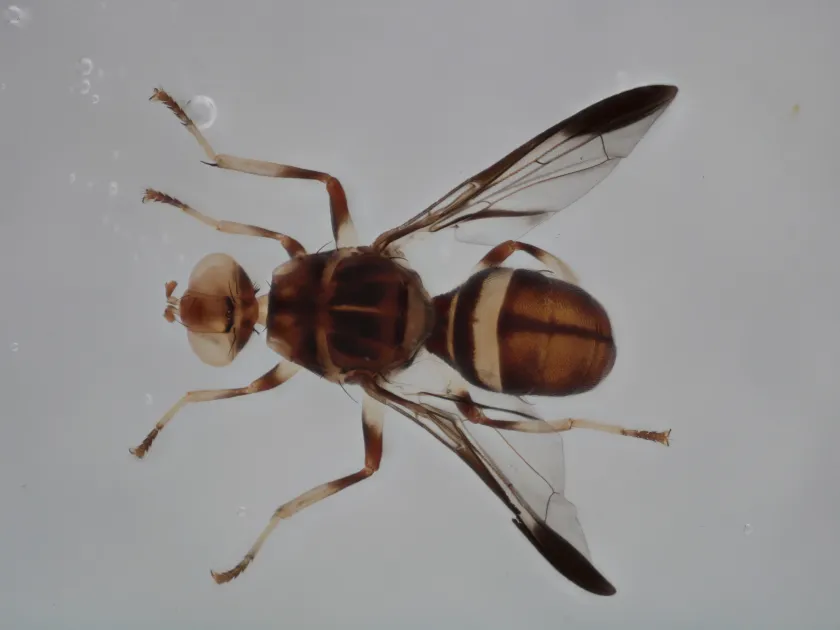
Description
How to identify
Dacus xanthopterus is a member of the Tephritidae family, commonly known as fruit flies. These insects are distinguished by their specific wing patterns and yellowish tinges, which are characteristic of this species within the order Diptera.
Adult flies are highly mobile and possess keen sensory capabilities, which they use to locate suitable host plants during the fruiting stage. The body coloration typically ranges from brown to yellowish-brown, aiding in camouflage among leaves and stems.
The life cycle consists of four distinct stages: egg, larva, pupa, and adult. The larval stage is the most destructive to agricultural production, as it develops inside the fruit, shielded from the external environment and predators.
Overwintering usually takes place in the pupal stage, buried in the soil or within plant debris. This survival strategy allows the species to endure unfavorable winter temperatures and emerge as adults in the spring when host plants become available.
Proper identification in the field is complex and often requires technical knowledge. Growers are encouraged to use pheromone traps to monitor adult flight patterns rather than relying on visual identification alone.
What it damages
The primary hosts for Dacus xanthopterus are plants belonging to the Cucurbitaceae family. This includes various commercially significant crops such as cucumbers, melons, watermelons, and squash.
The damage is caused primarily by the larvae, which tunnel through the fruit flesh to feed. This feeding behavior destroys the interior of the fruit, making it unmarketable and susceptible to structural collapse.
Because the larvae develop internally, the damage is often hidden until the final stages of the infestation. Farmers may notice signs of rotting or deformity only when the fruit is already severely compromised.
Furthermore, larval feeding facilitates the entry of secondary pathogens, including bacteria and fungi, which cause rapid decay. Even minor infestations can lead to total crop loss if the fruit begins to rot prematurely.
High population densities can cause significant yield losses, potentially destroying a large percentage of the harvest in affected areas, which represents a major economic risk for vegetable growers.
Signs of infestation
Early signs of infestation include small, subtle puncture marks on the skin of the fruit, created by the female during oviposition. These points may show localized darkening or a small secretion of sap.
Deformation is a common symptom; infested fruits often grow in irregular shapes or develop bumpy, uneven surfaces. Growth can also be stunted, leading to undersized fruit that fails to reach maturity.
Upon cutting open a suspect fruit, one can observe larval tunnels filled with excrement and decaying tissue. The larvae themselves, which are small and whitish-yellow, may be found inside the softening flesh.
The presence of adults can be detected using sticky or pheromone-based monitoring traps placed near the crops. A sudden increase in premature fruit drop is another strong indicator of an active pest population.
In the final stages, the affected fruit becomes extremely soft and may collapse under its own weight. The interior may turn into a liquid, necrotic mass, which serves as a breeding ground for future generations of the pest.
Control measures
Cultural control is the cornerstone of management. Deep plowing of the soil after harvest is highly effective, as it exposes pupae to harsh weather conditions and natural predators, significantly reducing the survival rate.
Sanitation is equally critical; all infested fruit and crop residues must be collected and destroyed immediately. Leaving such material in the field provides a perfect environment for the life cycle to continue.
Pheromone traps serve as an effective tool for both population monitoring and mass trapping of males. By reducing the number of fertile males, the overall reproductive success of the population is lowered.
Chemical control should be implemented judiciously, targeting the adult stage before eggs are deposited. It is essential to follow local regulations regarding pesticide use and ensure that pre-harvest intervals are respected.
In greenhouse settings, physical barriers such as fine-mesh screens on vents and doors are highly effective. Combined with regular field scouting, these integrated management strategies minimize reliance on broad-spectrum insecticides.
Taxonomy
- Latin name
- Dacus xanthopterus
- Order
- Diptera (flies)
- Family
- Tephritidae
- EPPO code
- DACUXA
Discussion
No discussions yet — be the first.