
Dacus venetatus fruit fly
Dacus venetatus
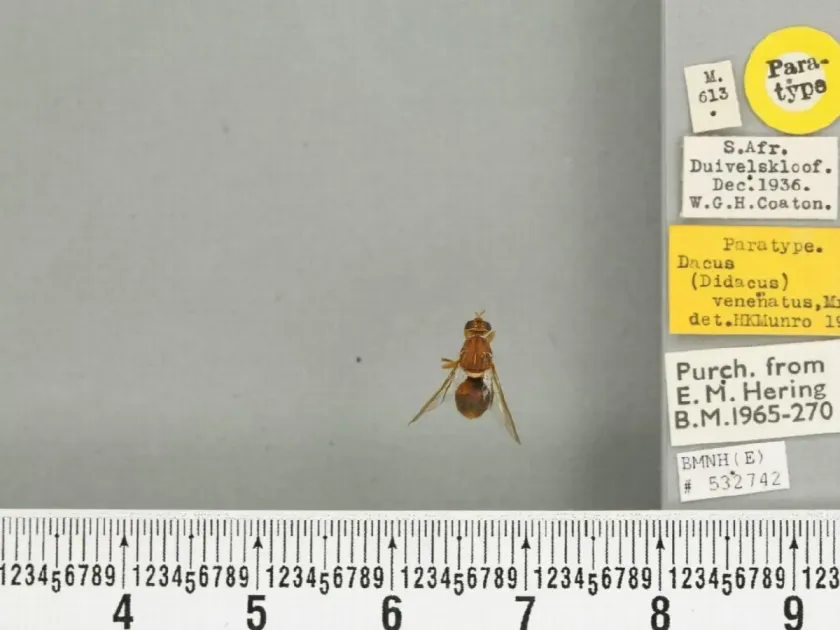
Description
How to identify
Dacus venetatus is a fruit fly belonging to the Tephritidae family, order Diptera. This species is known for its ability to infest fruit crops, making it a target for agricultural monitoring.
Adults possess specialized sensory organs and typical wing patterns that characterize this family. They are highly active during warm periods, seeking host fruits to deposit their eggs.
The life cycle encompasses four developmental stages: egg, larva, pupa, and adult. The female is equipped with an ovipositor, allowing her to penetrate fruit skin effectively.
Larvae are apodous and cylindrical, with a creamy-white color. They spend their entire developmental period inside the host fruit, feeding on the fleshy tissues.
Effective management requires precise identification, often involving traps and seasonal surveillance to differentiate this species from other local tephritids.
What it damages
The primary economic damage is caused by the larvae, which tunnel through the fruit pulp. This feeding behavior leads to the structural decay of the infested fruit.
Damage often manifests as softening and discoloration. Infested fruits rarely reach maturity and often drop prematurely from the tree, resulting in significant yield loss.
In addition to larval feeding, the punctures caused by the female's ovipositor serve as entry points for secondary pathogens, such as fungi and bacteria, causing rapid rot.
Marketability is severely compromised, as infested fruit cannot be stored, transported, or sold in fresh produce markets, leading to total harvest rejection in severe cases.
- Premature fruit abscission.
- Structural decay of fruit pulp.
- Secondary bacterial and fungal infections.
- Complete loss of post-harvest shelf life.
- Reduced overall crop marketability.
When it appears
Adult fly activity typically begins with the onset of warm spring weather. The species thrives in environments where temperatures allow for rapid developmental rates.
The peak infestation period correlates with the ripening stages of host fruits. This is when the host is most vulnerable to egg-laying by adult females.
Depending on local climatic conditions, multiple generations can occur within a single growing season, significantly increasing the population pressure on crops.
Pupation frequently occurs in the soil beneath the host plant, where pupae remain protected during adverse conditions or throughout the winter season.
Monitoring using pheromone-baited traps should start well before the first fruits reach the susceptible stage to intercept the early generation adults.
Signs of infestation
Visible signs of infestation begin with minute oviposition stings on the skin of the fruit, which may be accompanied by minor localized tissue changes or discoloration.
Another indicator is the irregular or patchy ripening of fruit, where infected areas soften while the rest of the fruit appears to be developing normally.
A sudden increase in fruit drop is a classic symptom. Even fruits that look healthy externally often contain larvae upon closer inspection or sectioning.
Internal tissue breakdown is evident when fruit is cut open; larvae are typically found surrounded by tunnel systems and necrotic, fermented plant material.
Infested areas may emit a fermentation odor, which is often a secondary result of the tissue decay and microbial activity triggered by the initial infestation.
Control measures
Sanitation is a cornerstone of management: collecting and destroying fallen fruit is critical to prevent larvae from completing their life cycle in the soil.
The use of attract-and-kill traps or pheromone-based monitoring systems helps manage adult populations while minimizing the need for broad-spectrum insecticide sprays.
Chemical control, if necessary, should be applied during the window of highest adult activity, ensuring that insecticides are chosen to comply with pre-harvest intervals.
Soil cultivation in orchards during the dormant season can disrupt the pupation sites in the ground, significantly reducing the survival rate of the overwintering generation.
Integrated Pest Management (IPM) strategies, incorporating biological controls and cultural practices, provide the most sustainable approach to long-term control.
Taxonomy
- Latin name
- Dacus venetatus
- Order
- Diptera (flies)
- Family
- Tephritidae
- EPPO code
- DACUVE
Discussion
No discussions yet — be the first.