
Telfairia fruit fly
Dacus telfaireae
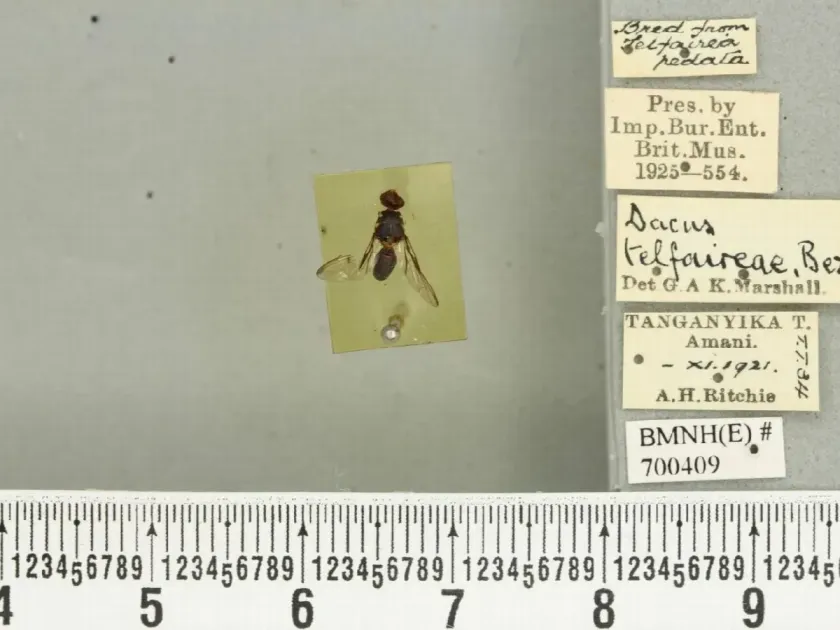
Description
How to identify
The Telfairia fruit fly belongs to the order Diptera and the family Tephritidae. It is a specialized pest closely related to other species within the Dacus genus.
The adult fly has a slender body with well-developed wings, often featuring characteristic markings that are essential for accurate species identification in a laboratory setting.
Larvae resemble typical tephritid maggots: legless, white to yellowish in color, and tapering towards the head, specifically adapted for feeding inside fruit tissues.
The life cycle is tightly synchronized with the environmental conditions of tropical regions where its host plants, primarily Telfairia species, are cultivated.
Field identification is difficult due to the morphological similarity with other Dacus species, often necessitating microscopic or genetic analysis for confirmation.
What it damages
The primary hosts for this fruit fly are members of the Cucurbitaceae family, specifically the genus Telfairia, including the fluted pumpkin (Telfairia occidentalis).
Larvae burrow into developing fruits to feed on the flesh and seeds, which leads to total destruction of the fruit's market value and quality.
Feeding damage creates entry points for secondary pathogens, such as bacteria and fungi, which accelerate the decomposition of the fruit.
In infested regions, this pest can cause significant yield losses, potentially destroying a large proportion of the harvest if left unmanaged.
The pest may also utilize wild cucurbits as reservoirs, making it difficult to eradicate completely from commercial agricultural environments.
Signs of infestation
The first sign of infestation is the presence of tiny punctures on the fruit surface, which are caused by the female fly depositing eggs beneath the skin.
Browning of the skin around these puncture marks is common, often accompanied by sap oozing and a distinct smell of decay as the rot progresses.
Internal examination of infested fruit reveals extensive tunnels created by larvae, along with the presence of multiple maggots feeding within the fruit pulp.
Affected fruits often show premature yellowing or abnormal deformations, which are easily visible to scouts walking through the crop rows.
In advanced stages, the fruit turns into a pulpy, rotten mass, rendering it completely useless for consumption or sale, resulting in severe crop failure.
Control measures
The primary control strategy involves strict sanitation, such as the frequent collection and deep burial or destruction of all fallen and damaged fruit to kill larvae.
The use of traps baited with male-specific attractants is highly effective for both monitoring the presence of the fly and reducing adult population levels.
Bagging young fruits with paper or fine mesh covers provides a physical barrier, effectively preventing females from accessing the fruit to lay their eggs.
Chemical control should be applied judiciously, targeting the adult stage during periods of peak activity, and only when the pest population exceeds economic thresholds.
Crop rotation and maintaining field borders free of wild cucurbit species are essential long-term strategies to minimize the presence and impact of this pest.
Taxonomy
- Latin name
- Dacus telfaireae
- Order
- Diptera (flies)
- Family
- Tephritidae
- EPPO code
- DACUTE
Discussion
No discussions yet — be the first.