
Dacus sphaeristicus
Dacus sphaeristicus
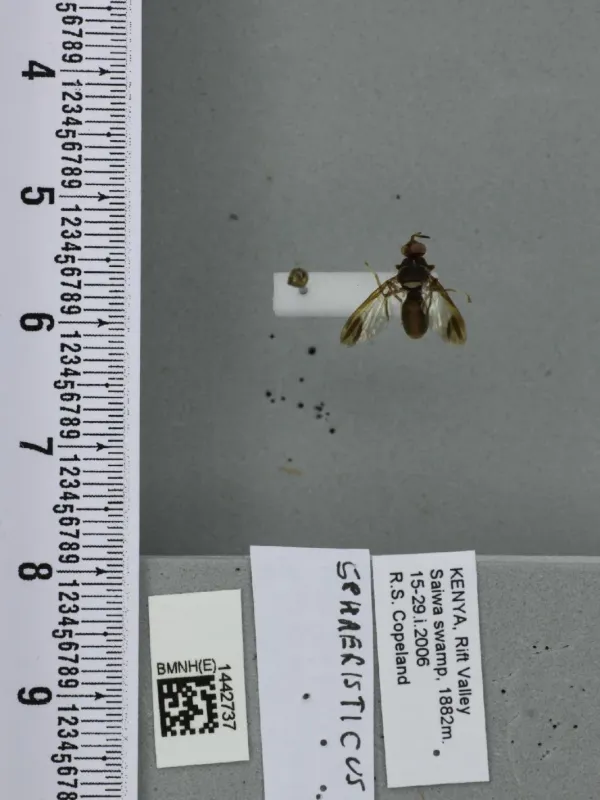
Description
How to identify
Dacus sphaeristicus is a member of the Tephritidae family, also known as fruit flies. These insects are significant agricultural pests known for their ability to infest various fruit-bearing plants in tropical and subtropical regions.
Adult flies possess wings with distinct patterns and coloration, which is a key diagnostic feature. Their body structure is adapted for agile flight, allowing them to navigate efficiently within tree canopies to locate suitable fruit for oviposition.
The larvae are typical of the family, appearing as cream-colored, legless maggots. They are the stage responsible for the primary damage to crops, as they feed on the internal tissues of the fruits throughout their development.
The life cycle encompasses four stages: egg, larva, pupa, and adult. Pupation typically occurs within the soil, though some individuals may pupate inside infested fruits or dried tissues, depending on environmental conditions.
Entomologists distinguish Dacus sphaeristicus from other fruit fly species by examining wing venation patterns and specific male genitalia characteristics, which are critical for accurate monitoring in agricultural settings.
What it damages
The damage caused by this pest is primarily internal. Larvae tunnel through the fruit pulp, breaking down cell walls and causing the fruit to soften rapidly, rot, and fall prematurely.
The initial entry points created by female flies during egg-laying become susceptible sites for secondary pathogens, including bacteria and fungi, which accelerate the decomposition process and destroy the entire fruit.
Economically, Dacus sphaeristicus causes severe losses by reducing both the quantity and quality of marketable produce. Infested fruits are often deemed unsuitable for consumption or international export.
In cases of high infestation rates, entire harvests can be compromised within a few weeks. The pest's ability to remain hidden inside the fruit makes it particularly difficult to manage during the harvest and packing stages.
The damage is not just limited to the fruit itself; weakened trees may also experience reduced vigor, making them more susceptible to other abiotic stresses or pests.
When it appears
Dacus sphaeristicus activity is highly temperature-dependent. Warm conditions, typically above 20°C, trigger the emergence of adults and the start of the breeding season, coinciding with fruit development.
Multiple generations can occur within a single growing season if environmental conditions remain favorable, such as consistent warmth and humidity, leading to exponential population growth.
The peak activity period usually occurs during the ripening phase of host fruits. Adults are most active during early morning and late afternoon hours, seeking shelter during the intense heat of midday.
Overwintering usually takes place in the pupal stage, buried deep within the soil beneath the host plant, where they remain dormant until the following spring or the onset of rainy seasons.
Monitoring programs use temperature data and climate modeling to predict the likely onset of pest activity, allowing farmers to implement protective measures before the infestation becomes widespread.
Signs of infestation
The most visible sign of infestation is the presence of small puncture marks on the fruit skin, often surrounded by a dark discoloration or a small droplet of sap exuded from the site.
Internal symptoms include localized softening of the fruit flesh. When such fruits are sliced open, the larvae are often found feeding on the tissue, accompanied by dark tunnels and rot.
Premature ripening or change in fruit color is another common indicator. Fruits that appear mature but feel soft or exhibit abnormal shape are likely infested with larvae.
The presence of fallen fruit on the ground, especially when it is still unripe, is a major red flag that warrants immediate inspection of the canopy for signs of Dacus sphaeristicus.
Monitoring traps containing specific attractants or food-based lures are the most effective method for detecting the presence of adults before significant damage to the crop occurs.
Control measures
Effective management begins with strict orchard sanitation. Collecting and destroying fallen or damaged fruits prevents larvae from pupating in the soil and reduces the population for the next generation.
Chemical control involving systemic or contact insecticides is often used, but it must be synchronized with the life cycle of the pest and strictly follow pre-harvest intervals to ensure safety.
Biological control, including the release of specific parasitoid wasps that target the larvae, can be an integral component of an environmentally friendly integrated pest management (IPM) strategy.
Mass trapping using pheromone-baited traps or bait stations is highly successful in monitoring and suppressing male populations, thereby disrupting the mating cycle.
- Tilling the soil around trees to expose and kill pupae.
- Using protective mesh or bagging individual fruits on high-value trees.
- Implementing quarantine restrictions to prevent movement of infested produce.
- Applying balanced fertilizers to promote tree health and resistance.
Taxonomy
- Latin name
- Dacus sphaeristicus
- Order
- Diptera (flies)
- Family
- Tephritidae
- EPPO code
- DACUSH
Discussion
No discussions yet — be the first.