
Dacus longistylus
Dacus longistylus
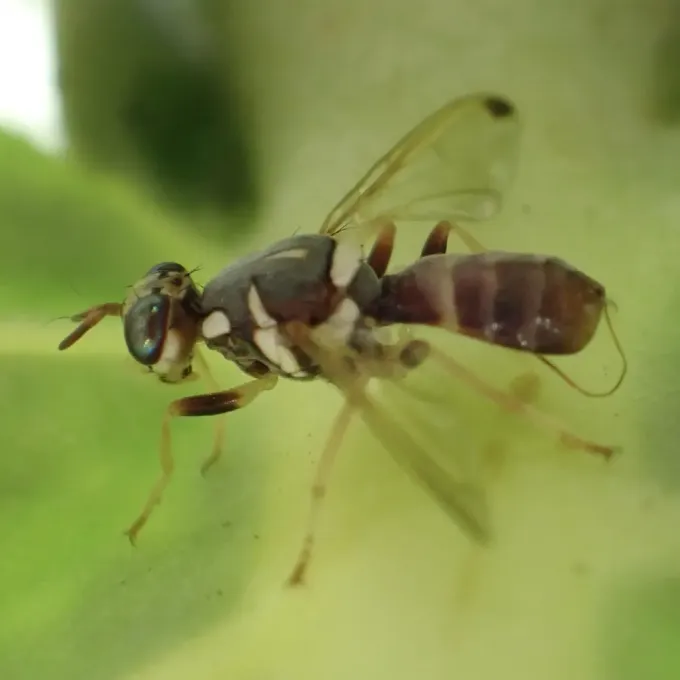
Description
How to identify
Dacus longistylus is a species of fruit fly belonging to the family Tephritidae (order Diptera). It is well-known for its high degree of specialization regarding host plants.
The adult fly exhibits typical tephritid morphology, characterized by patterned wings and a robust body. Females possess a long ovipositor, which is an essential adaptation for penetrating the tough rind of its host fruits.
The larval stage is typical for fruit flies: vermiform, legless, and creamy-white. They are specifically adapted to feed on the interior tissues and seeds of their host.
Accurate identification of this species often requires careful examination of the wing venation patterns and the morphology of the male and female terminalia.
These flies are generally found in tropical and subtropical regions where their host plants thrive, often causing significant localized damage.
What it damages
The primary host plant for Dacus longistylus is Calotropis procera. The larvae bore into the fruit, consuming the interior seeds and pulp.
This feeding behavior causes the fruit to rot prematurely and drop from the plant, which prevents the successful dispersal of the host plant's seeds.
In areas where Calotropis is cultivated for its medicinal properties or as a source of fiber, Dacus longistylus can reduce harvest yields to near zero.
Secondary infections often follow larval boring, turning the fruit into a decaying mass, which is entirely unsuitable for any economic or industrial use.
The economic damage is particularly severe because the larvae are protected inside the fruit, making them largely inaccessible to standard chemical treatments.
When it appears
The life cycle of Dacus longistylus is closely synchronized with the phenology of the host plant, specifically the fruit-bearing season of Calotropis.
Adult flies are most active during warm and humid conditions, which favor rapid development of eggs and larvae within the fruit tissues.
The fly's activity peaks during the daylight hours when females actively search for suitable fruits to lay their eggs, using their sensitive ovipositors.
Multiple generations can occur within a single year if the host plant provides a continuous supply of ripening fruits throughout the season.
Pupation typically occurs in the soil beneath the host plant, where the puparia remain until environmental conditions trigger the emergence of the next generation.
Signs of infestation
The earliest symptom of infestation is the presence of tiny, pin-prick marks on the surface of the fruit caused by the female's ovipositor.
In many cases, these punctures exhibit minor discoloration or exudation of sap, which are reactions of the plant tissue to the intrusion.
As larvae develop inside, the fruit often shows abnormal bulging or deformation, indicating internal structural damage caused by feeding.
A sure sign of advanced infestation is the decay of the fruit interior and the eventual presence of exit holes, created when larvae emerge to pupate in the soil.
Upon opening a suspect fruit, one will find the internal contents consumed and infested with whitish larvae along with accumulated frass.
Control measures
Management of Dacus longistylus relies heavily on integrated pest management (IPM) practices, emphasizing prevention and early detection.
Sanitation is a critical control measure: gathering and destroying all fallen and infested fruits prevents larvae from pupating in the soil and reduces future population numbers.
Monitoring using pheromone-baited traps allows growers to track the population density of adult flies and time their control measures more effectively.
Chemical control is generally difficult due to the larvae's protected environment, so insecticides are typically limited to targeting adult flies.
- Regular monitoring with attractant traps.
- Sanitation: immediate removal and burial of infested fruits.
- Encouraging natural predators and parasitoids in the ecosystem.
Taxonomy
- Latin name
- Dacus longistylus
- Order
- Diptera (flies)
- Family
- Tephritidae
- EPPO code
- DACULO
Discussion
No discussions yet — be the first.