
Dacus hyalobasis
Dacus hyalobasis
Description
How to identify
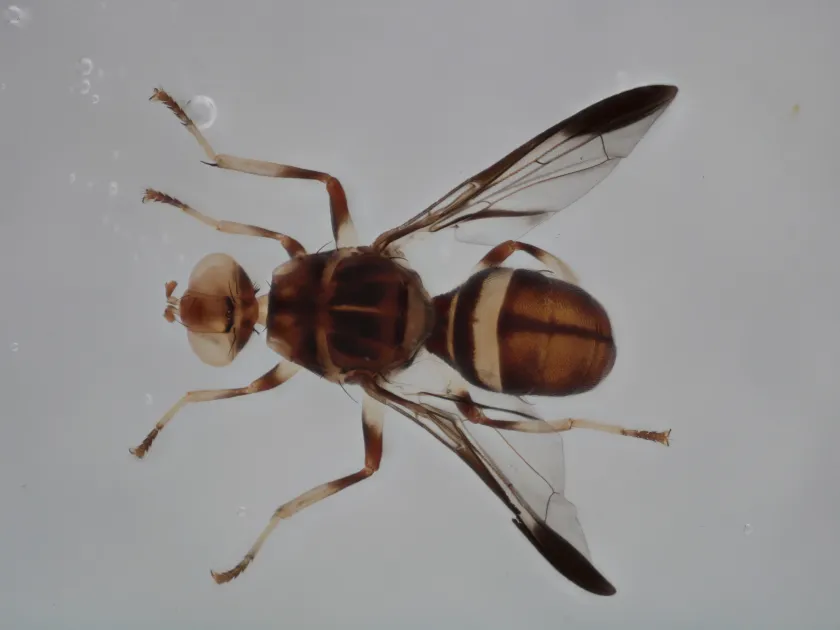
Dacus hyalobasis belongs to the family Tephritidae, order Diptera. This insect resembles a small fly, with coloration that allows it to effectively camouflage itself on host plants.
Adults have transparent wings with dark markings, which is reflected in their Latin name. The body of the imago typically displays yellowish-brown or dark shades common to many fruit flies in the genus Dacus.
The life cycle of the pest is closely linked to the development of host plant fruits. Development includes the stages of egg, larva, puparium, and adult, which occur primarily within the plant tissues.
Distinguishing this species from closely related fruit flies requires examining wing venation and specific bristles on the head and thorax, which necessitates the use of a microscope for accurate diagnosis.
Larvae typically have a cylindrical shape characteristic of tephritid flies, without a distinct head capsule, and undergo three larval instars inside the fruit.
What it damages
The main crops damaged by this species are members of the family Cucurbitaceae. Cucumbers, zucchinis, pumpkins, and various types of melons are the primary targets.
The insect can also be found on wild members of this family, which serve as population reservoirs during the off-season or in the absence of cultivated fields.
Damage is caused by larvae that penetrate inside the ovaries and young fruits immediately after hatching from eggs laid by the female under the fruit skin.
Damage to the fruit tissues leads to the disruption of normal development of the vegetable crop, resulting in growth stunting or fruit deformation during ripening.
Severe infestations can lead to the loss of a significant portion of the commercial yield both in open fields and in greenhouse conditions.
Signs of infestation
The first visual sign of infestation is the presence of small punctures on the surface of young ovaries, caused by the female's ovipositor during egg-laying.
Areas around the punctures often show tissue darkening, sometimes accompanied by sap exudation, which indicates the beginning of decay inside the fruit.
Cutting open an infested fruit reveals larval galleries filled with excrement, leading to softening of the flesh and the appearance of a specific unpleasant odor.
Premature yellowing and dropping of ovaries may also indicate the presence of hidden larvae within the plant tissues.
Secondary infections of bacterial or fungal origin often accompany the damage caused by this pest, accelerating the destruction of the fruits.
Control measures
Effective protection begins with agronomic practices, including the timely removal and destruction of all crop residues and damaged fruits.
Deep autumn plowing of the soil significantly reduces the population of overwintering pupae, which pupate in the top layer of soil after the larvae emerge from the fruits.
The use of pheromone or sticky traps helps to timely detect the presence of the pest and assess the adult population to make decisions regarding insecticide treatments.
In cases of massive outbreaks, insecticide treatments are recommended during the period of active adult flight, taking into account pre-harvest intervals.
Biological control methods involve the use of entomophages, such as parasitic Hymenoptera, which are capable of infecting larvae and pupae of the pest under natural conditions.
Taxonomy
- Latin name
- Dacus hyalobasis
- Order
- Diptera (flies)
- Family
- Tephritidae
- EPPO code
- DACUHL
Discussion
No discussions yet — be the first.