
Humeral fruit fly
Dacus humeralis
Description
How to identify
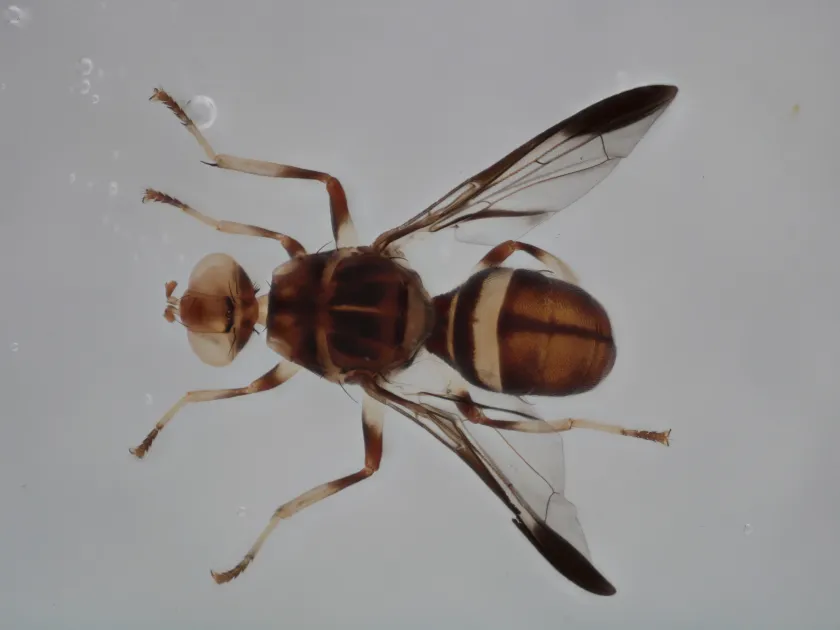
The humeral fruit fly (Dacus humeralis) belongs to the family Tephritidae, order Diptera. This insect is similar in appearance to typical fruit flies, characterized by a specific pattern on the body and wings.
The adult insect has distinct yellow shoulder spots, which give the species its common name. The body is typically dark, brownish-black, contrasting with the bright markings on the thorax.
The wings of the fly are transparent with characteristic venation typical of the Tephritidae family. The eyes of the insect often have a greenish or iridescent sheen, which is clearly visible in sunlight.
Larvae of the humeral fruit fly are legless maggots, white or cream-colored, typical of fruit flies. They possess a mouthpart structure with black hooks used for softening and feeding on fruit pulp.
Adults measure about 6–8 mm, making them quite noticeable in orchards and plantations during the fruit ripening period.
What it damages
The main damage is caused by larvae that develop inside the fruits of various tropical and subtropical plants, making them a serious threat to commercial fruit production.
The range of affected crops includes numerous species of the Cucurbitaceae and Solanaceae families, as well as several woody fruit-bearing plants in the regions where it occurs.
In infested areas, Dacus humeralis can cause significant economic losses, reducing the marketability and quality of produce by 50–80% if not properly controlled.
Damaged fruits often become unsuitable for sale or processing, as larval activity triggers premature rotting and premature fruit drop.
In addition to direct tissue damage, larvae facilitate the entry of secondary fungal and bacterial infections that can lead to total crop loss.
When it appears
The life cycle is closely tied to the ripening period of host plants. Flies become most active during periods of warm and humid weather, which promotes reproduction.
The female lays eggs directly under the skin of ripening fruits, using her ovipositor to pierce the epidermis.
Larval development inside the fruit lasts between two to three weeks, depending on the ambient temperature, after which they leave the fruit to pupate in the soil.
Pupation occurs in the upper layers of the soil, where the puparium can remain for some time, waiting out unfavorable conditions until the emergence of the next adult generation.
In favorable climates, this pest can produce several generations per year, significantly complicating control measures during long harvest seasons.
Signs of infestation
The first visual sign of infestation is small punctures on the surface of the fruit left by the female's ovipositor, around which rot spots may appear.
The second stage is a color change in the skin where larvae congregate, as well as the appearance of depressed areas indicating the destruction of internal fruit tissue.
When cutting open an infested fruit, one can observe tunnels filled with larval excrement and decaying plant tissues, giving the pulp a foul odor and appearance.
Premature yellowing and massive fruit drop of unripe produce is a characteristic symptom of high levels of infestation.
The presence of exit holes in the fruit, through which larvae emerge to enter the soil for pupation, is the final indicator of the fly's activity.
Control measures
Effective protection is based on an integrated approach, combining quarantine measures, good horticultural practices, and the use of specific traps.
- Collecting and deep burying fallen fruit to prevent larvae from escaping into the soil.
- Using pheromone or attractant traps for monitoring and trapping adult flies.
- Application of approved insecticides during periods of peak fly activity before egg-laying commences.
- Implementing crop rotation and clearing wild host plants from the vicinity of commercial crops.
- Using protective netting or fruit bagging to prevent female flies from laying eggs.
Taxonomy
- Latin name
- Dacus humeralis
- Order
- Diptera (flies)
- Family
- Tephritidae
- EPPO code
- DACUHU
Discussion
No discussions yet — be the first.