
Melon fly
Dacus frontalis
Description
How to identify
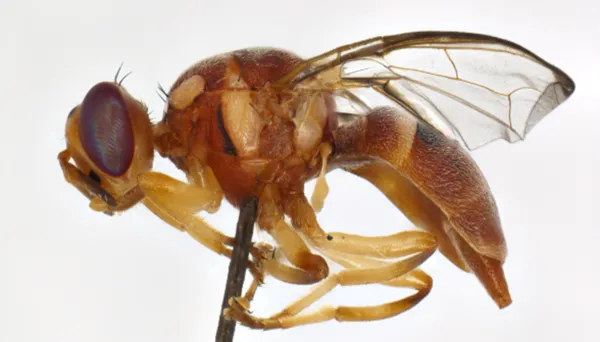
The melon fly (Dacus frontalis) is a significant agricultural pest belonging to the Tephritidae family, order Diptera. The adult fly is characterized by a yellowish-brown body and transparent wings featuring distinct dark markings.
The larva of this insect is a legless maggot with a cylindrical, worm-like body, measuring between 7 and 10 millimeters in length. They are typically creamy-white, equipped with hardened mouth hooks used for feeding on plant tissues.
Pupation primarily takes place within the soil or inside decaying fruit tissues. The puparium is barrel-shaped and brown, providing a resilient protective casing for the developing insect during its transition stages.
Adult flies are highly mobile and demonstrate strong flight capabilities, which allows them to effectively colonize new host plant patches during the growing season. Their reproductive rate is tightly correlated with ambient temperatures.
The life cycle follows a complete metamorphosis pathway, including egg, larval, pupal, and adult stages. Depending on environmental conditions, multiple generations can emerge within a single calendar year.
What it damages
Melon flies primarily attack plants in the Cucurbitaceae family. Their preferred hosts include melons, watermelons, cucumbers, pumpkins, and squashes, all of which are highly susceptible to infestation.
The female uses her ovipositor to pierce the rind of developing fruit and deposit eggs directly into the pulp. This action damages the surface and introduces fungal and bacterial spores into the interior.
As the larvae hatch, they begin to feed extensively on the interior pulp, creating complex tunnels throughout the fruit. This destruction leads to rapid softening and disintegration of the fruit’s internal structure.
Infected fruits often show signs of premature ripening, yellowing, and eventual decay. Without intervention, infestations can lead to substantial economic losses, with up to 80 percent of the harvest becoming unsalable.
Damage can occur from the early fruit set stage up to full maturity. This broad susceptibility window makes the pest a persistent threat throughout the entire development of the crop.
When it appears
Adult flies become active in the spring as soil and air temperatures begin to rise. The population typically peaks during the warm summer months, coinciding with the flowering and fruit-setting period of host plants.
Humid and hot weather conditions significantly shorten the development cycle, leading to rapid population surges. Multiple successive generations can infest a field throughout the long growing season.
As autumn temperatures drop, adult activity ceases, and the pest overwinters as pupae in the soil. This dormancy period is a survival strategy, ensuring the species persists until the following season.
Signs of infestation
The first indicator of an infestation is the appearance of small puncture marks on the fruit rind, often surrounded by discolored or water-soaked tissue patches.
- Small drops of plant sap oozing from the oviposition sites.
- Premature yellowing or localized rotting of the fruit surface.
- Deformation or stunting of the fruit’s natural shape.
- Presence of a foul odor resulting from internal tissue decay.
Internal examination of suspected fruit will reveal tunneling and the presence of larvae. The pulp is often converted into a semi-liquid, rotting mass contaminated with larval waste.
Control measures
Deep plowing after harvest is a fundamental cultural control measure. This disturbs the soil, exposing overwintering pupae to the surface where they are vulnerable to extreme weather and natural predators.
Sanitation is crucial; all infested and fallen fruit must be collected promptly and destroyed, preferably by burning or deep burial, to prevent larvae from completing their life cycle in the soil.
Insecticide applications should be used cautiously, timed specifically to target adult flies before they have the opportunity to lay eggs. Pheromone and color-based traps are effective tools for monitoring population density.
Crop rotation remains a primary preventative strategy. By avoiding the cultivation of cucurbits in the same area for several years, growers can effectively disrupt the pest's life cycle and local population buildup.
Selecting early-maturing varieties allows growers to harvest their crop before the melon fly population reaches its annual peak. This proactive approach significantly reduces the potential for heavy infestations.
Taxonomy
- Latin name
- Dacus frontalis
- Order
- Diptera (flies)
- Family
- Tephritidae
- EPPO code
- DACUFR
Discussion
No discussions yet — be the first.