
Dacus famona
Dacus famona
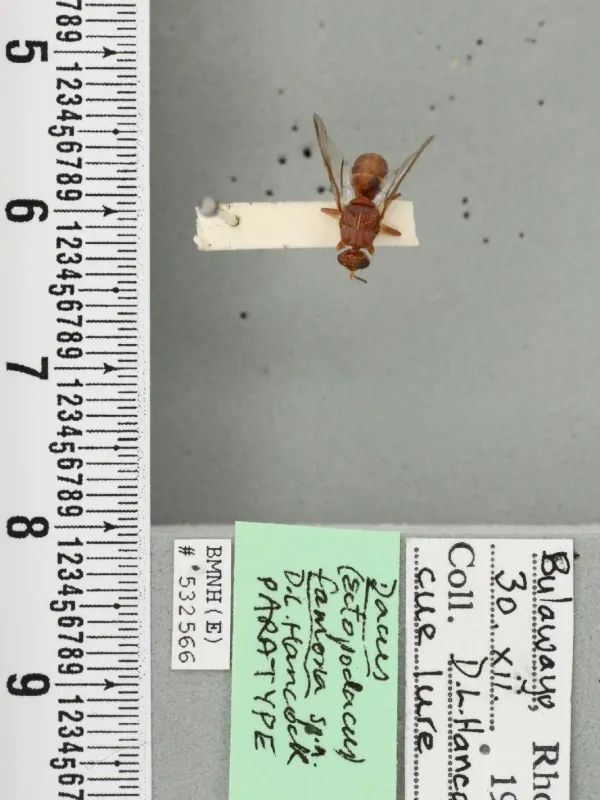
Description
How to identify
Dacus famona belongs to the family Tephritidae, commonly known as fruit flies, within the order Diptera. This specialized pest is morphologically similar to other members of the genus Dacus, which are known as significant phytophagous threats to tropical and subtropical fruits.
Adults exhibit the characteristic wing patterns typical of fruit flies and have bright abdominal coloration, which aids in camouflage on fruit surfaces. The head features prominent eyes and specialized mouthparts adapted for feeding on plant juices.
The larvae are typical legless fly maggots, whitish or cream-colored, with developed mouth hooks. The larval stage is the most destructive to agricultural crops, as their cryptic lifestyle makes them extremely difficult to detect and control in the early stages.
The insect's life cycle is closely tied to climatic conditions and the availability of food sources. Females possess a sharp ovipositor, allowing them to penetrate deep into the fruit skin to lay eggs, protecting their offspring from external environmental factors and predators.
For population monitoring in agroecosystems, specialized pheromone traps specific to the Dacus genus are employed. This allows agronomists to react promptly to the emergence of adults before they can cause significant damage to the yield.
What it damages
This pest prefers a wide range of fruit crops, including both wild and cultivated species. Dacus famona is particularly attracted to fleshy, high-sugar fruits, which serve as an ideal environment for larval development.
Host crops include various species of Cucurbitaceae and Solanaceae, as well as several tree fruits. The damage is manifested by the destruction of the fruit's internal structure, rendering it unfit for consumption or market sale.
Larval infestation introduces pathways for secondary infections. Pathogenic bacteria and fungi enter through the oviposition punctures made by the female, causing rot and rapid fruit spoilage even at the initial stages of infestation.
Economic losses arise not only from direct crop damage but also from the necessity of implementing costly quarantine and phytosanitary measures. Massive infestations can lead to losses of up to 70–80% of marketable products in orchards and plantations.
The agronomic importance of Dacus famona is significant in warm regions where the lack of harsh winters allows the pest to breed almost year-round, resulting in multiple generations within a single growing season.
Signs of infestation
The first visual sign of infestation consists of tiny punctures on the fruit's skin surface, surrounded by slight darkening. These are the sites where the female has damaged the epidermis to deposit her eggs.
As the damage progresses, the fruit begins to ripen prematurely or takes on an abnormal color. The internal tissues soften, which is often accompanied by a foul rotting odor emanating from the damaged area.
- Presence of entry holes approximately 1 mm in diameter.
- Deformation of the fruit as larvae grow inside.
- Exudation of sap from the puncture points.
- Internal cavities filled with larval frass.
When infested fruits are opened, larvae actively feeding on the pulp are revealed. This is the most reliable method of field identification and requires the immediate removal and destruction of the affected fruit.
In advanced cases, the fruit is completely destroyed from the inside, turning into a mushy mass that eventually falls to the ground. Fallen fruit becomes a primary source for the further spread of the pest to neighboring trees and plots.
Control measures
The protection system against Dacus famona is based on Integrated Pest Management (IPM) principles. The first step involves orchard sanitation: the mandatory collection and deep burial or thermal treatment of all fallen fruit containing larvae.
The use of insecticides should be strictly targeted and aimed at eliminating adults before they can lay eggs. Contact-stomach poisons applied to the canopy or used in bait stations are effective tools in the management strategy.
One modern protection method involves the use of food-based attractants combined with insecticidal components. This approach minimizes chemical exposure to the environment by acting specifically on the target pest.
Agrotechnical methods include the use of protective nets or individual fruit bagging on the trees. This method is highly effective in private gardens and on small-scale farms where individual plant protection is feasible.
Biological control involves the use of natural enemies of fruit flies, such as parasitic Hymenoptera. Implementing such methods requires careful ecosystem monitoring and the maintenance of beneficial insect populations to ensure sustainable long-term control.
Taxonomy
- Latin name
- Dacus famona
- Order
- Diptera (flies)
- Family
- Tephritidae
- EPPO code
- DACUFA
Discussion
No discussions yet — be the first.