
Dacus eclipsis fruit fly
Dacus eclipsis
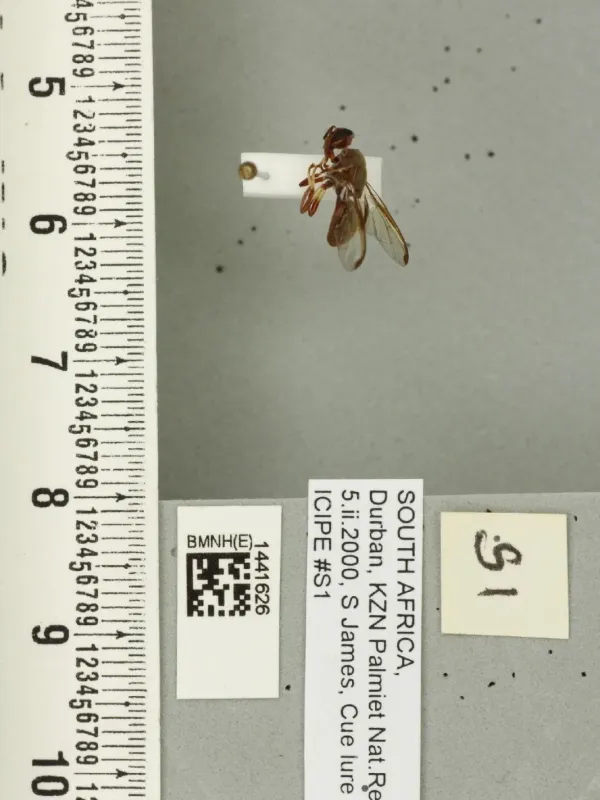
Description
How to identify
Dacus eclipsis is a species of fruit fly belonging to the Tephritidae family, order Diptera. These insects are characterized by their distinct body markings and specialized wings.
Adult flies possess high agility, allowing them to travel long distances in search of suitable hosts for egg-laying during their reproductive phase.
The larvae are legless, maggot-like creatures that are adapted for burrowing through the fleshy pulp of fruits, which is their primary food source.
Pupae are typically cylindrical and are found in the upper soil layers or within decaying fruits, serving as a survival stage for the insect.
Identification is primarily based on morphological features such as wing venation patterns and specific abdominal markings unique to the Dacus genus.
What it damages
Damage is caused by larvae feeding inside the fruit, which destroys the internal tissue and often leads to the complete loss of the commercial product.
Dacus eclipsis primarily attacks a wide range of tropical and subtropical fruits, significantly impacting both yield and the quality of the harvested produce.
The initial puncture wounds made by the female fly's ovipositor create entry points for secondary pathogens, accelerating fruit decay and rot.
Severe infestations can lead to total crop failure, making this species a major threat to agricultural productivity in regions where it is established.
Due to its high destructive potential, the presence of this fruit fly often results in strict quarantine regulations for the export of fruits from affected areas.
When it appears
The life cycle and activity of Dacus eclipsis are highly dependent on favorable environmental temperatures and humidity levels throughout the year.
During the active season, the population can go through multiple generations, allowing it to rapidly multiply if conditions remain stable for growth.
Egg-laying activity usually peaks during the maturation phase of the fruit, when the pulp is most suitable for larval development.
Larval development duration is significantly influenced by temperature, which dictates the speed of the transition through various larval instars.
Overwintering occurs either in the soil as pupae or in protected areas as adults, ensuring the survival of the species during cold or dry seasons.
Signs of infestation
One of the earliest signs of infestation is the appearance of small, dark, puncture marks on the skin of developing fruits, indicating egg-laying sites.
Tissues around these punctures often soften and become discolored, which is an early indication of internal decay caused by the feeding larvae.
If an affected fruit is cut open, one can clearly see tunnels created by the larvae, often accompanied by a distinct and unpleasant fermented odor.
Premature fruit drop is a common indicator that a fruit fly population is actively breeding within the orchard or garden environment.
Upon inspecting fallen fruits, larvae may be seen emerging as they prepare to move into the soil to complete their metamorphosis into pupae.
Control measures
Sanitation is the most critical control measure, involving the systematic collection and destruction of all fallen fruits to break the life cycle of the pest.
Pheromone and protein-based traps are highly effective for monitoring population density and timing the application of control agents to minimize infestations.
Biological control through the use of natural predators or entomopathogenic organisms can provide a sustainable way to suppress the fly population.
- Tilling the soil under trees to expose and kill overwintering pupae.
- Covering individual fruits with protective bags to prevent egg-laying.
- Using bait stations with attractants to capture and remove adult flies.
Chemical control involving systemic insecticides may be used as a last resort, provided that safety guidelines and pre-harvest intervals are strictly followed.
Taxonomy
- Latin name
- Dacus eclipsis
- Order
- Diptera (flies)
- Family
- Tephritidae
- EPPO code
- DACUEC
Discussion
No discussions yet — be the first.