
Dacus demmerezi
Dacus demmerezi
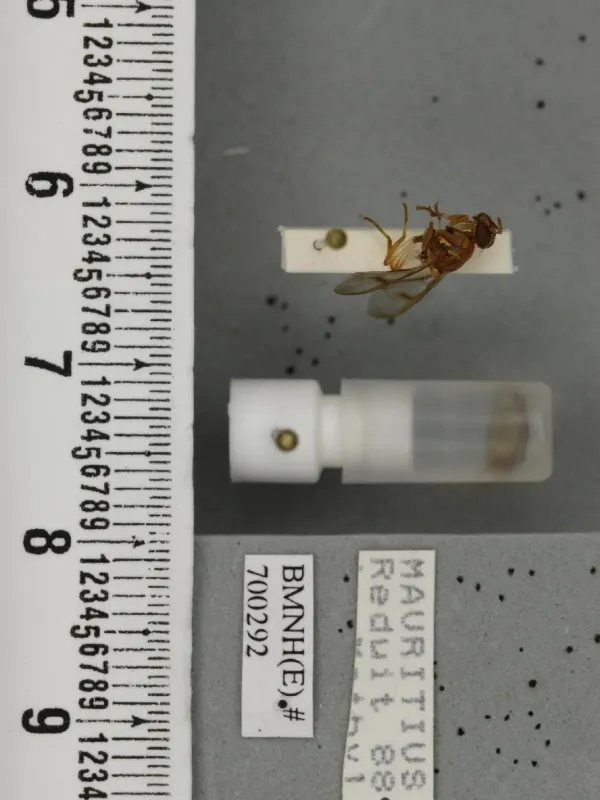
Description
How to identify
Dacus demmerezi belongs to the Tephritidae family, order Diptera. It is a specialized species of fruit fly with a characteristic appearance typical of the genus Dacus.
Adult flies have distinctive coloration, often with contrasting wing spots that assist in mating rituals. The body is compact, adapted for rapid maneuvering within plant foliage.
The larvae of this pest develop inside fruits, featuring the typical legless body form of flies, appearing white or yellowish. They possess mouthparts adapted for destroying fruit pulp.
Pupation occurs primarily in the soil, where larvae migrate after completing their feeding cycle within the damaged fruit. This stage is crucial for population monitoring.
For accurate species identification, specialists utilize pheromone traps that attract males, allowing for the assessment of infestation density in a specific area.
What it damages
The primary crops targeted by this pest include various cucurbits, as well as a range of other vegetable and fruit crops.
The greatest economic impact occurs in warm climates, where the pest's biological cycle is synchronized with the maturation period of major commercial crops.
Larvae feed internally, creating tunnels that destroy the pulp structure and render the product unsuitable for market or long-term storage.
Damaged fruits are often prone to secondary infections from fungal and bacterial rots, leading to total yield loss in infested fields.
The pest significantly reduces the market value of produce, as even a single internal infestation makes the fruit unmarketable.
Signs of infestation
The first sign of infestation is the appearance of tiny punctures on the surface of young fruits, left by the female during oviposition.
In later stages, tissue softening and epidermis discoloration often appear around the puncture site, indicating internal larval development.
Cutting open an infested fruit reveals numerous larval tunnels filled with frass, giving the pulp a darkened appearance.
Premature yellowing and fruit drop of young ovaries are also important indirect indicators of a high infestation level on the plot.
The presence of specific exit holes, through which mature larvae leave the fruit to pupate in the soil, signals the completion of one generation's life cycle.
Control measures
Effective protection begins with agrotechnical methods, such as regular collection and deep burial of fallen fruit to destroy the larvae.
The application of contact and stomach-action insecticides is effective during the adult flight period, before they can deposit eggs into the fruits.
Installing pheromone traps allows not only for monitoring pest density but also for precisely timing chemical treatments.
Biological control involves the use of entomophagous insects that parasitize larvae and pupae, significantly reducing the pest population under natural conditions.
- Regular soil cultivation between rows to destroy puparia.
- Use of protective netting on high-value crop plantings.
- Adherence to crop rotation and spatial isolation from infestation sources.
Taxonomy
- Latin name
- Dacus demmerezi
- Order
- Diptera (flies)
- Family
- Tephritidae
- EPPO code
- DACUDE
Discussion
No discussions yet — be the first.