
Ethiopian fruit fly
Dacus ciliatus
Description
How to identify
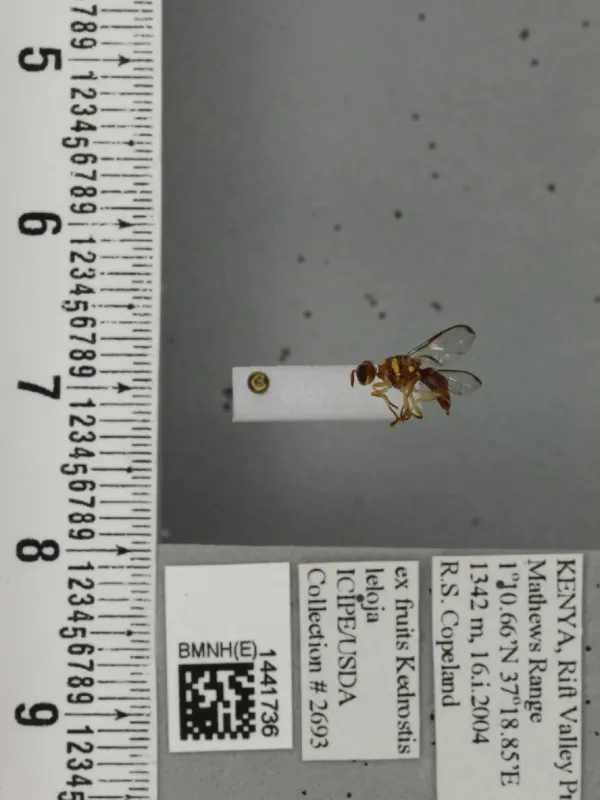
The Ethiopian fruit fly (Dacus ciliatus) is a member of the Tephritidae family, order Diptera. Adults are approximately 6–7 mm in length and exhibit a distinct yellowish-brown coloration with characteristic dark markings on their wings.
The females possess a sharp, elongated ovipositor, which allows them to penetrate the skin of fruits to deposit their eggs inside the fleshy tissue. Larvae are legless, maggot-shaped, reaching about 10 mm in length, and vary from white to cream in color.
Identification of the imago is primarily based on the thoracic pattern and the specific dark band along the costal margin of the wings. These features help distinguish it from other species within the Dacus genus.
Pupae are found in the soil or within infested fruit remains, appearing as dark brown, barrel-shaped puparia. This stage is crucial for tracking the pest’s population cycle.
Proper identification at the farm level is essential, as early detection prevents the establishment of a large population that can rapidly devastate the crop during the growing season.
What it damages
The primary hosts of the Ethiopian fruit fly include various cucurbitaceous plants such as melons, watermelons, cucumbers, zucchinis, and pumpkins. This pest shows a strong preference for soft-skinned fruits.
In many regions, Dacus ciliatus is considered a significant quarantine pest. Its potential to cause up to 100% loss of the fruit crop makes it a high-priority target for agricultural monitoring.
Beyond cultivated fields, the fly also infests wild cucurbit species, which serve as reservoirs for the pest, ensuring its presence throughout the agricultural year.
The larvae cause direct damage by feeding on the internal tissues, which leads to the structural collapse of the fruit and the introduction of secondary microbial rot.
The economic impact is profound, as the infestation results not only in the loss of harvestable yield but also in the degradation of quality, rendering the fruits unmarketable.
When it appears
The life cycle of the Ethiopian fruit fly is highly temperature-dependent. Under optimal conditions (25–30°C), the generation time can be as short as 20–25 days.
Multiple generations can occur within a single growing season, leading to a rapid exponential increase in the population density as the summer progresses.
Adults are most active during warm daylight hours, focusing their efforts on locating suitable host fruits to deposit eggs before the rinds become too thick and resistant.
The species survives adverse weather conditions in the pupal stage, typically buried in the soil or hiding in crop debris, allowing for rapid emergence the following season.
Agronomic monitoring for this pest should be intensified as soon as fruit set begins, as this is the most critical window for preventative intervention.
Signs of infestation
The initial signs of infestation are subtle: tiny punctures on the fruit surface, often accompanied by localized discoloration or slight tissue softening where the female oviposited.
- Fruit deformation and stunted development.
- Soft, rotting spots that expand rapidly across the fruit surface.
- Premature dropping of young fruit or blossoms.
- Internal pulp liquefaction caused by larval feeding and secondary infection.
- A distinct fermentation odor emanating from heavily infested fruit.
Upon slicing an infested fruit, one can observe multiple maggots feeding within the tissue, effectively hollowing out the interior and destroying the plant's vascular integrity.
Externally, the fruit may appear deceptively normal until the larval destruction inside causes the rind to lose its structural integrity and begin to wilt.
The presence of small circular exit holes on the rind indicates that the larvae have finished feeding and are ready to drop to the soil for pupation.
Control measures
Managing the Ethiopian fruit fly requires an integrated approach that combines cultural practices, physical monitoring, and targeted chemical applications.
Good agricultural practices such as deep ploughing after the harvest are essential, as this destroys the pupae overwintering in the soil and interrupts the pest's cycle.
Strict sanitation measures, including the immediate collection and destruction of all infested fruits, are vital to preventing larvae from completing their development and re-infesting the soil.
The use of pheromone-baited traps and protein-based attractants is a cornerstone of an effective monitoring program, allowing growers to initiate pesticide treatments only when thresholds are exceeded.
Chemical control should be applied judiciously, utilizing systemic insecticides when necessary while ensuring that pre-harvest intervals are strictly followed to protect consumers and beneficial insects.
Taxonomy
- Latin name
- Dacus ciliatus
- Order
- Diptera (flies)
- Family
- Tephritidae
- EPPO code
- DACUCI
Discussion
No discussions yet — be the first.