
Dacus adustus
Dacus adustus
Description
How to identify
Dacus adustus is a member of the Tephritidae family, also known as fruit flies. It is a well-documented pest that poses significant risks to various fruit-bearing plants across its geographical distribution.
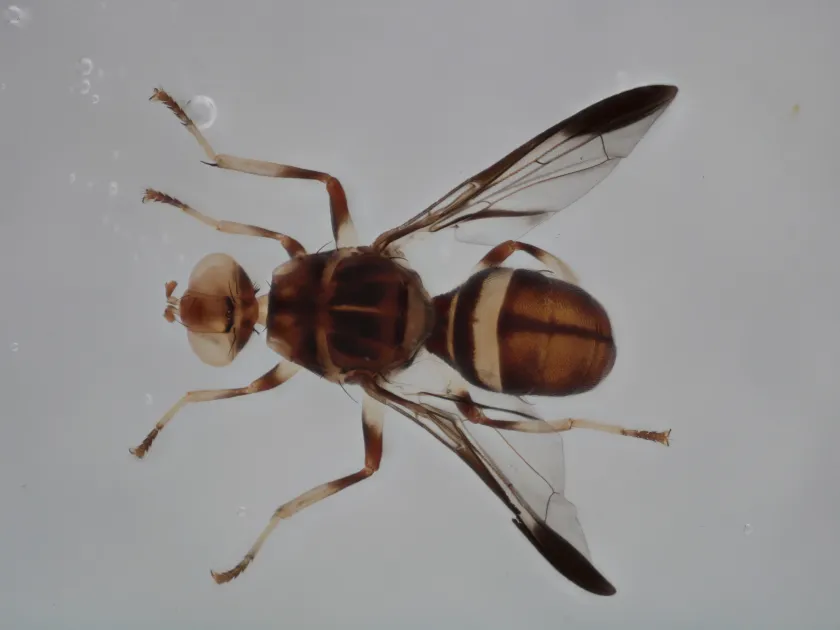
The adult fly typically measures between 5 and 8 millimeters in length. Its body exhibits patterns of dark pigmentation, which is a key diagnostic feature for distinguishing it from other species within the Dacinae subfamily.
The wings are clear, featuring specialized venation that is characteristic of this group. Females are equipped with a hardened ovipositor used to pierce the skin of ripening fruits to deposit eggs into the soft tissue.
Larvae are maggot-like, creamy-white in appearance, and legless. They spend their entire developmental period feeding within the fruit, growing through several instars before transitioning into the pupal stage.
Identification often requires careful inspection under a microscope by an expert, as the morphological traits of Dacus adustus can be easily confused with closely related tephritid species.
What it damages
The primary damage is caused by the larval stage. As the larvae tunnel through the fruit flesh, they destroy the internal structure and quality of the produce, rendering it completely unmarketable.
This species affects a wide range of host plants, particularly tropical and subtropical fruits. Significant infestations can result in the total loss of the harvest if left unmanaged by agricultural practices.
The mechanical damage caused by feeding larvae creates entry points for secondary pathogens, such as bacteria and fungi, which rapidly accelerate the decay of the fruit.
Infected fruits often show signs of premature ripening and drop from the plant before full maturity. This behavior is a direct consequence of the physiological stress placed on the plant by the infestation.
Economic losses include direct reduction in yield, increased expenditures on pest control measures, and restricted market access due to international phytosanitary quarantine regulations.
When it appears
The activity of Dacus adustus is closely linked to the phenology of its host plants. Adults emerge and become active during the fruit-set and maturation phases of their preferred hosts.
Depending on the local climate, the fly can produce multiple generations per season. This continuous life cycle allows populations to build up rapidly if environmental conditions are favorable.
Pupation generally occurs in the soil beneath the host plant. The emergence of adults in spring often correlates with the availability of suitable fruit on which females can lay their eggs.
Humidity and moderate temperatures are critical factors for survival. Extreme heat or drought can lead to temporary declines in population, but the species is highly adapted to tropical environments.
Timing the monitoring programs to coincide with the fruit ripening cycle is essential for successful pest management and early intervention before eggs are deposited deep within the tissue.
Signs of infestation
The first external sign of infestation is the presence of small puncture marks, or "stings," on the fruit surface. These punctures are caused by the female's ovipositor during egg-laying.
Internally, the presence of the larvae is indicated by a breakdown of the flesh. Upon cutting the fruit, one can observe tunneling patterns and the presence of larvae or their excrement.
The fruit surface may show localized discoloration or patches of rot originating from the puncture site. In many cases, the fruit loses its firm texture and becomes abnormally soft.
Premature fruit drop is a strong indicator of an existing problem. Any fallen fruit should be inspected to determine if Dacus adustus larvae are present within the decaying flesh.
- Puncture marks on the fruit skin
- Internal larval tunneling
- Discoloration and localized rot
- Premature fruit drop
Control measures
Managing Dacus adustus requires an Integrated Pest Management (IPM) approach that emphasizes prevention and early detection over simple chemical applications.
Sanitation is the most critical cultural practice. Removing and destroying fallen or damaged fruit on a daily basis is essential to break the life cycle by killing the larvae before they emerge to pupate.
Monitoring using pheromone-based or food-based traps is highly recommended. These traps help growers track population density and determine the precise timing for targeted control measures.
Chemical control involving the application of insecticides should be used sparingly and timed with the adult emergence cycles. Proper chemical rotation is necessary to prevent the development of resistance.
Biological control methods, such as the release of parasitoid wasps that target larvae or eggs, offer a sustainable alternative that can complement chemical or cultural practices in commercial orchards.
Taxonomy
- Latin name
- Dacus adustus
- Order
- Diptera (flies)
- Family
- Tephritidae
- EPPO code
- DACUAD
Discussion
No discussions yet — be the first.