
Bamboo weevil
Cyrtotrachelus buqueti
Description
How to identify
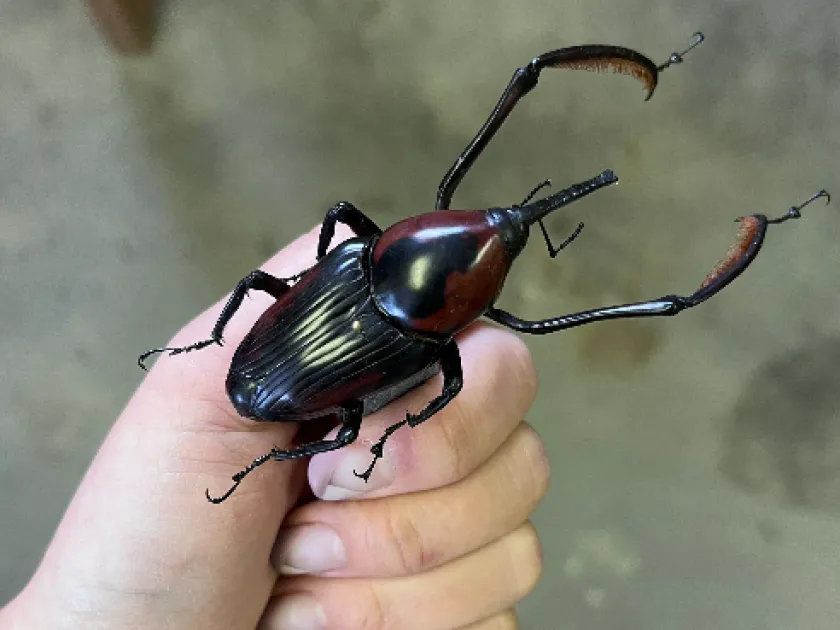
The bamboo weevil (Cyrtotrachelus buqueti) is a member of the Curculionidae family. It is a robust beetle, often reaching a significant size, distinguished by its elongated snout used for feeding and laying eggs.
The adult beetle usually displays a dark reddish-brown or chestnut coloration. Its body is hard-cased and streamlined, which is an adaptation for its lifestyle within dense bamboo stands.
The larvae are legless and fleshy, with a cream-colored body and a hard, dark brown head capsule containing powerful mandibles for boring through plant tissue.
Adults are capable fliers, which facilitates their spread between different bamboo clusters during the breeding season. They are most active during warm and humid weather.
The morphology of the head and the characteristic rostrum are the primary diagnostic features used to identify this species among other coleopterans in bamboo environments.
What it damages
This pest is a significant threat to young bamboo shoots. The larvae bore into the tender stalks, consuming the inner pith and disrupting the plant's vascular system.
This feeding behavior causes the shoots to become deformed, wilted, and stunted. Eventually, the structural integrity of the bamboo culm is lost, leading to premature death.
Commercial bamboo plantations suffer major losses due to this pest, as infested culms become unusable for timber production or culinary purposes.
The tunnels created by the larvae provide entry points for bacteria and fungi, leading to secondary rot which further destroys the plant tissue and accelerates decline.
In cases of high infestation rates, entire clumps of young bamboo can be destroyed, negatively impacting the productivity of the affected area for several seasons.
When it appears
The life cycle of the bamboo weevil is closely synchronized with the growth of bamboo shoots. They are most prevalent when new shoots are actively emerging.
The breeding season begins as soon as environmental conditions favor bamboo growth. Adult females seek out fresh shoots to deposit their eggs into the tender tissues.
The incubation period is relatively short, followed by larval development that happens inside the stalk. The larvae spend most of their growth phase protected within the plant.
Pupation typically occurs either inside the hollowed-out stalk or in the soil near the base of the plant, depending on the specific environmental conditions and habitat.
Multiple generations may occur in tropical or warm-temperate regions, making it a persistent challenge for bamboo growers throughout the main growing season.
Signs of infestation
Visible signs of infestation include small, circular entry holes on the exterior of the young shoots, created by the female weevil during egg-laying.
Shoots often exhibit wilting, yellowing of the leaves, or drooping tops, which are outward indicators of internal damage to the conducting vessels.
Examination of the inside of an infested shoot reveals extensive tunnels filled with frass, which is a mix of excrement and chewed plant material characteristic of larval feeding.
The affected area of the stem may show localized darkening or softening. In advanced stages of infestation, the stem may break under its own weight.
The presence of adult weevils resting on the stems, particularly during the early morning or evening hours, is a primary indicator of an active pest population.
Control measures
The primary control measure involves physical removal and destruction of infested shoots as soon as symptoms appear to prevent the larvae from completing their development.
Integrated Pest Management (IPM) techniques, including the use of pheromone traps, are highly effective in monitoring and reducing adult populations before egg-laying occurs.
Chemical control can be applied using systemic insecticides during the peak of adult activity to protect young, susceptible shoots from colonization.
Biological control methods involve encouraging natural predators or using entomopathogenic organisms that target the larvae and pupae in the soil or plant stems.
- Regular monitoring of bamboo stands during the shooting season.
- Sanitary pruning of all damaged material to reduce pest reservoir.
- Application of environmentally safe, selective insecticides if necessary.
Taxonomy
- Latin name
- Cyrtotrachelus buqueti
- Order
- Coleoptera (beetles)
- Family
- Dryophthoridae
- EPPO code
- CYRRBU
Discussion
No discussions yet — be the first.