
Bamboo weevil
Cyrtotrachelus
Description
How to identify
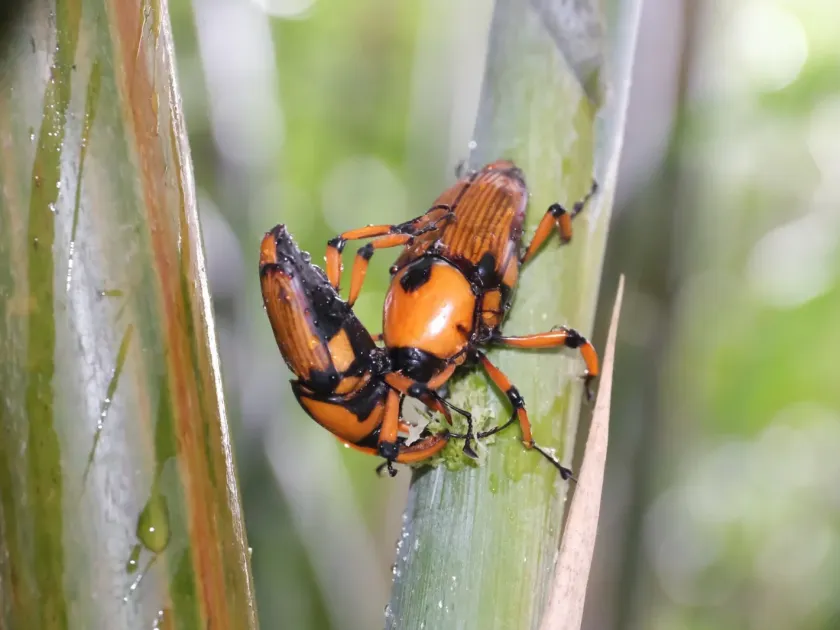
The bamboo weevil (Cyrtotrachelus) is a member of the Curculionidae family within the order Coleoptera. These beetles are easily distinguished by their elongated snouts, known as rostrums, which are used for feeding and piercing bamboo stalks during egg-laying.
Adult beetles typically possess a dark reddish-brown to black coloration, which serves as excellent camouflage on bamboo stems. They are relatively large insects, often measuring several centimeters in length, making them significant pests in their native habitats.
The larvae are legless, white to cream-colored grubs with a well-developed, hardened head capsule. They are strictly endophagous, meaning they complete their development entirely inside the soft tissues of bamboo shoots.
Among the various species, Cyrtotrachelus longimanus is particularly notable for its impact on agriculture. Identification often requires examining the morphology of the legs and the pronotum, which are key diagnostic features for entomologists.
The life cycle is closely synchronized with the growth phases of the bamboo plant. After mating, females bore holes into the softest parts of the bamboo to deposit eggs, ensuring that the emerging larvae have immediate access to nutrient-rich internal tissues.
What it damages
The bamboo weevil primarily attacks various species of bamboo, including those in the Phyllostachys and Bambusa genera, which are economically valuable for construction and food production.
Adult beetles inflict damage by piercing the surface of young shoots, causing sap leakage and localized necrosis, which disrupts the normal development of the plant.
The larvae are responsible for the most severe damage. By feeding on the internal pith of the shoots, they create tunnels that weaken the structure, eventually causing the shoot to wither and collapse.
Significant infestations can destroy the majority of the new growth in a bamboo grove, leading to a substantial decrease in the biomass and overall productivity of the plantation.
Beyond crop loss, the physical destruction of the shoots reduces the quality of the harvested bamboo, rendering the material brittle and useless for industrial applications.
When it appears
The seasonal activity of the bamboo weevil is highly dependent on the emergence of bamboo shoots, which usually occurs during the warm and humid monsoon or rainy seasons.
Adults emerge from their overwintering sites in the soil or plant debris once temperatures rise to an optimal range for mating and oviposition.
Egg-laying activity is concentrated during the period when shoots are in their most tender stage, providing the larvae with the necessary food source for rapid growth.
Summer months mark the peak of larval development inside the stalks. This is a critical time for monitoring, as the pests are hidden inside the stems and often go undetected until significant damage is already done.
As the season progresses toward autumn, the larvae conclude their feeding phase and prepare for pupation. They may either remain within the base of the stalks or descend into the soil to undergo metamorphosis.
Signs of infestation
Early symptoms of an infestation include the appearance of tiny pin-prick holes on the surface of young shoots, left by the female weevil during the egg-laying process.
A clear sign of internal damage is the sudden yellowing or wilting of the shoot tips, despite proper irrigation, which indicates that the internal vascular system has been severed.
When an affected stalk is cross-sectioned, one can observe internal galleries filled with larval frass and pulverized plant fiber, confirming the presence of the pest.
The presence of fine wood dust or shavings at the base of the bamboo shoots is a secondary indicator, produced by the larvae as they tunnel through the dense plant tissue.
Ultimately, the collapse and breakage of the shoots serve as the final diagnostic sign, as the internal feeding leaves the structure unable to support its own weight.
Control measures
Sanitation is the primary management strategy: all infested shoots should be removed and destroyed immediately to prevent the larvae from completing their life cycle and emerging as adults.
Systemic insecticides can be applied during the early stages of shoot growth, providing protection from the inside out and targeting larvae before they cause extensive damage.
Cultural practices, such as tilling the soil around bamboo clumps during the off-season, can help expose and destroy pupae, significantly reducing the population for the next cycle.
Biological control, using specialized entomopathogenic fungi, is an effective and environmentally friendly approach that can help manage weevil populations in large-scale groves.
- Implement regular surveillance during the peak shoot emergence period.
- Use light traps to monitor and reduce adult beetle density at night.
- Maintain orchard cleanliness by removing dried or damaged stems that could serve as breeding grounds.
Taxonomy
- Latin name
- Cyrtotrachelus
- Order
- Coleoptera (beetles)
- Family
- Dryophthoridae
- EPPO code
- CYRRSP
Discussion
No discussions yet — be the first.