
Cyphonia clavigera
Cyphonia clavigera
Description
How to identify
Cyphonia clavigera belongs to the Membracidae family, commonly known as treehoppers, within the order Hemiptera. This insect is distinguished by a highly specific morphology, making it easily identifiable within its family.
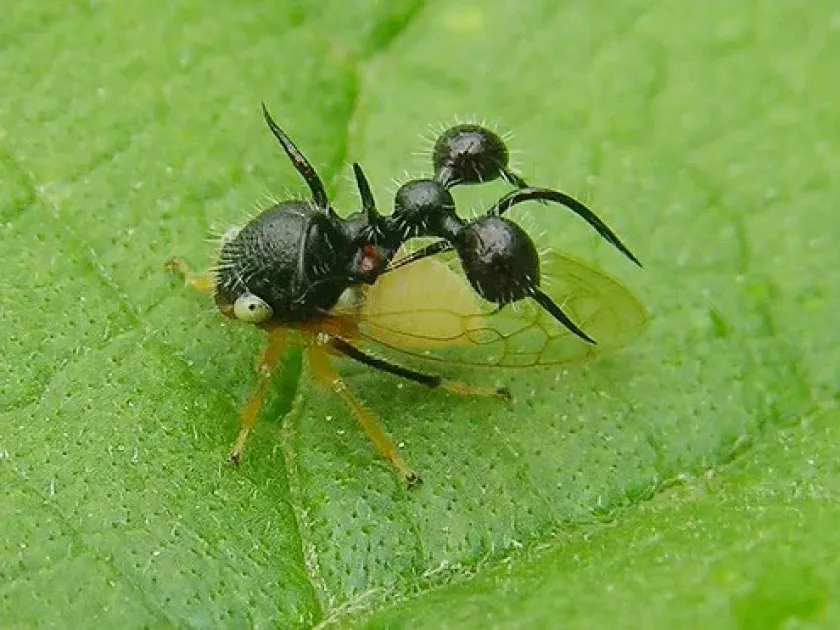
The adult insect features a specialized chitinous protrusion on its pronotum, which resembles a mace or a branched spine. This structure, which often exceeds the size of the insect's body, serves as a defense mechanism and a form of mimicry, allowing the pest to camouflage itself as thorns or twigs.
The coloration of the body usually ranges from dark brown to black, rendering the insect nearly invisible against the bark or stems of host plants. The overall length of the adults, including their characteristic structures, generally ranges from 5 to 10 millimeters.
The nymphs of Cyphonia clavigera have softer bodies and lack the elaborate pronotal structures seen in adults. They tend to live a reclusive life, concentrating in areas with high humidity and sufficient plant sap for feeding.
The biology of this species is well-documented within tropical entomology. Like other treehoppers, it possesses a specialized piercing-sucking mouthpart, which it uses to penetrate deep into the plant tissue to access vital nutrients.
What it damages
Cyphonia clavigera primarily targets a wide range of woody and shrubby plants, mostly inhabiting the tropical and subtropical regions of South America.
Key hosts include members of the Fabaceae and Solanaceae families. In agricultural settings, the pest is frequently observed on crops such as cacao, coffee, and various wild-growing fruit trees.
The pest generally leads a secretive existence, feeding primarily on the plant's phloem. By extracting plant sap, Cyphonia weakens the plant's immune system, leaving it susceptible to secondary infections and environmental stress.
The most significant damage occurs on young shoots and vegetative parts of the plant. Persistent sap-feeding leads to the deformation of leaves, premature defoliation, and the cessation of growth in the affected branches.
Beyond mechanical damage, this treehopper can act as a vector for various phytopathogens. During the puncturing process, viruses and bacteria can be introduced into the plant through the insect's salivary glands, leading to systemic disease.
Signs of infestation
The first sign of a Cyphonia clavigera infestation is the noticeable wilting of terminal shoots, which become flaccid and gradually turn yellow or brown.
Characteristic ring-like marks from the insect's feeding apparatus can be found on the surface of the stems. In these locations, tissue necrosis or the leakage of plant resin or gum is often visible.
The presence of colonies is typically accompanied by the secretion of honeydew, a sweet, sticky substance. This promotes the growth of sooty mold, a fungus that covers leaves in a black layer, effectively inhibiting photosynthesis.
Upon close inspection of the underside of leaves or branch forks, adult insects can be observed. They are highly alert and will quickly fly to neighboring areas if disturbed.
A secondary indicator of pest activity is the presence of ants, which are attracted to the honeydew produced by the treehoppers. The ants often protect the colonies from natural predators, further exacerbating the infestation.
Control measures
Managing Cyphonia clavigera requires a multi-faceted strategy that combines cultural, biological, and chemical control methods.
Regular pruning and the removal of heavily infested branches are critical. This sanitary practice effectively reduces the population of nymphs and adults in the canopy, preventing the spread of the pest.
Biological control involves the encouragement of natural predators such as lacewings, lady beetles, and predatory bugs. Maintaining high biodiversity in the orchard helps naturally suppress pest numbers without relying on synthetic chemicals.
In cases of severe infestation, systemic insecticides are recommended. Products based on neonicotinoids are effective as they are absorbed into the plant tissues, targeting the insects as they feed on the sap.
Preventative care should include the management of ant populations in the area. By disrupting the mutualistic relationship between ants and treehoppers, the overall control of the pest becomes significantly more efficient.
Taxonomy
- Latin name
- Cyphonia clavigera
- Order
- Hemiptera (bugs, aphids, leafhoppers)
- Family
- Membracidae
- EPPO code
- CYPACG
Discussion
No discussions yet — be the first.