
Box tree moth
Cydalima perspectalis
Description
How to identify
The box tree moth (Cydalima perspectalis) is an invasive species originating from East Asia, belonging to the Crambidae family. The adult moth has a wingspan of approximately 40–45 mm and usually features white wings with a thick brown border, though dark variants exist.
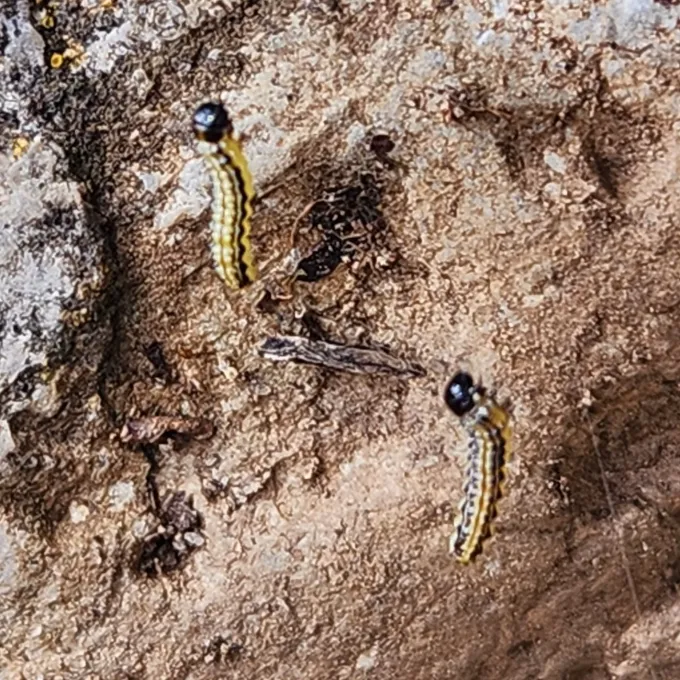
The larvae are the most destructive stage. When fully grown, the caterpillars reach up to 40 mm in length. They are characterized by a light green body, black stripes, white spots, and a shiny black head.
Pupae are typically hidden within a dense, white silken cocoon spun between leaves. They measure about 25 mm and change from a light green color with dark markings to a dark brown as they mature.
Eggs are laid in clusters of 10 to 20 on the underside of leaves. They are translucent yellow and very small, making them difficult to detect during the early stages of an infestation.
The species has a high reproductive rate, producing multiple generations throughout the growing season, which allows populations to explode in a very short amount of time.
What it damages
The box tree moth feeds exclusively on boxwood plants (Buxus species). The larvae consume the foliage and, in cases of heavy infestation, can also strip the bark from young stems.
A mature colony of caterpillars can completely defoliate a large boxwood hedge in just a few days, leaving behind only the skeletonized remains of the leaves and twigs covered in webbing.
Severe defoliation drastically reduces the aesthetic value of the plant. If the plant is attacked repeatedly over consecutive seasons, it often leads to complete plant mortality.
Because boxwood leaves contain alkaloids, the larvae become toxic to most birds, resulting in very few natural predators and enabling the moth to spread rapidly across urban and rural landscapes.
Secondary damage occurs when the weakened plant becomes susceptible to diseases, particularly various types of fungal blight, which further hinders the plant's recovery.
When it appears
Adult moths are active from spring through autumn, typically appearing in April and remaining active until October, depending on the local climate and temperature.
The pest overwinters as a young larva in a protected hibernarium made of silk, attached to the leaves of the host plant, where it remains dormant until the spring.
Spring activity begins as soon as temperatures exceed 10°C, at which point the larvae resume feeding, creating significant damage to the new growth appearing on the hedges.
The summer months (July and August) often coincide with the peak population density, as the second and third generations of the insect reach their most voracious feeding stages.
Continuous monitoring is essential throughout the entire season, as the hidden nature of the larvae within the dense canopy often masks the extent of the infestation until it is severe.
Signs of infestation
The presence of fine, white webbing spun across the leaves and stems is the first visual indicator that an infestation has started in the dense interior of the plant.
Accumulated green-black frass (larval droppings) at the base of the plant or on the leaves is a clear sign that a colony is actively feeding above.
Skeletonized leaves, where the soft tissue has been eaten away leaving only the veins, are a common characteristic of damage caused by older larvae.
The foliage appearing brown, withered, or completely stripped bare suggests that the caterpillars have been feeding on the plant for a significant amount of time.
- White webbing between leaves and twigs.
- Green or brown droppings on the foliage.
- Skeletonized leaves with veins visible.
- Bare branches and loss of plant vigor.
Control measures
Manual removal of the larvae and webbing is effective for small, isolated infestations and is highly recommended to slow down the initial spread in gardens.
Pheromone traps are essential tools for monitoring the presence and population density of adult moths, helping gardeners time their insecticide applications accurately.
Biological control using Bacillus thuringiensis is highly effective and safe for beneficial insects, provided it is applied when the larvae are still in their early developmental stages.
Chemical control involving contact or systemic insecticides should be applied with high pressure to ensure the product penetrates the dense interior of the boxwood shrub where the larvae reside.
Regular maintenance, including proper pruning and fertilization, helps the boxwood recover after an attack, but treatments must be repeated according to the life cycle of the moth to prevent re-infestation.
Taxonomy
- Latin name
- Cydalima perspectalis
- Order
- Lepidoptera (butterflies)
- Family
- Crambidae
- EPPO code
- DPHNPE
Discussion
No discussions yet — be the first.