
Culicoides pulicaris
Culicoides pulicaris
Description
How to identify
Culicoides pulicaris is a species of biting midge belonging to the family Ceratopogonidae, widely recognized as a significant pest in agricultural settings.
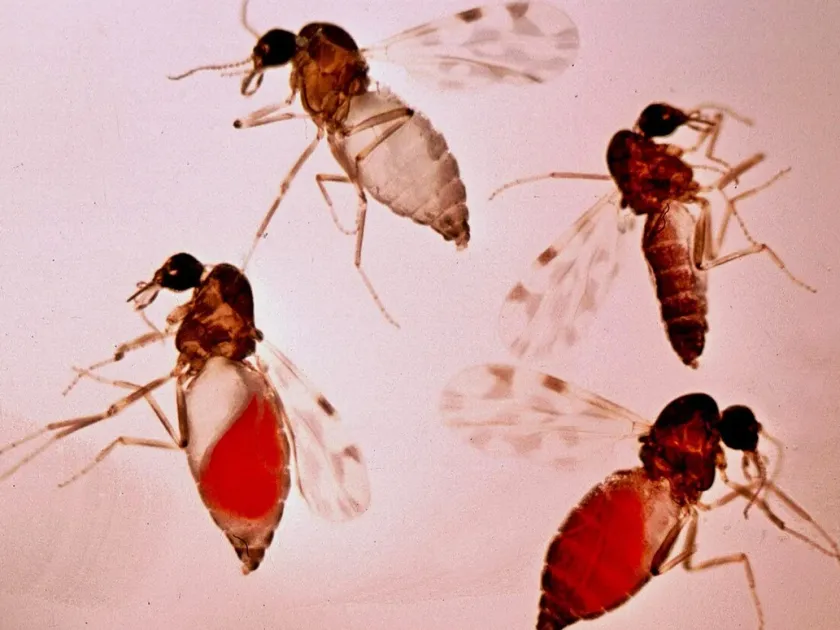
These insects are extremely small, typically measuring between 1 and 3 mm in length, making them difficult to detect with the naked eye.
Adult midges can be identified by the distinctive dark, spotted pattern on their wings, which is a key diagnostic feature for this species.
The females possess piercing-sucking mouthparts specifically adapted for feeding on the blood of mammals and birds, essential for egg maturation.
The life cycle involves complete metamorphosis, consisting of egg, four larval stages, pupa, and the adult stage, with larvae typically residing in moist environments.
What it damages
While Culicoides pulicaris does not feed on plant tissues, it is a devastating pest in the livestock industry, causing severe indirect damage.
Bites from these midges lead to intense irritation, allergic dermatitis, and significant behavioral stress in cattle, sheep, and horses.
The most severe impact is their role as biological vectors for viruses such as the Bluetongue virus and the Schmallenberg virus.
Disease outbreaks transmitted by these midges often result in high mortality rates, particularly among young livestock, and significant economic loss.
Reduced weight gain, decreased milk production, and overall loss of animal condition are common consequences of persistent midge attacks.
When it appears
The activity of Culicoides pulicaris is highly dependent on environmental conditions, typically spanning from late spring to early autumn.
Peak emergence occurs during warm and humid weather conditions, with the highest biting activity observed during dawn and dusk.
These insects prefer calm weather, as winds exceeding a certain velocity significantly limit their flight capability and host-seeking behavior.
They overwinter in the larval stage, residing in damp soil, decaying organic matter, or around water bodies where they remain protected from frost.
Rapid population growth often follows heavy rainfall events which expand the available breeding habitats for the larval stages.
Control measures
Effective management requires a combination of habitat modification and the direct protection of livestock from midge exposure.
Eliminating breeding sites by draining stagnant water and properly managing manure piles significantly reduces local midge populations.
Applying pour-on insecticides or using permethrin-impregnated ear tags can provide essential relief to animals during peak activity periods.
Housing livestock in insect-proof barns, especially during crepuscular hours, is an effective strategy to minimize transmission of viral pathogens.
- Regular removal of moist organic debris from farmyards.
- Use of chemical repellents on livestock skin.
- Installing fine-mesh screens on barn windows and ventilation systems.
Taxonomy
- Latin name
- Culicoides pulicaris
- Order
- Diptera (flies)
- Family
- Ceratopogonidae
- EPPO code
- CULIPL
Discussion
No discussions yet — be the first.