
Biting midges
Culicoides
Description
How to identify
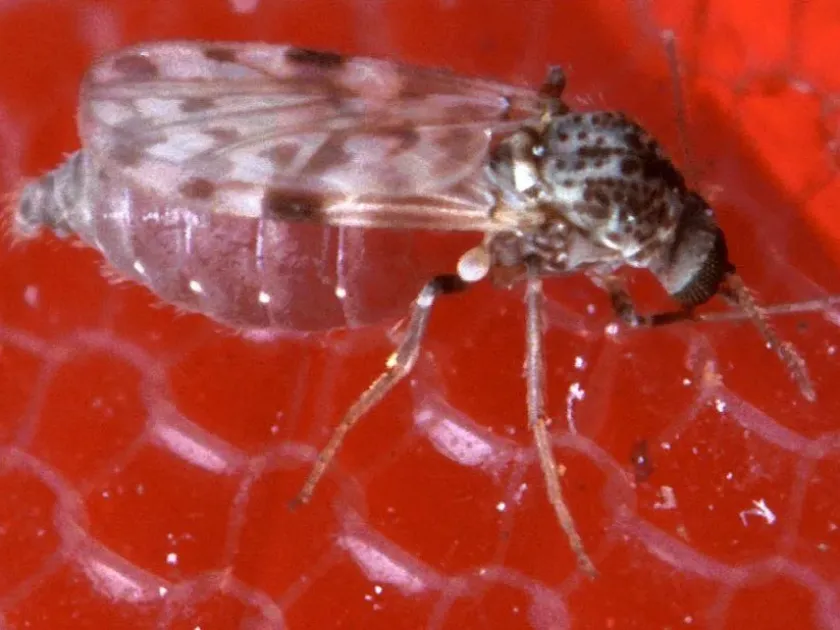
Biting midges (genus Culicoides) are tiny blood-sucking flies belonging to the family Ceratopogonidae. Adult midges are extremely small, measuring approximately 1–3 mm, with a brownish-grey appearance and spotted wings.
They possess a piercing-sucking mouthpart designed for feeding on the blood of vertebrates, including livestock and humans. Males feature antennae covered in dense hairs, while females have less noticeable, slender antennae.
The larvae of biting midges are worm-like, transparent, or whitish, and possess a well-developed head capsule. They exhibit active, wriggling movements in aquatic or moist substrates.
Pupae are elongated and equipped with respiratory horns, which allow them to respire while floating on the surface of mud or damp soil layers.
Due to their minute size, identifying specific species of Culicoides requires expert microscopic examination and specialized entomological knowledge.
What it damages
While not direct pests of agricultural crops, biting midges significantly impact the agricultural sector by acting as major vectors for various animal diseases, such as Bluetongue virus.
Infestations of livestock lead to severe productivity losses, including decreased milk yield, reduced weight gain in calves, and general weakness caused by stress and blood loss.
The annoyance caused by biting midges forces animals to expend extra energy on defensive behaviors, resulting in less time spent on grazing and resting, which undermines overall farm profitability.
In regions with high midge density, agricultural operations are often severely hindered, as workers may face intolerable discomfort, necessitating the use of specialized protective gear.
Repeated bites can cause severe dermatitis, hypersensitivity, and secondary skin infections in animals, requiring expensive veterinary treatment and management interventions.
When it appears
The activity of biting midges is heavily dependent on climatic factors, particularly ambient humidity levels and favorable temperature ranges.
They are most active during dusk and dawn, or during overcast, still weather conditions when humidity is high enough to prevent dehydration of the adult insects.
The season of activity typically spans from late spring to early autumn, with population peaks occurring during mid-summer, especially after periods of high rainfall.
Midges overwinter primarily in the larval stage, residing in moist soil, decaying organic matter, or mud along the margins of ponds and streams.
The life cycle can be remarkably rapid; in optimal conditions, development from egg to adult can occur in less than three weeks, allowing for multiple generations per season.
Signs of infestation
The primary indication of a biting midge infestation is noticeable restlessness in livestock, with animals rubbing against fences, trees, or each other to alleviate itching.
Visual inspection often reveals red papules, swelling, and crusting on areas of thin skin, such as the udder, abdomen, and the inner surface of the thighs.
High densities of these insects can be observed as a shimmering cloud of midges hovering above wet manure piles, drainage ditches, or muddy banks of water bodies.
In the evenings, an audible humming sound may be detected, and the insects are known to easily bypass standard window screening due to their very small size.
Human encounters with high midge populations lead to intense itching, localized welts, and potentially severe allergic reactions, serving as a clear indicator of a local infestation.
Control measures
The most effective long-term strategy is habitat modification: draining stagnant water, filling in muddy depressions, and improving drainage to eliminate larval breeding sites.
Protecting livestock involves the consistent application of insecticides and repellents specifically labeled for animal use to deter midges from landing and feeding.
Farm buildings can be managed by installing high-density mesh screens and using insecticide-impregnated netting, alongside indoor fumigation or misting systems.
- Regular removal and proper management of manure to prevent midge breeding.
- Mowing tall grass and vegetation around pastures and barns to reduce resting sites for adults.
- Using light traps to monitor population spikes and assist in the timing of pesticide applications.
Biological control methods, such as enhancing natural predator populations like dragonflies or specialized predatory beetles, may also contribute to population suppression in managed areas.
Taxonomy
- Latin name
- Culicoides
- Order
- Diptera (flies)
- Family
- Ceratopogonidae
- EPPO code
- CULISP
Discussion
No discussions yet — be the first.