
Highland midge
Culicoides impunctatus
Description
How to identify
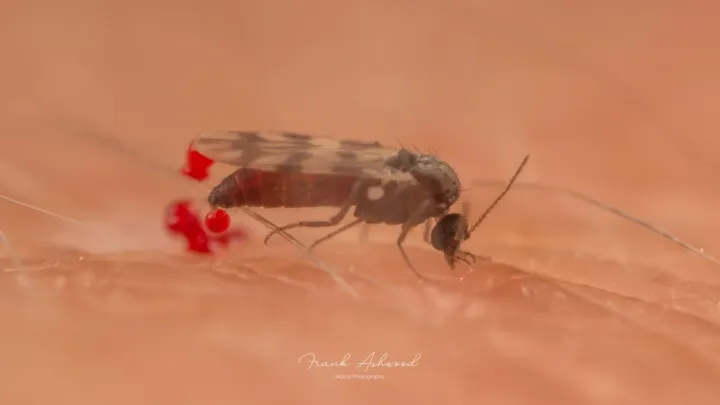
The Highland midge (Culicoides impunctatus) is a small blood-sucking insect belonging to the family Ceratopogonidae. Despite their minute size (1.5–2 mm), they represent a significant nuisance due to their massive population numbers.
The adults are characterized by patterned wings and a grayish-brown body. Their life cycle is strongly tied to water-saturated soil and decaying organic matter, which serve as ideal habitats for their larvae.
Female midges require a blood meal for egg development. They are highly attracted to the carbon dioxide, heat, and moisture emitted by large mammals, making cattle and sheep primary targets.
The development from egg to adult takes several weeks, depending on ambient temperature and moisture levels. Larvae are particularly resilient and can survive in boggy, acidic soils common in highland regions.
Their flight ability is limited by wind; therefore, these midges are most active during calm, overcast, and humid days when the air is stagnant.
What it damages
The impact of Culicoides impunctatus on agriculture is primarily focused on livestock health. Constant biting causes immense irritation and stress to the animals, leading to weight loss and reduced milk production.
Clinical signs of infestation include severe dermatitis, pruritus (itching), and raw, bleeding skin lesions caused by the animals scratching against fences and trees to relieve the discomfort.
Beyond direct physical irritation, these midges are critical vectors for viral pathogens, notably the Bluetongue virus, which causes systemic illness, fever, and death in ruminants.
The presence of midges forces livestock to alter their grazing behavior. Animals may stop grazing during daylight hours and cluster together in tight groups to reduce exposed body surface area, leading to overgrazing in specific spots.
Economic losses accumulate through veterinary care costs, reduced meat and milk quality, and the necessity of applying topical insecticides to large herds throughout the season.
When it appears
The Highland midge season typically spans from late spring through late summer. Peak emergence and aggressive biting activity occur between June and August, coinciding with high humidity levels.
They exhibit distinct circadian rhythms, showing high activity levels during the early morning and late evening hours, though they remain active during daylight under cloudy conditions.
Signs of infestation
Farmers can identify an infestation by observing animal agitation. Cattle often shake their heads and tails continuously or move restlessly across the pasture. Visible skin welts and scabs are clear indicators of midges' presence.
Control measures
Effective control requires a multi-faceted approach. Improving land drainage to eliminate boggy, waterlogged areas is essential to destroy midge breeding sites.
Topical application of pour-on insecticides or insecticidal ear tags provides a protective layer that helps deter midges from feeding on the animals' skin for extended periods.
Strategic grazing management, such as moving livestock to more exposed, windy fields during peak midge activity, is a low-cost method to reduce the intensity of attacks.
Providing access to well-ventilated housing or using large industrial fans in livestock pens can significantly disrupt midge activity, as they are poor fliers and cannot settle in strong air currents.
- Drainage of wet pastures and boggy lands.
- Use of synthetic pyrethroid repellents.
- Regular herd health monitoring for vector-borne diseases.
- Installation of screens or windbreaks to minimize midge entry.
Taxonomy
- Latin name
- Culicoides impunctatus
- Order
- Diptera (flies)
- Family
- Ceratopogonidae
- EPPO code
- CULIIM
Discussion
No discussions yet — be the first.