
Formosa bagworm
Cryptothelea formosicola
Description
How to identify
The Formosa bagworm Cryptothelea formosicola belongs to the family Psychidae, commonly known as bagworms. Males are small moths with a wingspan of about 20 mm, while females are wingless, legless, and maggot-like, spending their entire adult lives within a protective larval case.
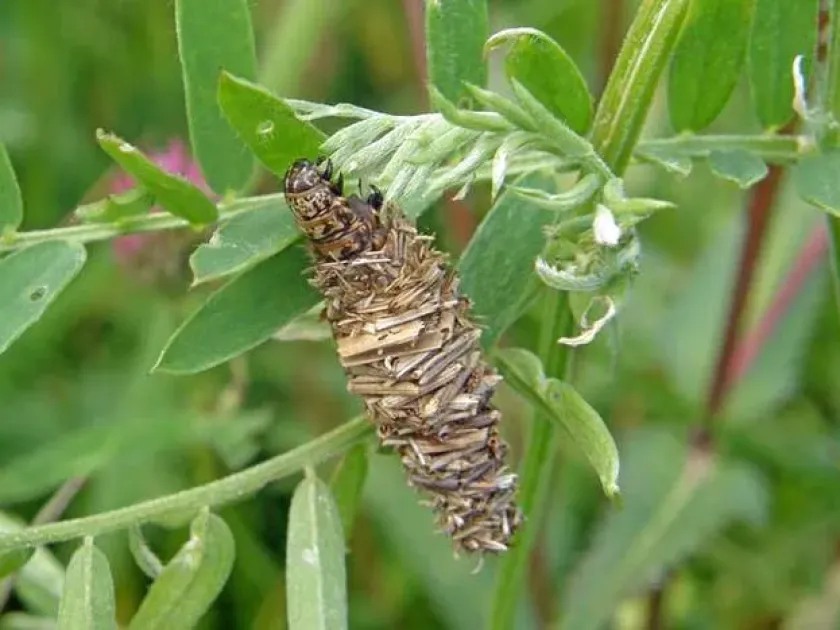
The most distinctive feature is the case (or "bag") constructed by the larvae. They assemble it from bits of bark, leaves, twigs, and silk. This case provides excellent camouflage and physical protection against predators and extreme environmental conditions.
The larvae possess a tough, sclerotized head and thoracic shield, which help them secure themselves within the bag. As they grow, they expand their cases, incorporating new plant debris from their host range.
Larvae typically exhibit grayish or brownish hues, blending seamlessly with bark. Males are usually dark-colored, enabling them to remain inconspicuous during their nocturnal mating flights.
The life cycle is tightly integrated with the environment; since the insect rarely leaves its case until pupation, it remains shielded from many environmental factors.
What it damages
This species is a polyphagous pest, meaning it attacks a wide range of woody plants and shrubs. Tea plants, fruit trees, and various ornamental deciduous and coniferous trees are frequent hosts.
Larvae primarily consume leaf tissue, creating irregular holes or completely skeletonizing the foliage. Severe infestations can lead to complete defoliation, which severely stresses the plant and compromises its aesthetic value.
Beyond leaf consumption, the pest causes damage by utilizing plant tissue, buds, and bark to construct and repair its bags. This activity can interfere with the development of new shoots and affect overall sap circulation.
Heavy populations of Formosa bagworms can lead to stunted growth, reduced yields in fruit-bearing trees, and increased susceptibility to secondary infections and opportunistic pests.
Due to the pest's cryptic nature and camouflaged cases, many growers are unaware of an infestation until the damage to the canopy becomes significant.
When it appears
Activity begins in early spring as overwintering larvae resume feeding. Ambient temperature is the primary driver of their metabolic rate and development speed during the growing season.
Pupation typically occurs in mid-summer, followed by the emergence of males for mating. As adults do not feed, their life cycle is brief and focused entirely on reproduction.
Eggs are laid by the female inside her old protective case, where they enter diapause until conditions become favorable. Depending on the climate, the species may complete one or multiple generations per year.
The winter stage is spent as larvae or eggs inside the reinforced cases attached to twigs, providing protection against freezing temperatures.
Effective control relies on targeting the young larval stage immediately after hatching, as they are most vulnerable to treatments before they develop extensive protective cases.
Signs of infestation
The most obvious sign of infestation is the presence of cone-shaped bags hanging from branches and trunks. These structures often resemble inanimate plant debris until they are observed to move.
Leaf damage manifests as ragged holes or chewed edges. In severe cases, large sections of the canopy may appear thinned or skeletonized.
An accumulation of frass (larval droppings) beneath an infested tree is a strong indicator of active feeding by a large colony in the upper canopy.
Fine silk threads used by the larvae to anchor their bags to the host plant are often visible upon close inspection.
- Presence of mobile "bags" on branches or bark.
- Defoliation or ragged leaf margins.
- Damage to succulent new shoots and buds.
Control measures
The most effective mechanical control is the manual removal and destruction of cases during the dormant season (winter). This reduces the population for the upcoming spring without the use of chemicals.
If chemical control is necessary, contact-stomach insecticides are most effective when applied during the early larval stage, before the bags become large and thickened.
Biological pesticides, such as those containing Bacillus thuringiensis, offer an effective and eco-friendly management option for garden and park settings.
Good horticultural practices, including proper irrigation and fertilization, help maintain plant vigor, making trees more resilient to pest-induced stress.
Pheromone traps can be used for monitoring adult male flights, allowing growers to time their control efforts precisely and minimize the overall chemical footprint.
Taxonomy
- Latin name
- Cryptothelea formosicola
- Order
- Lepidoptera (butterflies)
- Family
- Psychidae
- EPPO code
- CRYTFO
Discussion
No discussions yet — be the first.