
Cabbage cluster caterpillar
Crocidolomia
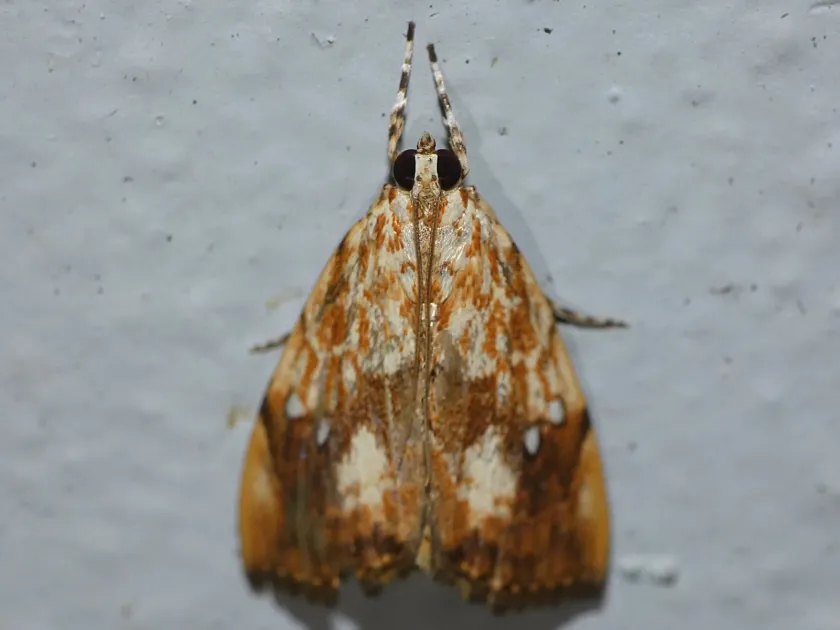
Description
How to identify
The Cabbage cluster caterpillar (Crocidolomia pavonana) is a significant agricultural pest belonging to the order Lepidoptera and the family Crambidae. It is a notorious defoliator primarily found in tropical and subtropical regions worldwide.
Adult moths are relatively small, with a wingspan ranging from 20 to 25 mm. Their forewings feature a mottled pattern of grey, brown, and white, providing excellent camouflage against soil and plant surfaces during the day.
Larvae pass through five instars. Early instars are pale green, while later stages exhibit a brownish-green coloration with distinct longitudinal stripes. They are noted for their gregarious behavior in early stages, often clustering together on leaves.
Female moths lay eggs in clusters on the undersides of leaves, typically covering them with protective scales. A single egg mass can contain between 30 and 100 eggs, which hatch in about 3 to 5 days under warm conditions.
The entire life cycle is rapid, often completed in less than 25 days. This high turnover rate allows the population to explode quickly, causing severe economic damage if left unchecked.
What it damages
This pest exclusively targets Brassicaceae family crops, including cabbage, cauliflower, broccoli, bok choy, radish, and mustard. It is a major limiting factor for vegetable production in warmer climates.
Young larvae feed collectively, skeletonizing the leaves by consuming the parenchyma and leaving the veins intact. This severe defoliation significantly reduces the plant's photosynthetic capacity.
As larvae mature, they disperse and bore into the heads of cabbage or the curds of cauliflower and broccoli. This internal damage is especially devastating as it destroys the marketable part of the crop entirely.
Larval feeding creates entry points for secondary infections. Bacterial soft rot and fungal diseases often follow, leading to the rapid decay of the entire crop in the field.
Economic losses are compounded by the presence of frass (fecal matter) inside the heads, which makes the produce unmarketable and difficult to clean even after harvesting.
When it appears
The activity of Crocidolomia is highly temperature-dependent. It thrives in warm, humid weather, which accelerates larval growth and reproduction, making it most problematic during peak summer months.
In tropical environments, breeding occurs year-round, with overlapping generations. The pest is most active during the night, which is when adult moths engage in mating and oviposition activities.
Rainy seasons often trigger population spikes. Increased humidity and the availability of succulent host plant tissue provide the ideal environment for the rapid expansion of the caterpillar colonies.
The pest relies on a continuous supply of host plants. Seasonal shifts that favor the growth of weeds from the Brassicaceae family allow the population to survive between crop cycles.
Field scouting should begin immediately upon transplanting. Monitoring programs using light traps or pheromone lures are essential to detect the arrival of adult moths before egg-laying reaches critical levels.
Signs of infestation
The first sign of infestation is the appearance of egg masses on the underside of leaves. These look like small, shiny, flattened patches, often yellowish or white, covered with protective scales.
Early feeding damage manifests as 'window-paning' on leaves, where the young larvae have scraped away the green tissue but left the upper leaf epidermis intact, eventually leading to full skeletonization.
The presence of fine, granular dark frass in the central whorl of the plant is a clear indicator that larvae have moved to the heart of the plant and are actively feeding.
- Webbing between leaves where larvae hide during the day.
- Stunted growth of the main head or failure to form a curd in broccoli/cauliflower.
- Wilting or yellowing of foliage due to larval tunneling and secondary rot.
Close inspection of the plant's growing point is necessary, as mature larvae often retreat into the dense interior of the cabbage head, making them invisible from a casual inspection.
Control measures
Integrated Pest Management (IPM) is crucial. Crop rotation is the first line of defense; avoiding sequential planting of cruciferous vegetables helps break the pest's life cycle.
Biological controls are highly effective. Formulations based on Bacillus thuringiensis (Bt) provide excellent control of young larvae while preserving beneficial predatory insects that naturally suppress populations.
Chemical control requires careful timing. Systemic insecticides are most effective when applied at the first sign of larval hatching, before the caterpillars have burrowed deeply into the vegetable tissue.
Cultural practices include removing and destroying wild cruciferous weeds, which act as reservoirs for the pest, and deep plowing after harvest to kill pupae residing in the soil.
Pheromone trapping and the use of physical barriers, such as insect netting for small-scale production, can significantly reduce the pressure of Crocidolomia by preventing adult moths from reaching the crops.
Taxonomy
- Latin name
- Crocidolomia
- Order
- Lepidoptera (butterflies)
- Family
- Crambidae
- EPPO code
- CROCSP
Discussion
No discussions yet — be the first.