
Crambus praefectellus
Crambus praefectellus
Description
How to identify
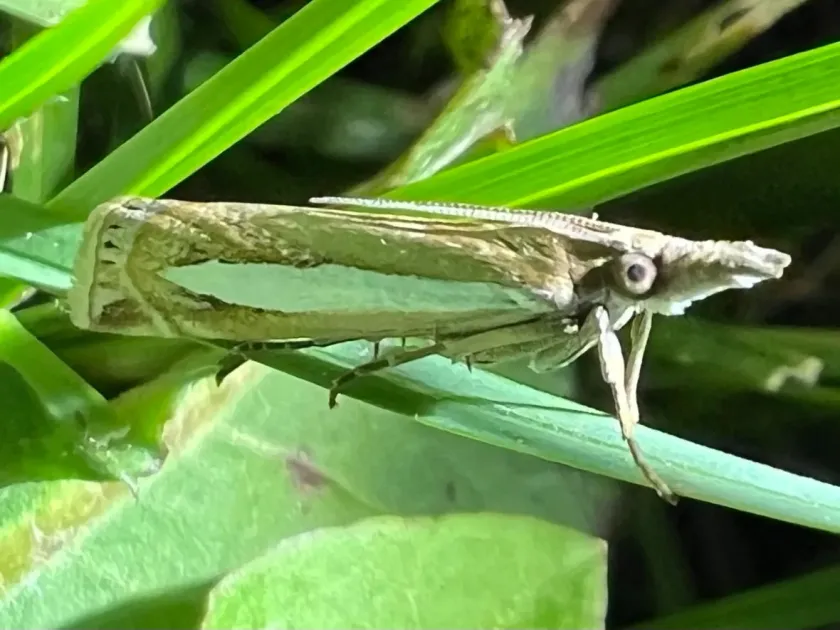
Crambus praefectellus, commonly known as a type of sod webworm, belongs to the family Crambidae. The adult moth is small and characterized by its habit of rolling its wings tightly around its body while at rest, resembling a small cylinder.
The forewings are generally creamy-white or light tan with a distinct silvery-white longitudinal stripe bordered by dark lines, which is a key identification feature for this species.
The wingspan typically ranges between 20 and 25 millimeters. The larvae are medium-sized, reaching up to 20 mm, and are generally off-white or grayish with dark, raised spots (pinacula) on each body segment.
The head of the caterpillar is hard, dark, and specialized for feeding on fibrous plant tissues. They often construct silken tunnels or tubes near the soil surface as a protective shelter.
Their life cycle is closely linked to grasses and cereal crops, making them common inhabitants of meadows, pastures, and agricultural fields globally.
What it damages
The damage is caused by the larvae, which feed on the basal portion of stems and the roots of young plants. This feeding pattern causes severe injury to the vascular system of the crop.
The primary hosts include cereal crops such as wheat, barley, rye, and oats. Young corn plants can also be heavily damaged when the larvae bore into the crown area.
Pasture grasses and turf are also significantly affected, as the caterpillars consume the stems, leading to patches of dead or thinning vegetation in fields.
In newly sprouted crops, the larvae can tunnel into the stem, causing the central leaf to wilt and die, a phenomenon often described as a "dead heart" condition.
Heavy infestations can lead to substantial stand loss, requiring replanting of the affected field areas if the threshold for economic damage is exceeded.
When it appears
Adult moths are typically active during the summer months, specifically from June through July. They are nocturnal or crepuscular, hiding in thick vegetation or debris during daylight hours.
Females scatter eggs while flying over the field or deposit them on the surface of the soil and plant stems. The larvae develop throughout the summer, with the species having one or two generations depending on the climate.
Overwintering occurs as late-stage larvae deep within the soil profile, where they form silk-lined cocoons to protect themselves from harsh winter temperatures.
As spring temperatures increase, the larvae pupate in the soil, followed by the emergence of the next generation of moths to continue the reproductive cycle.
Environmental conditions, particularly moisture levels during the egg-laying period, significantly dictate the population dynamics of the pest for the upcoming season.
Signs of infestation
The earliest symptom of an infestation is the yellowing and wilting of the central leaf of young plants, which remain healthy at the base, indicating disruption of water uptake.
Upon closer inspection of the soil around the base of the plant, one can often find small silken tubes or debris matted together, which are characteristic of larval activity.
Patches of thinning crop stands or missing seedlings in a row are classic indicators of sod webworm presence within a cereal or corn field.
Careful excavation of the soil around the dying plants usually reveals the presence of caterpillars or their fecal pellets (frass), which are small and dark.
Large-scale damage appears as irregular bare spots in the field that gradually expand if the larvae are not controlled in time.
Control measures
Effective management begins with proper crop rotation, which breaks the life cycle of the pest by denying it its preferred host plants for consecutive growing seasons.
Deep fall tillage is a crucial cultural practice as it disturbs the soil and exposes overwintering larvae to cold temperatures and natural predators, significantly reducing populations.
The removal of grassy weeds in and around the field margins is essential, as these weeds act as a reservoir for the pest to maintain its population during off-seasons.
- Application of systemic insecticides as seed treatments for proactive crop protection.
- Foliar insecticide applications when pest scouting reveals counts above the economic threshold.
- Use of biological agents such as Bacillus thuringiensis on young larvae to minimize chemical usage.
Regular monitoring using light traps for adult moths can provide an early warning system to help agronomists time their control efforts more effectively.
Taxonomy
- Latin name
- Crambus praefectellus
- Order
- Lepidoptera (butterflies)
- Family
- Crambidae
- EPPO code
- CRAMPR
Discussion
No discussions yet — be the first.