
Crambus mutabilis
Crambus mutabilis
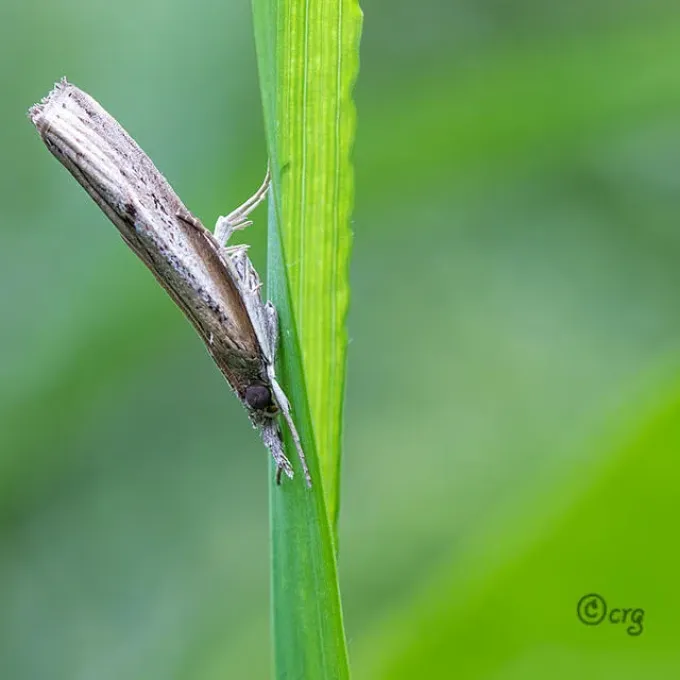
Description
How to identify
Crambus mutabilis, commonly known as a type of grass moth, belongs to the family Crambidae within the order Lepidoptera. It is recognized as a significant pest of various grass species.
Adult moths typically have a wingspan ranging from 20 to 25 mm. Their forewings are generally grayish-brown or straw-colored, often featuring subtle longitudinal streaks or darker markings.
The hindwings are lighter, typically off-white or light gray, with a fringed border. When at rest, the moth adopts a distinct triangular, "tent-like" posture against the surface.
The larvae are approximately 20 mm long when fully developed. They possess a characteristic dark-colored head capsule and a body covered in sparse, fine hairs with dark tubercles.
Distinguishing C. mutabilis from other Crambus species often requires taxonomic expertise, focusing on wing venation and abdominal structure to ensure accurate identification in agricultural research.
What it damages
Crambus mutabilis larvae primarily infest members of the Poaceae family. They are known to cause damage to a wide range of both wild grasses and cultivated cereal crops.
Wheat, rye, barley, and oats are the most common hosts. The larvae feed on the stems and leaf bases, often working at or just below the soil surface, which causes significant stress to the plant.
In addition to small grains, corn crops can be susceptible to damage during the seedling stage, leading to reduced plant stands and potential yield loss if the infestation is severe.
Pasturelands and hayfields are also commonly affected. The feeding activity of the larvae destroys the structural integrity of the stems, leading to yellowing and plant death.
The severity of the damage is often exacerbated during drought conditions, as the plants have less capacity to recover from the physical injury caused by the larvae.
When it appears
The life cycle of C. mutabilis involves overwintering as mature larvae within silken cocoons buried in the soil, which protects them from harsh winter temperatures.
In the spring, as soil temperatures rise, the larvae complete their development and pupate. Adult moths typically emerge in late spring or early summer, depending on the latitude.
The flight period of the adults can be quite prolonged. In some regions, the pest may complete one or two generations per year, extending the risk period for susceptible crops.
Moth activity is predominantly nocturnal. They are often observed in the evening or on overcast days, hiding in dense vegetation during periods of direct sunlight.
Monitoring for adult emergence is crucial for farmers to predict the potential density of the subsequent larval generation that will attack the crops.
Signs of infestation
One of the earliest signs of infestation is the development of localized "thinning" or yellowing spots within a field where plant growth appears stunted or withered.
Careful inspection of the soil near the base of the damaged plants often reveals silk-lined tunnels, which serve as protective habitats for the feeding larvae.
A key indicator is the severed stem at the base, which allows the plant to be easily pulled from the ground. This damage is typically found in the crown region of the plant.
During night inspections, one might see larvae actively feeding on the base of the stems, causing irregular, ragged edges on the leaves and stalks.
If left unmanaged, the infestation sites expand as larvae move from plant to plant, leading to patches of bare ground and overall decreased crop density.
Control measures
Cultural control is the first line of defense. Deep autumn plowing is highly effective as it disturbs the larval overwintering sites and exposes them to natural predators.
Crop rotation is essential for breaking the pest's life cycle. Avoiding continuous cereal cropping in fields with a history of grass moth presence significantly lowers population pressure.
Effective weed management along field margins is critical, as these areas often serve as reservoirs for the pest, allowing them to migrate into crops later in the season.
Chemical control, including the application of pyrethroids, is recommended only after scouting confirms that the population has exceeded the economic threshold for the crop.
Biological control using microbial insecticides, such as those based on Bacillus thuringiensis, offers a targeted approach that reduces the need for broad-spectrum chemicals.
Taxonomy
- Latin name
- Crambus mutabilis
- Order
- Lepidoptera (butterflies)
- Family
- Crambidae
- EPPO code
- CRAMMU
Discussion
No discussions yet — be the first.