
Crambus
Crambus
Description
How to identify
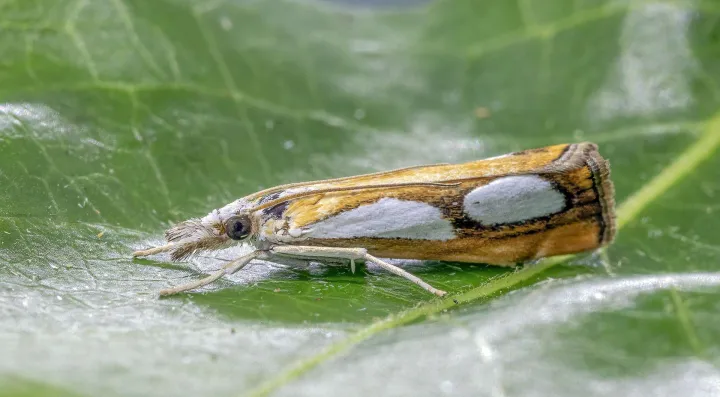
Crambus, commonly known as the sod webworm, belongs to the family Crambidae of the order Lepidoptera. The adults are small moths with a wingspan of 20–25 mm, recognizable by their narrow, elongated wings which they fold tightly around their bodies when at rest.
The forewings are typically straw-colored, yellowish, or brownish, often adorned with silver or metallic streaks. This coloration provides excellent camouflage against dead grass or stalks, making them difficult to spot in daylight.
The larvae are caterpillars, growing up to 15–20 mm in length. They generally have a light grey or brownish body with rows of distinct dark spots (tubercles) and a shiny, darker-colored head capsule.
These moths are primarily nocturnal and crepuscular. During the day, they remain stationary in the grass canopy or near the soil surface, flushing out only when disturbed and flying in short, erratic patterns.
Their lifecycle undergoes complete metamorphosis: egg, larva, pupa, and adult. They typically overwinter as partially grown larvae within silk-lined tunnels in the soil or under thatch layers.
What it damages
Sod webworms are polyphagous pests, though they show a marked preference for Poaceae (grass family). Crops such as wheat, barley, oats, and rye are frequently targeted, alongside various turfgrass species.
The larvae are responsible for the damage. They feed on the leaves and stems of young plants near the soil surface, often cutting them off or gnawing into the crown, which effectively kills the plant or severely stunts its growth.
In lawns and golf courses, severe infestations manifest as irregular brown patches where the grass has been destroyed. If left unchecked, these patches can expand rapidly, turning large areas of green turf into dead, dry vegetation.
Young cereal crops are particularly vulnerable during the early stages of development. Heavy larval feeding can lead to thin stands, yield losses, and the necessity for reseeding affected areas.
Economic damage is correlated with larval density. In high numbers, webworms can cause significant financial loss by compromising plant vigor and productivity, making crops more susceptible to environmental stressors.
When it appears
Adult moths typically emerge in late spring and early summer. Mating and egg-laying occur shortly thereafter, with females scattering eggs over suitable host vegetation or the soil surface.
Depending on the species and geographical climate, there may be one or more generations per year. Warm temperatures significantly accelerate the development of larvae, increasing their activity levels.
The most intense feeding period for the larvae is during the summer months. In regions with longer growing seasons, overlapping generations can make it difficult to identify a clear window for intervention.
As autumn approaches and temperatures decline, larvae enter a diapause or reduced activity state, burying themselves deeper into the soil thatch to survive the winter months.
Effective scouting is critical during the peak flight of moths. Monitoring tools, such as pheromone traps or light traps, help agronomists determine the precise timing for targeted insecticidal applications.
Signs of infestation
One of the earliest signs of a Crambus infestation is the appearance of small, irregular areas of thinning or yellowing grass that seem to have been "clipped" near the base.
Close inspection of the thatch layer often reveals small silk-lined tunnels or tubes, which are the characteristic homes of the larvae during the day.
Small green or brown granular frass (excrement) is frequently found around the base of the stems, providing a clear indicator of active feeding in that localized area.
An increased presence of birds, such as robins or starlings, feeding on the turf is a classic secondary sign that a high population of larvae is present in the upper soil profile.
When pulling on dead grass patches, if the roots are absent or the stems are severed at the crown, it is a definitive diagnostic sign of sod webworm activity rather than drought or disease.
Control measures
Integrated Pest Management (IPM) is the best approach for controlling Crambus. This involves combining cultural practices with biological and chemical interventions to maintain populations below economic thresholds.
Cultural control measures focus on maintaining healthy turf through proper fertilization and irrigation. Regular aeration and dethatching can also reduce the environment favorable for larvae.
Biological control, including the use of entomopathogenic nematodes or Bacillus thuringiensis-based products, offers an environmentally friendly alternative to traditional pesticides, especially for turf management.
Chemical control should be timed to coincide with the presence of young larvae. Systemic or contact-based insecticides are most effective when applied in the late afternoon or evening when the larvae are surfacing to feed.
- Rotate cereal crops with non-host species to break the life cycle of the pest.
- Remove weeds and debris around field edges to eliminate breeding grounds.
- Perform regular scouting during moth flight seasons to detect early infestations.
Taxonomy
- Latin name
- Crambus
- Order
- Lepidoptera (butterflies)
- Family
- Crambidae
- EPPO code
- CRAMSP
Discussion
No discussions yet — be the first.