
Cosmosoma myrodora
Cosmosoma myrodora
Description
How to identify
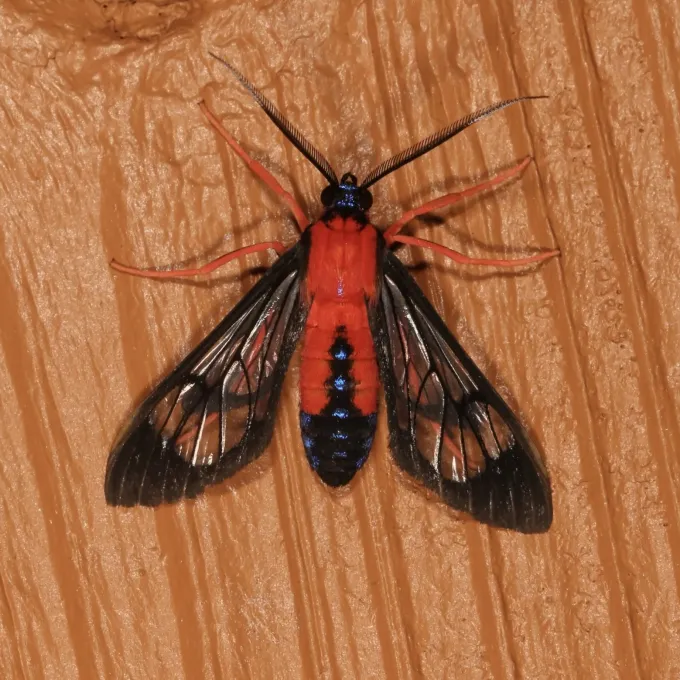
Cosmosoma myrodora is a species of moth belonging to the family Erebidae, subfamily Arctiinae. It is widely recognized for its visual mimicry of wasps due to the translucent windows on its wings.
The adult moth features a distinct color pattern with orange and black bands on its abdomen, which acts as a warning signal (aposematism) to deter potential predators.
The larvae, or caterpillars, are typically covered in dense, bristle-like hairs. This physical characteristic is a common defense mechanism among many species in the Arctiinae subfamily.
The wingspan of this species ranges from approximately 30 to 35 millimeters, and the adults are active fliers primarily during the daytime, often observed visiting various nectar sources.
The life history consists of a complete metamorphosis: egg, larva, pupa, and adult. Each stage is adapted to specific environmental conditions, with the pupa stage often being the one that survives winter months.
What it damages
The primary larval host plant for Cosmosoma myrodora is Mikania scandens, commonly known as climbing hempvine. This plant serves as the main nutritional source for developing caterpillars.
The larvae feed on the leaf tissue, frequently causing skeletonization. In cases of significant infestation, they can consume large portions of the foliage, negatively impacting the plant's health.
By consuming leaf surfaces, the larvae reduce the photosynthetic capacity of the host plant, which can lead to stunted growth and reduced vigor, especially in younger plants.
Although it is generally not a major threat to commercial agriculture, it can be a nuisance in horticultural settings or in natural areas where the host plant Mikania is actively cultivated or protected.
The cumulative effect of larval feeding can lead to partial or total defoliation of the host plant if the population density reaches high levels during the summer months.
When it appears
Adult moths are typically active during the warm summer months, coinciding with the flowering period of various nectar-producing plants that they rely on for energy.
The larval stage is most active from late spring through late summer. Depending on local climatic conditions, the moth may complete multiple generations within a single season.
The species survives the winter in the pupal stage, encased in a silk-like cocoon, often hidden within plant debris or near the base of the host plant, waiting for suitable spring temperatures.
Emergence of the first generation of adults usually occurs when the environment provides enough warmth to sustain their metabolic activities and mating behaviors.
Farmers and gardeners can anticipate peak larval activity by tracking local temperature trends, which influence the development rate of both the host plant and the insect.
Signs of infestation
The most prominent sign of an infestation is the presence of irregular holes and skeletonized areas on the leaves of Mikania scandens, often accompanied by leaf margins being consumed.
The presence of frass (caterpillar droppings) on the leaves or on the ground beneath the plant serves as a strong indicator that larvae are actively feeding nearby.
Early-stage larvae tend to congregate on the undersides of leaves, making them visible upon close inspection before they disperse to other parts of the plant.
Some plants may show signs of stress, such as drooping or yellowing leaves, as a result of heavy grazing pressure from a localized population of these caterpillars.
Pupal cases, which may be found attached to stems or tucked into folded leaves, indicate that the caterpillars have completed their feeding stage and are nearing adulthood.
Control measures
Hand-picking the caterpillars is the most straightforward and effective method for small-scale infestations in garden beds or small landscapes.
Biological control using Bacillus thuringiensis (Bt) sprays can be highly effective, as it specifically targets the larvae while remaining safe for beneficial pollinators and predators.
Sanitation practices, including the removal of dead plant material at the end of the season, can destroy overwintering pupae and significantly reduce the local pest population for the following year.
Light traps can be utilized to capture adult moths, thereby reducing the number of eggs laid and curbing the growth of the next generation of larvae.
Encouraging the presence of natural enemies, such as parasitic wasps and predatory beetles, creates a balanced ecosystem that naturally regulates the population of Cosmosoma myrodora.
Taxonomy
- Latin name
- Cosmosoma myrodora
- Order
- Lepidoptera (butterflies)
- Family
- Erebidae
- EPPO code
- CSMSMY
Discussion
No discussions yet — be the first.