
Cosmosoma auge
Cosmosoma auge
Description
How to identify
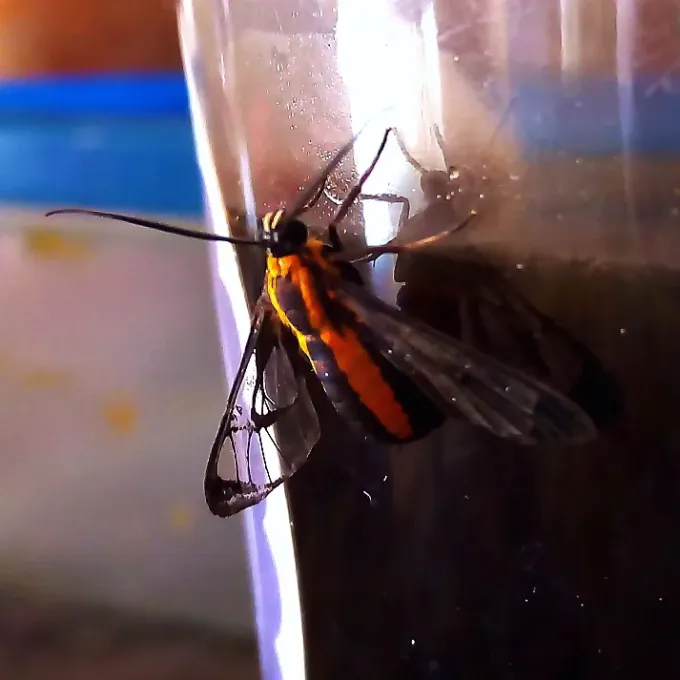
Cosmosoma auge is a moth species belonging to the family Erebidae and subfamily Arctiinae. Often referred to as a wasp moth, it exhibits Batesian mimicry, evolving to resemble stinging wasps with its transparent wing sections and vibrant orange or yellow markings on a dark body.
The adult moth has a wingspan ranging from 30 to 40 mm. Its warning coloration serves as a primary defense mechanism against avian predators. Despite its resemblance to a wasp, it is a harmless pollinator in its adult stage, though its offspring can be troublesome.
The larvae, or caterpillars, are typically hairy, which is a common characteristic of tiger moths. These hairs can provide a defense against predators and may cause mild skin irritation if handled, serving as a deterrent for many insectivores.
The pupal stage occurs within a silk-based cocoon. The caterpillar incorporates its own hairs into the silken structure for added protection and camouflage. These cocoons are typically attached to the undersides of leaves or within hidden stem junctions.
This species is predominantly found in tropical and subtropical regions, including Florida and the Caribbean. While generally not a major agricultural threat, it can reach high populations in localized ornamental gardens or greenhouses.
What it damages
The primary host plant for Cosmosoma auge larvae is Mikania scandens, commonly known as hempvine. However, in urban and garden environments, these caterpillars may feed on various members of the Asteraceae family.
The main form of damage is defoliation. Young larvae begin by skeletonizing leaves, consuming the soft tissue between veins. Older larvae consume entire leaf sections, leaving behind only the primary vein structures, which severely hampers the plant's photosynthetic capability.
Extensive larval feeding can lead to stunted growth and diminished flowering in ornamental plants. If an infestation is not controlled early, the cumulative impact on the foliage can lead to significant aesthetic damage to garden beds.
The wounds inflicted by the larvae provide entry points for secondary pathogens, such as fungal and bacterial infections. This is particularly problematic in humid conditions where plant diseases spread rapidly through compromised tissue.
While mature plants may tolerate minor damage, young seedlings or newly transplanted shrubs are at risk of suffering severe developmental setbacks due to the loss of necessary foliage during their critical growth phases.
When it appears
In warm climates, the life cycle of Cosmosoma auge is nearly continuous, with multiple overlapping generations appearing throughout the year. Activity peaks during the warmer, more humid months when plant growth is most vigorous.
Adult moths are diurnal, meaning they are active during the day. This is the optimal time for mating and oviposition, where females lay eggs in clusters on the undersides of host leaves to ensure an immediate food supply for the hatching larvae.
Larval activity is highest during the summer. Higher temperatures accelerate the metabolic rate of the insects, significantly shortening the development time from egg to pupa, which can lead to a rapid increase in population density.
Overwintering usually occurs in the pupal stage, hidden within debris or leaf litter. As temperatures rise in early spring, the adult moths emerge, marking the start of the new generation's activity cycle.
Monitoring for this pest involves observing host plants for signs of adult moths and using ultraviolet light traps during twilight hours, as these insects are attracted to artificial light sources.
Signs of infestation
The most reliable early sign of infestation is the presence of egg clusters on the undersides of leaves. These are small, cream-colored, and clustered together, often hidden from casual observation.
Frass, or caterpillar excrement, is a strong indicator of an active infestation. Small, dark, pellet-like droppings on leaves or the ground beneath the plant show that larvae are feeding directly above that location.
Leaf webbing or curling, where the edges are pulled together with silk, indicates that the caterpillars are preparing to pupate. These structures should be inspected, as they often contain the larvae or the developing pupae.
The presence of adults hovering around flowers is a sign that a mating pair is likely nearby. If multiple moths are spotted, an increase in larval activity should be expected within the next two weeks.
Yellowing, premature leaf drop, and ragged leaf edges are visible symptoms of advanced damage. When these signs appear, it indicates that the infestation has reached a level that necessitates intervention.
Control measures
Mechanical control is highly effective in home gardens. Manually picking off caterpillars and removing cocoons from the underside of leaves can significantly reduce population size without chemicals.
Biological control using microbial insecticides, such as those containing Bacillus thuringiensis (Bt), is effective against these larvae. Bt is highly specific to caterpillars and safe for beneficial insects, including bees and butterflies.
Chemical intervention should be reserved for severe outbreaks. Systemic insecticides can be applied to the foliage, but it is crucial to follow product labels to protect the surrounding environment and avoid harming non-target organisms.
Sanitation practices are essential. Clearing away weed species that act as alternative hosts for the moth will starve out local populations and decrease the likelihood of an infestation in subsequent seasons.
- Regular monitoring of host plant leaves.
- Using row covers for high-value young plants.
- Encouraging natural predators like birds and parasitic wasps.
Taxonomy
- Latin name
- Cosmosoma auge
- Order
- Lepidoptera (butterflies)
- Family
- Erebidae
- EPPO code
- CSMSAU
Discussion
No discussions yet — be the first.