
Cortinicara gibbosa
Cortinicara gibbosa
Description
How to identify
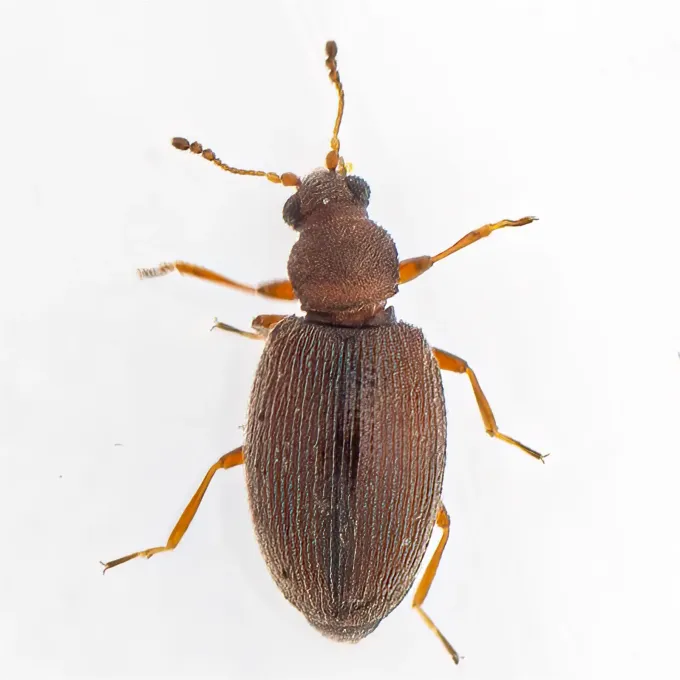
Cortinicara gibbosa, commonly known as a mold beetle, belongs to the family Latridiidae of the order Coleoptera. These insects are very small, typically measuring between 1.5 to 2 mm in length.
They are characterized by a distinctively convex or "humped" pronotum and elytra, which makes them recognizable under magnification. Their body color ranges from pale yellow to reddish-brown.
The elytra are marked with rows of punctures, and the antennae terminate in a three-segmented club, which is a diagnostic feature used by entomologists for precise identification.
Adults are capable fliers, which allows them to migrate easily between storage facilities or from field waste to indoors. They are generally elusive and tend to hide in cracks and crevices.
The larvae are minute and inhabit the same environments as the adults, specifically focusing on micro-habitats where fungal growth is present.
What it damages
Cortinicara gibbosa is primarily a scavenger that feeds on fungal spores and mycelium. They do not typically consume dry, healthy grain, but rather grain that has become damp or moldy.
By consuming fungi, these beetles act as indicators of poor storage conditions. However, their presence is problematic because they actively spread fungal spores throughout the commodity.
The damage caused is twofold: direct contamination of the product with their waste products and the acceleration of spoilage by creating hotspots within the stored material.
Large infestations can lead to significant quality loss, making the grain or stored goods unsuitable for human consumption or processing.
They are frequently associated with secondary heating of grain, a process where the biological activity of pests and fungi increases the temperature within the storage bulk.
When it appears
In temperature-controlled storage environments, Cortinicara gibbosa can remain active throughout the entire year, provided that humidity levels are sufficient for fungal growth.
The peak activity periods usually coincide with times of high ambient humidity, such as spring or late summer, when moisture condensation is common in poorly ventilated warehouses.
The life cycle is closely tied to environmental conditions. In favorable conditions, they can complete multiple generations in a single year, leading to exponential population growth.
During colder months, if the storage temperature drops significantly, the metabolic rate of the beetles slows down, and they enter a dormant state in secluded areas of the facility.
They can survive in extremely small residues of organic material, which allows them to persist in a facility even after it has been emptied of its main stock.
Signs of infestation
A musty or earthy smell is often the first indication of an infestation, as this scent is produced by the mold that the beetles inhabit.
Visual signs include the presence of tiny beetles on the surfaces of storage containers, walls, or at the top level of the grain bulk.
Closer examination will often reveal a fine layer of mold growth on the commodity, which serves as both the food source and the primary site of infestation.
Local heating of the grain bulk is a critical sign of infestation. If the temperature is higher in certain spots than in the rest of the pile, it suggests active biological decay and pest clustering.
Sifting through grain samples with fine-mesh screens is the most reliable way to detect both larvae and adults in a grain lot.
Control measures
Effective control of Cortinicara gibbosa centers on environmental management rather than chemical intervention alone.
- Keep grain moisture content below the threshold that supports mold growth.
- Ensure adequate warehouse ventilation to prevent condensation.
- Implement strict sanitation practices to remove all dust, debris, and spills.
- Pre-season fumigation or surface treatment of storage facilities.
- Monitor grain temperature regularly to identify and treat hotspots early.
Taxonomy
- Latin name
- Cortinicara gibbosa
- Order
- Coleoptera (beetles)
- Family
- Latridiidae
- EPPO code
- COTNGI
Discussion
No discussions yet — be the first.