
Cortinicara
Cortinicara
Description
How to identify
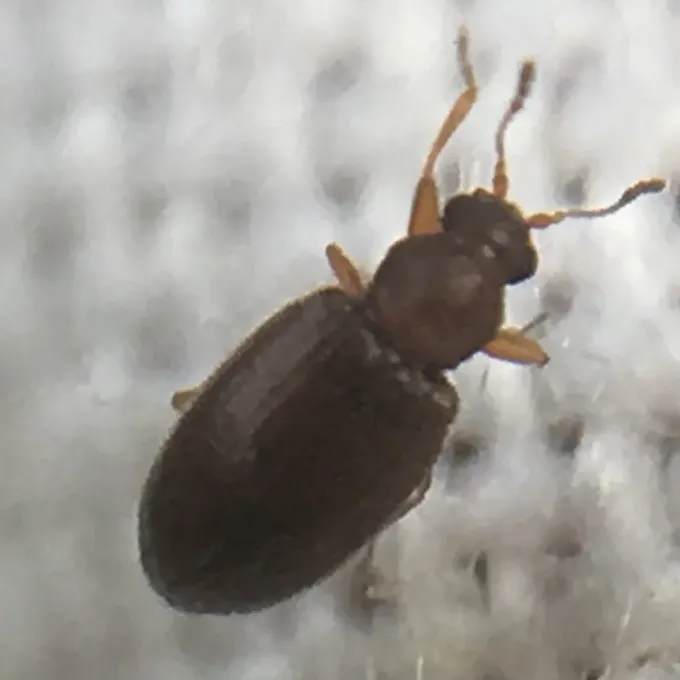
Cortinicara belongs to the family Latridiidae, commonly known as minute brown scavenger beetles. These pests are widely distributed in storage facilities and environments where agricultural products are kept. They are tiny beetles, usually measuring between 1.5 and 2.5 millimeters in length.
The beetle’s body features a distinct structure, often with notable sculpture on the pronotum and elytra. Their coloration ranges from yellowish-brown to dark brown, which provides excellent camouflage against organic debris and moldy substrates.
Adult beetles possess fully developed wings and are capable of active flight, which facilitates the rapid colonization of new storage areas. The larvae are small, mobile, and sometimes covered with sparse hairs, helping them adhere to the surface of the food source.
Identifying this pest in field or storage conditions requires the use of magnifying glasses or binocular microscopes due to their extremely small size. Morphological examination of the antennae and elytral punctation is essential for accurate classification.
Systematically, these insects belong to the order Coleoptera. They are typical secondary pests that usually occur alongside the development of pathogenic fungi in grain storage facilities.
What it damages
Cortinicara primarily affects grain crops, legumes, and other agricultural commodities when stored under improper conditions. It is not a primary pest and cannot bore through the intact coat of healthy seeds.
The main damage is caused by feeding on mold fungi and organic decay products that emerge due to high humidity. During their life cycle, both beetles and larvae contaminate products with excrement and cast skins.
High populations of these insects in storage lead to a significant decline in the commercial value of the grain. The product develops a distinct musty odor, which is extremely difficult to remove during further processing.
In cases of mass reproduction, beetles contribute to the spread of fungal spores, which triggers the self-heating of grain piles. This leads to the development of spoilage centers, loss of germination capacity, and the risk of mycotoxin accumulation.
Damage to grain by this pest is a clear indicator of disrupted temperature and humidity levels in the storage unit. Consequently, the presence of the pest serves as a signal for immediate inspection and grain maintenance.
When it appears
In the controlled environment of grain warehouses, the life cycle of Cortinicara can continue indefinitely if favorable conditions are met. However, the most active reproduction periods occur during spikes in external temperature and humidity.
In natural conditions, the pest's development is linked to decaying plant debris and fallen leaves. The migration into human-made storage areas most commonly occurs during the autumn season alongside contaminated agricultural produce.
The speed of development for one generation depends heavily on the ambient temperature. Under optimal summer conditions, the life cycle can be completed very quickly, leading to a rapid population surge within a single month.
Overwintering stages are typically represented by adults (imago), which can withstand low temperatures by hiding in wall cracks, floor gaps, or debris. Once temperatures rise, their activity resumes rapidly.
Agronomic monitoring must be carried out monthly, especially when placing grain in long-term storage, with specific attention paid to humidity levels in the facility.
Signs of infestation
The primary sign of an infestation is the discovery of the beetles themselves on the surface of the grain or inside the grain mass. They tend to congregate in areas with high moisture and visible signs of initial decay.
A characteristic signal is the emergence of a musty or "moldy" smell from the grain batch. This odor indicates that conditions have become suitable for the growth of fungi, which serve as the primary food source for Cortinicara.
Visually, one can notice the discoloration of grain and the presence of powdery debris, which is produced by larval activity. Grain husks may appear dull due to the presence of fungal spore coatings.
The use of food or adhesive traps in warehouses allows for the detection of even minor infestations. The presence of just a few individuals indicates a risk of a larger future outbreak.
Accumulations of insect excrement and debris found in cleaning machinery after processing grain are also clear evidence of the pest's activity within the stored commodity batch.
Control measures
The foundation of Cortinicara control is the strict management of humidity and temperature within grain storage facilities. Drying grain to a critical level (below 14% moisture) deprives the pest of its food source and halts reproduction.
Thorough sanitary cleaning of warehouses before loading new crops is mandatory. All old grain residues, dust, and trash, which serve as overwintering sites, must be removed.
Fumigation of storage facilities with authorized chemical agents can effectively reduce population numbers. Such procedures must be performed by professionals following strict safety protocols.
Agronomic methods include regular turning or moving of grain to prevent self-heating spots and maintain stable temperature levels. Active ventilation systems help in maintaining low humidity levels.
- Control of grain moisture levels to dry states
- Sanitation of warehouses to remove dust and debris
- Application of chemical fumigation if necessary
- Regular monitoring using specialized traps
- Isolation of infested grain batches to prevent spread
Taxonomy
- Latin name
- Cortinicara
- Order
- Coleoptera (beetles)
- Family
- Latridiidae
- EPPO code
- COTNSP
Discussion
No discussions yet — be the first.